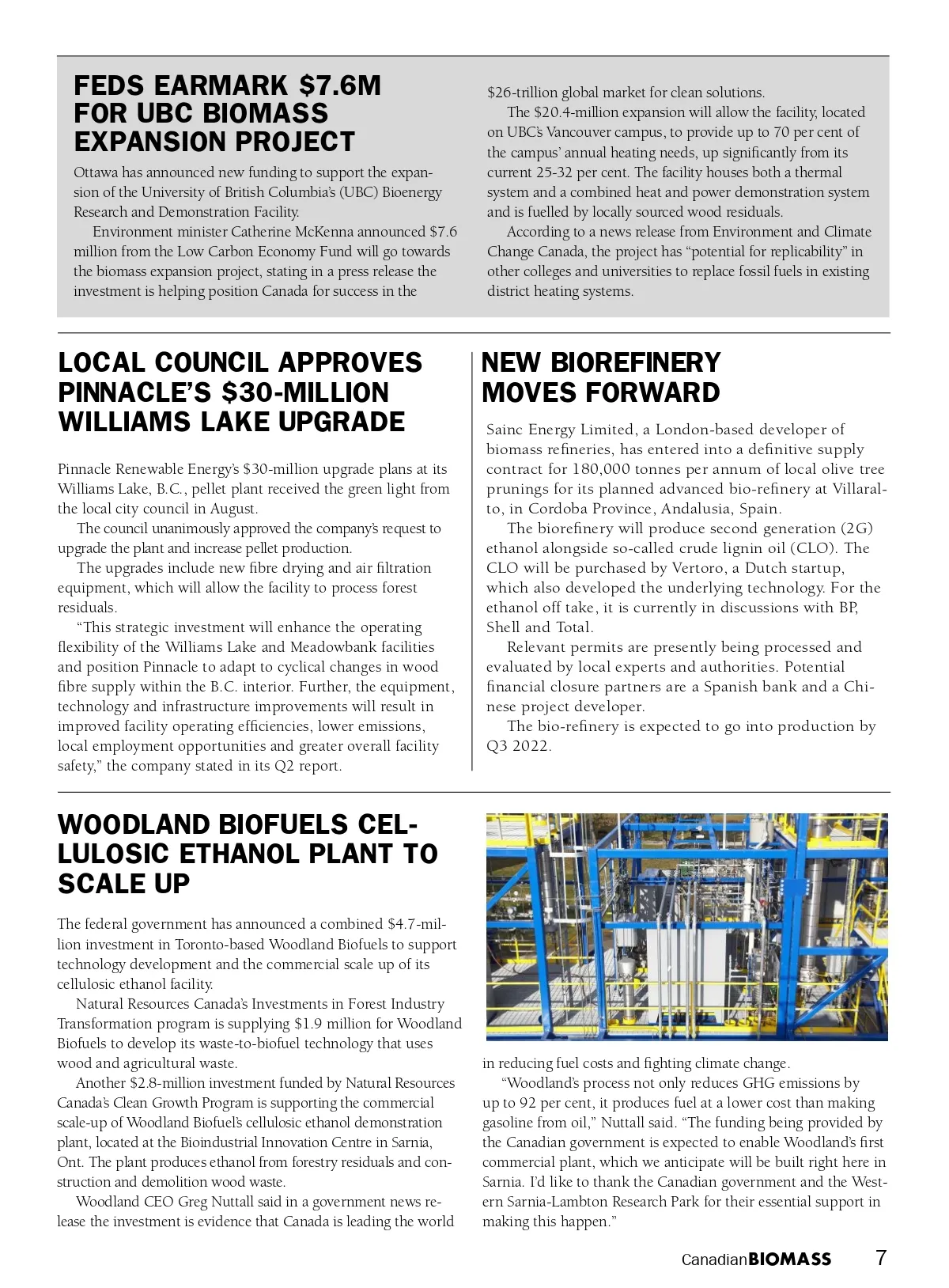
FEDS EARMARK $7.6M FOR UBC BIOMASS EXPANSION PROJECT Ottawa has announced new funding to support the expan-sion of the University of British Columbia’s (UBC) Bioenergy Research and Demonstration Facility. Environment minister Catherine McKenna announced $7.6 million from the Low Carbon Economy Fund will go towards the biomass expansion project, stating in a press release the investment is helping position Canada for success in the $26-trillion global market for clean solutions. The $20.4-million expansion will allow the facility, located on UBC’s Vancouver campus, to provide up to 70 per cent of the campus’ annual heating needs, up significantly from its current 25-32 per cent. The facility houses both a thermal system and a combined heat and power demonstration system and is fuelled by locally sourced wood residuals. According to a news release from Environment and Climate Change Canada, the project has “potential for replicability” in other colleges and universities to replace fossil fuels in existing district heating systems. LOCAL COUNCIL APPROVES PINNACLE’S $30-MILLION WILLIAMS LAKE UPGRADE Pinnacle Renewable Energy’s $30-million upgrade plans at its Williams Lake, B.C., pellet plant received the green light from the local city council in August. The council unanimously approved the company’s request to upgrade the plant and increase pellet production. The upgrades include new fibre drying and air filtration equipment, which will allow the facility to process forest residuals. “This strategic investment will enhance the operating flexibility of the Williams Lake and Meadowbank facilities and position Pinnacle to adapt to cyclical changes in wood fibre supply within the B.C. interior. Further, the equipment, technology and infrastructure improvements will result in improved facility operating efficiencies, lower emissions, local employment opportunities and greater overall facility safety,” the company stated in its Q2 report. NEW BIOREFINERY MOVES FORWARD Sainc Energy Limited, a London-based developer of biomass refineries, has entered into a definitive supply contract for 180,000 tonnes per annum of local olive tree prunings for its planned advanced bio-refinery at Villaral-to, in Cordoba Province, Andalusia, Spain. The biorefinery will produce second generation (2G) ethanol alongside so-called crude lignin oil (CLO). The CLO will be purchased by Vertoro, a Dutch startup, which also developed the underlying technology. For the ethanol off take, it is currently in discussions with BP, Shell and Total. Relevant permits are presently being processed and evaluated by local experts and authorities. Potential financial closure partners are a Spanish bank and a Chi-nese project developer. The bio-refinery is expected to go into production by Q3 2022. WOODLAND BIOFUELS CEL-LULOSIC ETHANOL PLANT TO SCALE UP The federal government has announced a combined $4.7-mil-lion investment in Toronto-based Woodland Biofuels to support technology development and the commercial scale up of its cellulosic ethanol facility. Natural Resources Canada’s Investments in Forest Industry Transformation program is supplying $1.9 million for Woodland Biofuels to develop its waste-to-biofuel technology that uses wood and agricultural waste. Another $2.8-million investment funded by Natural Resources Canada’s Clean Growth Program is supporting the commercial scale-up of Woodland Biofuel’s cellulosic ethanol demonstration plant, located at the Bioindustrial Innovation Centre in Sarnia, Ont. The plant produces ethanol from forestry residuals and con-struction and demolition wood waste. Woodland CEO Greg Nuttall said in a government news re-lease the investment is evidence that Canada is leading the world in reducing fuel costs and fighting climate change. “Woodland’s process not only reduces GHG emissions by up to 92 per cent, it produces fuel at a lower cost than making gasoline from oil,” Nuttall said. “The funding being provided by the Canadian government is expected to enable Woodland’s first commercial plant, which we anticipate will be built right here in Sarnia. I’d like to thank the Canadian government and the West-ern Sarnia-Lambton Research Park for their essential support in making this happen.” Canadian BIOMASS 7
Canadian Biomass Fall 2019: Page 7