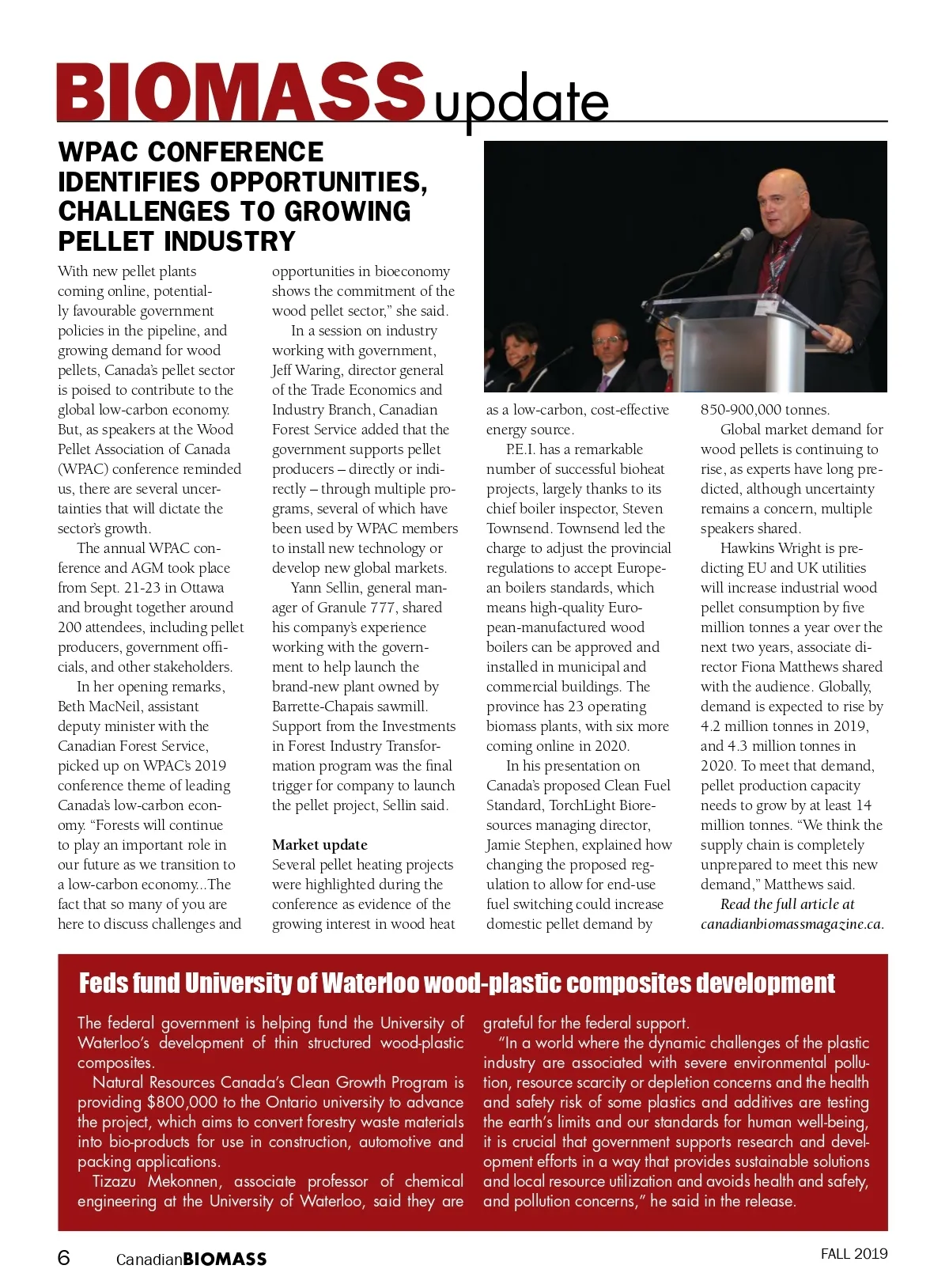
WPAC CONFERENCE IDENTIFIES OPPORTUNITIES, CHALLENGES TO GROWING PELLET INDUSTRY With new pellet plants coming online, potential-ly favourable government policies in the pipeline, and growing demand for wood pellets, Canada’s pellet sector is poised to contribute to the global low-carbon economy. But, as speakers at the Wood Pellet Association of Canada (WPAC) conference reminded us, there are several uncer-tainties that will dictate the sector’s growth. The annual WPAC con-ference and AGM took place from Sept. 21-23 in Ottawa and brought together around 200 attendees, including pellet producers, government offi-cials, and other stakeholders. In her opening remarks, Beth MacNeil, assistant deputy minister with the Canadian Forest Service, picked up on WPAC’s 2019 conference theme of leading Canada’s low-carbon econ-omy. “Forests will continue to play an important role in our future as we transition to a low-carbon economy...The fact that so many of you are here to discuss challenges and opportunities in bioeconomy shows the commitment of the wood pellet sector,” she said. In a session on industry working with government, Jeff Waring, director general of the Trade Economics and Industry Branch, Canadian Forest Service added that the government supports pellet producers – directly or indi-rectly – through multiple pro-grams, several of which have been used by WPAC members to install new technology or develop new global markets. Yann Sellin, general man-ager of Granule 777, shared his company’s experience working with the govern-ment to help launch the brand-new plant owned by Barrette-Chapais sawmill. Support from the Investments in Forest Industry Transfor-mation program was the final trigger for company to launch the pellet project, Sellin said. Market update Several pellet heating projects were highlighted during the conference as evidence of the growing interest in wood heat as a low-carbon, cost-effective energy source. P.E.I. has a remarkable number of successful bioheat projects, largely thanks to its chief boiler inspector, Steven Townsend. Townsend led the charge to adjust the provincial regulations to accept Europe-an boilers standards, which means high-quality Euro-pean-manufactured wood boilers can be approved and installed in municipal and commercial buildings. The province has 23 operating biomass plants, with six more coming online in 2020. In his presentation on Canada’s proposed Clean Fuel Standard, TorchLight Biore-sources managing director, Jamie Stephen, explained how changing the proposed reg-ulation to allow for end-use fuel switching could increase domestic pellet demand by 850-900,000 tonnes. Global market demand for wood pellets is continuing to rise, as experts have long pre-dicted, although uncertainty remains a concern, multiple speakers shared. Hawkins Wright is pre-dicting EU and UK utilities will increase industrial wood pellet consumption by five million tonnes a year over the next two years, associate di-rector Fiona Matthews shared with the audience. Globally, demand is expected to rise by 4.2 million tonnes in 2019, and 4.3 million tonnes in 2020. To meet that demand, pellet production capacity needs to grow by at least 14 million tonnes. “We think the supply chain is completely unprepared to meet this new demand,” Matthews said. Read the full article at canadianbiomassmagazine.ca. Feds fund University of Waterloo wood-plastic composites development The federal government is helping fund the University of Waterloo’s development of thin structured wood-plastic composites. Natural Resources Canada’s Clean Growth Program is providing $800,000 to the Ontario university to advance the project, which aims to convert forestry waste materials into bio-products for use in construction, automotive and packing applications. Tizazu Mekonnen, associate professor of chemical engineering at the University of Waterloo, said they are grateful for the federal support. “In a world where the dynamic challenges of the plastic industry are associated with severe environmental pollu-tion, resource scarcity or depletion concerns and the health and safety risk of some plastics and additives are testing the earth’s limits and our standards for human well-being, it is crucial that government supports research and devel-opment efforts in a way that provides sustainable solutions and local resource utilization and avoids health and safety, and pollution concerns,” he said in the release. FALL 2019 6 Canadian BIOMASS
Canadian Biomass Fall 2019: Page 6