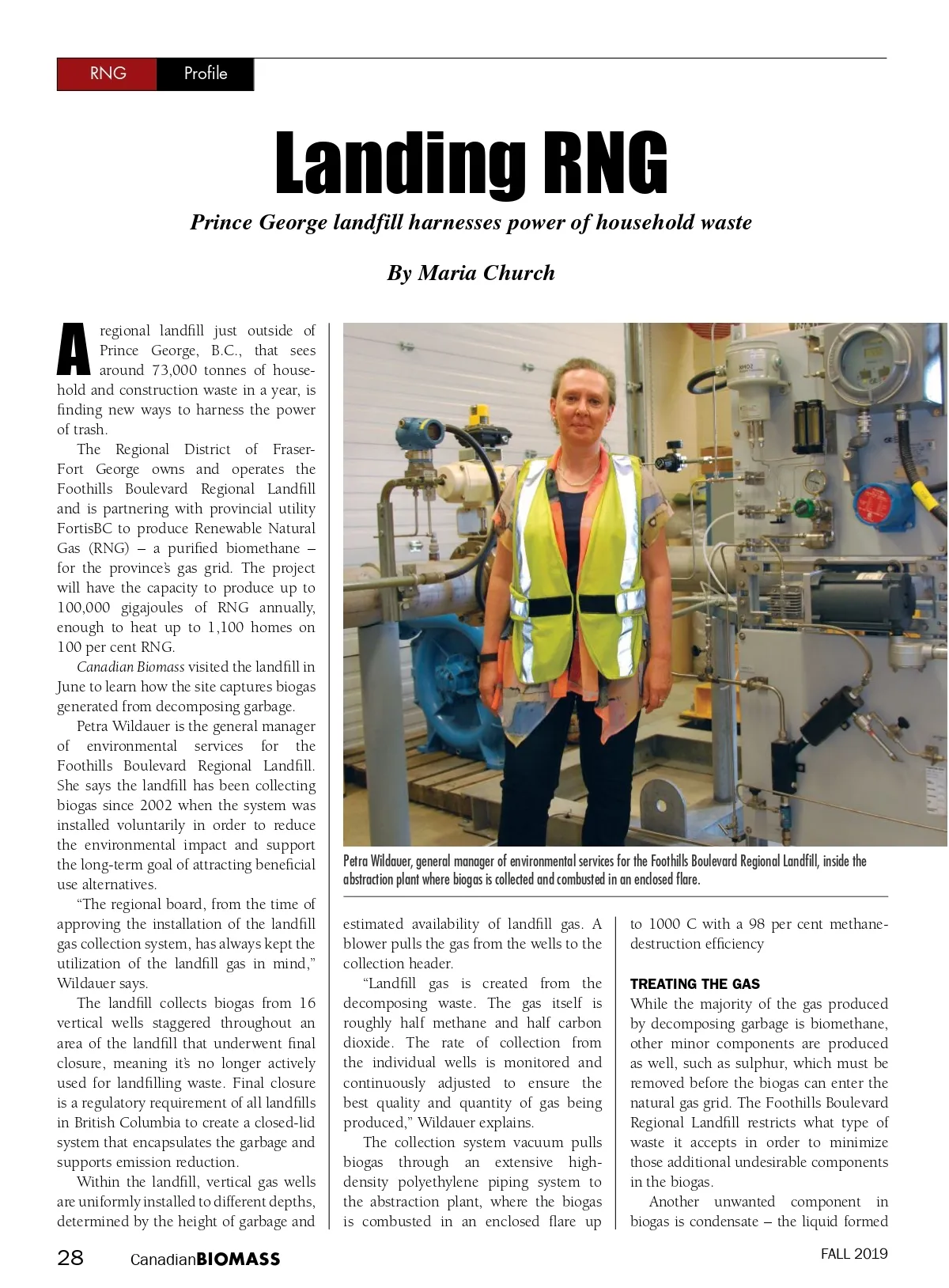
when landfill gas cools down. It is removed and collected in condensate traps located within low points within the collections system. The entire biogas collection and burn-off system was a turn-key project built by JZHC (John Zink Hamworthy Combustion) in 2002. The collection system infrastructure and computer software used provides continuous information on landfill gas quality and quantity. There are eight vertical wells and three horizontal wells in other areas of the landfill. This network of gas wells provides a total biogas flow of 256 cubic feet per minute or 435 cubic metres per hour. “Approximately 250 cubic feet is the standard to run any engine, so we are at that threshold of making it work for any utilization,” Wildauer says. ENTER FORTISBC FortisBC has five active RNG suppliers across the province, from Delta to Salmon Arm. The Prince George site would be their most northern. The utility first entered the RNG game nearly a decade ago when it began accepting biomethane from Fraser Valley Biogas in Abbotsford, B.C., in 2010. Fraser Valley Biogas was the first agricultural biogas operation in the province, and the first biogas plant in Canada to produce and inject RNG into a gas pipeline. Scott Gramm, manager of Renewable Natural Gas for FortisBC, was there from the beginning, working with Fraser Valley Biogas and the subsequent four suppliers in the province. “We want to do what’s right for our customers and we also want to align with government policy – those are the two primary reasons for us to work with RNG,” Gramm says. Two other landfills supply biogas to FortisBC: Salmon Arm Landfill in Salmon Arm, B.C., and Glenmore Landfill in Kelowna, B.C. FortisBC’s role with the landfill suppliers is to install and operate upgrading equipment on site. That equipment purifies the biomethane from the landfill, bringing it up to spec for injection into the natural gas pipeline. “The way you can think of it conceptually is like a water filter. You have water that’s kind of murky and dirty, you put it in a filter and it comes out clear. That’s essentially the step we’re doing for this biogas at landfills,” Gramm says. “When you remove the gas that isn’t useful, you’re essentially increasing the energy content per volume.” The upgrading equipment first removes contaminants such as hydrogen sulphides and volatile organic compounds from the breakdown of plastics and soaps, leaving carbon dioxide, nitrogen, oxygen and methane. A second, two-step process removes nitrogen, oxygen and carbon dioxide, leaving only methane for injection into the FortisBC pipeline. “For both Salmon Arm and Glenmore, we use pressure swing adsorption, leaving a purified gas. We odourize it with something called a mercaptan, which is really just for safety so that if there is a leak it’s obvious to detect,” Gramm says. The bulk of the project’s $8-million capital investment is coming from FortisBC. The upgrading plants are designed to operate unmanned. CONNECTIONS FortisBC’s equipment. “You always need redundancy for landfill gas. Our flare will be replaced eventually by a smaller flare that can handle less volume. Should either plant go down we can move back to flaring to reduce our emissions footprint,” Wildauer says. If approved, construction for the project is set for spring next year, with the first RNG anticipated to enter the grid in late 2020. TARGETING 15 PER CENT “On our side, we will be making sure our equipment matches the needs of FortisBC for transferring our gas,” Wildauer says. Requirements from the landfill include new insulated piping to the FortisBC facility, emergency shutoff valves, as well as upgrades to measurement devices to determine how much gas is flowing into In late 2018, the B.C. government released a policy document called CleanBC that outlines renewable energy targets for 2030. One target is a 15 per cent renewable gas standard for B.C.’s natural gas system. With the Foothills Boulevard Regional Landfill online next year, FortisBC will be around one per cent RNG. “If we want to get to the 15 per cent, we’re going to have to consider different sources of gas,” Gramm says. “That includes potentially wood waste-derived renewable natural gas, and we’re considering things like hydrogen in the long run. These are all possibilities.” FortisBC is continually on the hunt for new RNG projects with low-carbon intensity, for $30 a gigajoule or less, ideally within B.C., Gramm says. “If you have a project that fits, then reach out to us. We’re willing to talk to you.” • Canadian BIOMASS 29
Canadian Biomass Fall 2019: Page 29