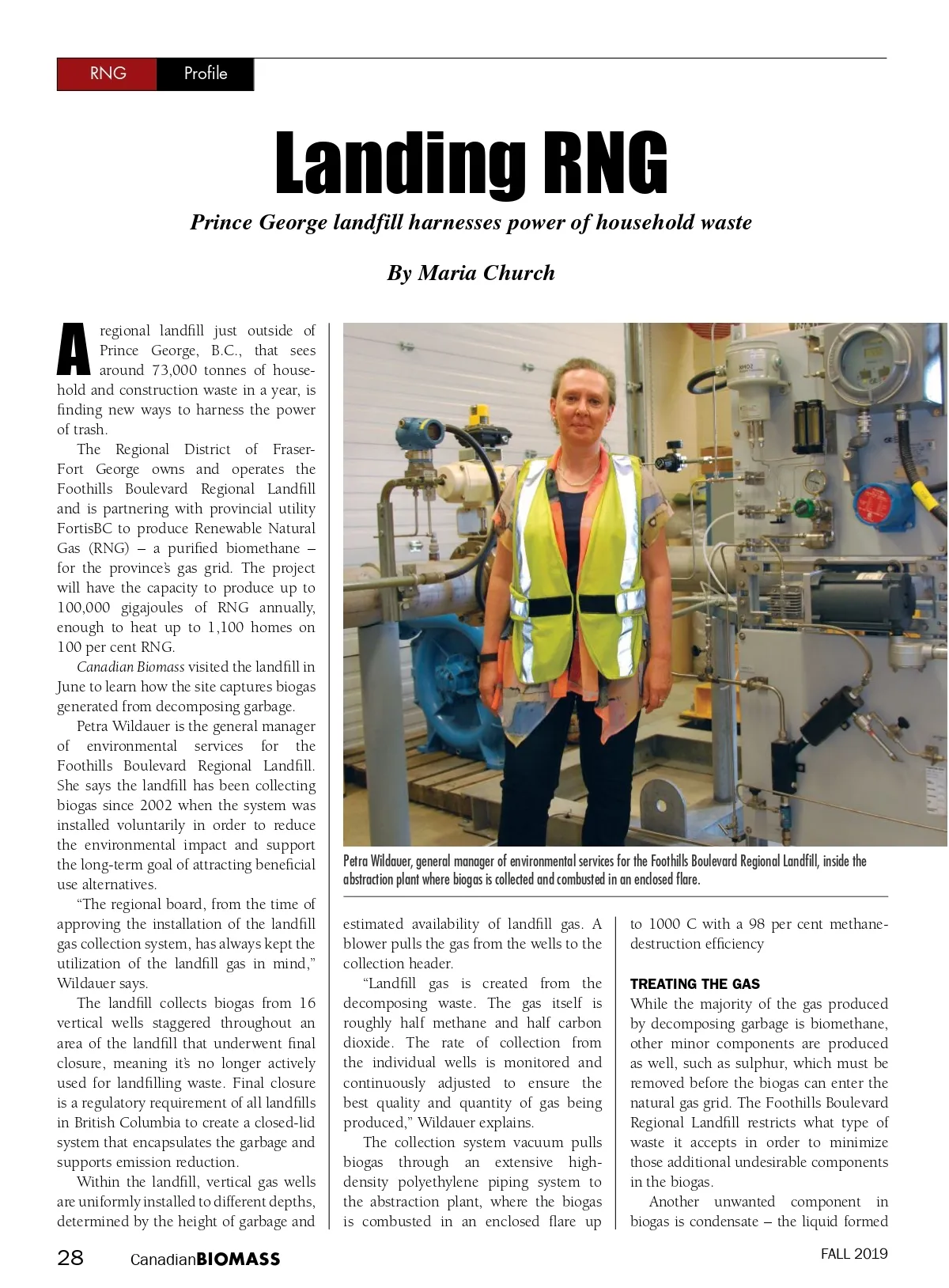
RNG Profile Prince George landfill harnesses power of household waste By Maria Church regional landfill just outside of Prince George, B.C., that sees around 73,000 tonnes of house-hold and construction waste in a year, is finding new ways to harness the power of trash. The Regional District of Fraser-Fort George owns and operates the Foothills Boulevard Regional Landfill and is partnering with provincial utility FortisBC to produce Renewable Natural Gas (RNG) – a purified biomethane – for the province’s gas grid. The project will have the capacity to produce up to 100,000 gigajoules of RNG annually, enough to heat up to 1,100 homes on 100 per cent RNG. Canadian Biomass visited the landfill in June to learn how the site captures biogas generated from decomposing garbage. Petra Wildauer is the general manager of environmental services for the Foothills Boulevard Regional Landfill. She says the landfill has been collecting biogas since 2002 when the system was installed voluntarily in order to reduce the environmental impact and support the long-term goal of attracting beneficial use alternatives. “The regional board, from the time of approving the installation of the landfill gas collection system, has always kept the utilization of the landfill gas in mind,” Wildauer says. The landfill collects biogas from 16 vertical wells staggered throughout an area of the landfill that underwent final closure, meaning it’s no longer actively used for landfilling waste. Final closure is a regulatory requirement of all landfills in British Columbia to create a closed-lid system that encapsulates the garbage and supports emission reduction. Within the landfill, vertical gas wells are uniformly installed to different depths, determined by the height of garbage and Landing RNG A Petra Wildauer, general manager of environmental services for the Foothills Boulevard Regional Landfill, inside the abstraction plant where biogas is collected and combusted in an enclosed flare. estimated availability of landfill gas. A blower pulls the gas from the wells to the collection header. “Landfill gas is created from the decomposing waste. The gas itself is roughly half methane and half carbon dioxide. The rate of collection from the individual wells is monitored and continuously adjusted to ensure the best quality and quantity of gas being produced,” Wildauer explains. The collection system vacuum pulls biogas through an extensive high-density polyethylene piping system to the abstraction plant, where the biogas is combusted in an enclosed flare up to 1000 C with a 98 per cent methane-destruction efficiency TREATING THE GAS While the majority of the gas produced by decomposing garbage is biomethane, other minor components are produced as well, such as sulphur, which must be removed before the biogas can enter the natural gas grid. The Foothills Boulevard Regional Landfill restricts what type of waste it accepts in order to minimize those additional undesirable components in the biogas. Another unwanted component in biogas is condensate – the liquid formed FALL 2019 28 Canadian BIOMASS
Canadian Biomass Fall 2019: Page 28