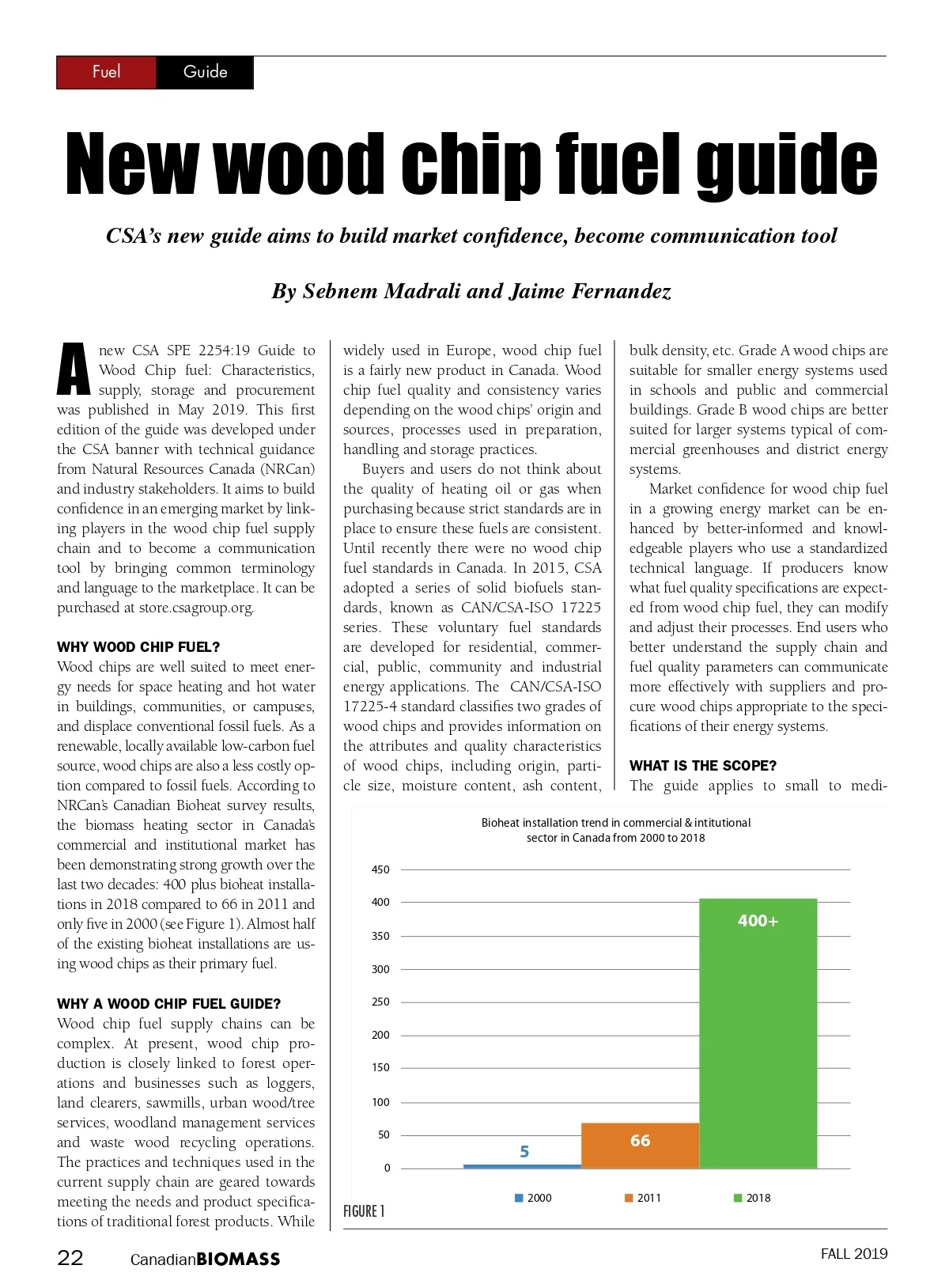
Fuel Guide New wood chip fuel guide CSA’s new guide aims to build market confidence, become communication tool By Sebnem Madrali and Jaime Fernandez new CSA SPE 2254:19 Guide to Wood Chip fuel: Characteristics, supply, storage and procurement was published in May 2019. This first edition of the guide was developed under the CSA banner with technical guidance from Natural Resources Canada (NRCan) and industry stakeholders. It aims to build confidence in an emerging market by link-ing players in the wood chip fuel supply chain and to become a communication tool by bringing common terminology and language to the marketplace. It can be purchased at store.csagroup.org. WHY WOOD CHIP FUEL? A Wood chips are well suited to meet ener-gy needs for space heating and hot water in buildings, communities, or campuses, and displace conventional fossil fuels. As a renewable, locally available low-carbon fuel source, wood chips are also a less costly op-tion compared to fossil fuels. According to NRCan’s Canadian Bioheat survey results, the biomass heating sector in Canada’s commercial and institutional market has been demonstrating strong growth over the last two decades: 400 plus bioheat installa-tions in 2018 compared to 66 in 2011 and only five in 2000 (see Figure 1). Almost half of the existing bioheat installations are us-ing wood chips as their primary fuel. WHY A WOOD CHIP FUEL GUIDE? widely used in Europe, wood chip fuel is a fairly new product in Canada. Wood chip fuel quality and consistency varies depending on the wood chips’ origin and sources, processes used in preparation, handling and storage practices. Buyers and users do not think about the quality of heating oil or gas when purchasing because strict standards are in place to ensure these fuels are consistent. Until recently there were no wood chip fuel standards in Canada. In 2015, CSA adopted a series of solid biofuels stan-dards, known as CAN/CSA-ISO 17225 series. These voluntary fuel standards are developed for residential, commer-cial, public, community and industrial energy applications. The CAN/CSA-ISO 17225-4 standard classifies two grades of wood chips and provides information on the attributes and quality characteristics of wood chips, including origin, parti-cle size, moisture content, ash content, bulk density, etc. Grade A wood chips are suitable for smaller energy systems used in schools and public and commercial buildings. Grade B wood chips are better suited for larger systems typical of com-mercial greenhouses and district energy systems. Market confidence for wood chip fuel in a growing energy market can be en-hanced by better-informed and knowl-edgeable players who use a standardized technical language. If producers know what fuel quality specifications are expect-ed from wood chip fuel, they can modify and adjust their processes. End users who better understand the supply chain and fuel quality parameters can communicate more effectively with suppliers and pro-cure wood chips appropriate to the speci-fications of their energy systems. WHAT IS THE SCOPE? The guide applies to small to medi-Bioheat installation trend in commercial & intitutional sector in Canada from 2000 to 2018 450 400 350 300 250 200 150 100 50 0 400+ Wood chip fuel supply chains can be complex. At present, wood chip pro-duction is closely linked to forest oper-ations and businesses such as loggers, land clearers, sawmills, urban wood/tree services, woodland management services and waste wood recycling operations. The practices and techniques used in the current supply chain are geared towards meeting the needs and product specifica-tions of traditional forest products. While 5 2000 66 2011 2018 FIGURE 1 22 Canadian BIOMASS FALL 2019
Canadian Biomass Fall 2019: Page 22