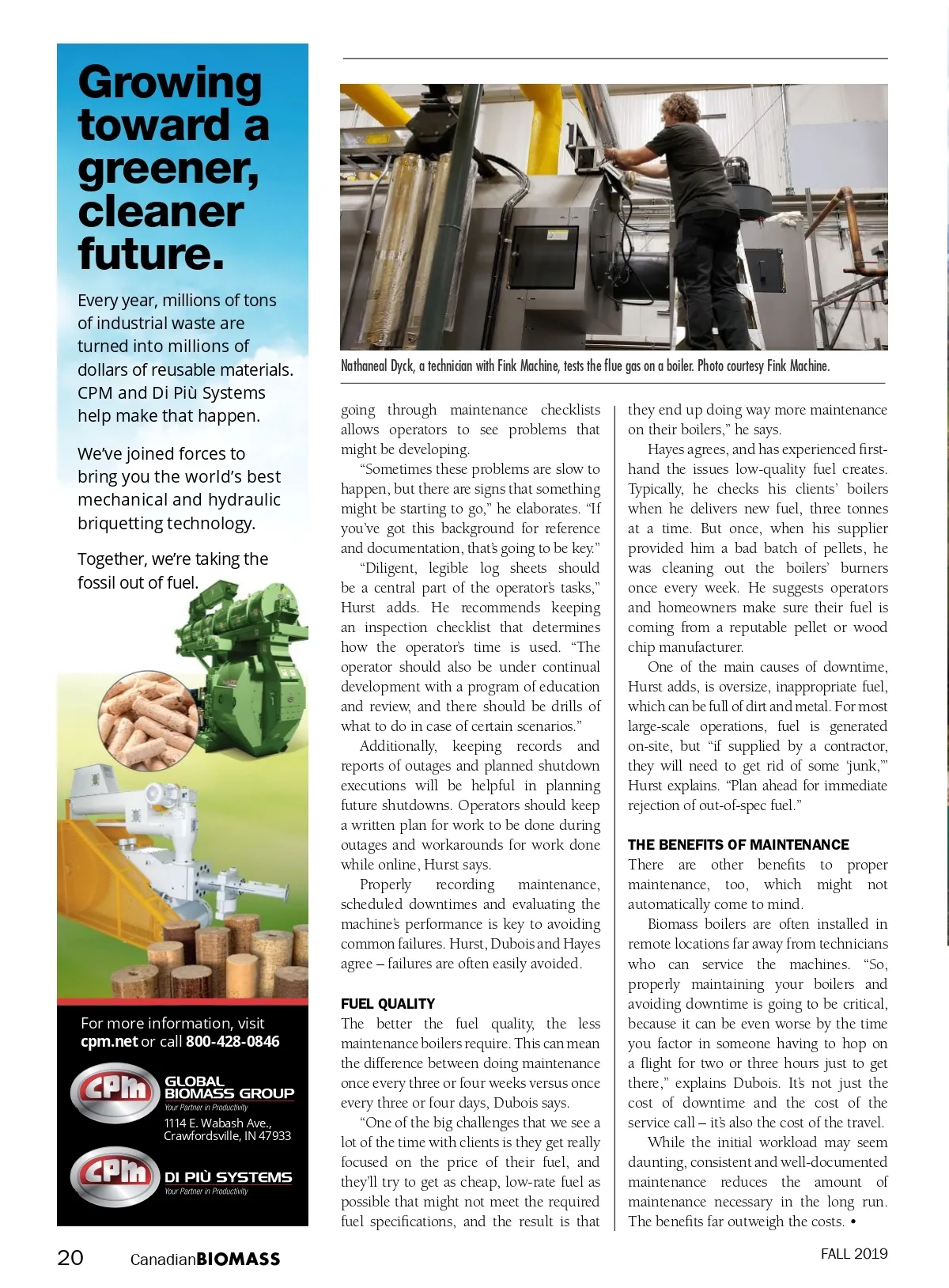
Growing toward a greener, cleaner future. Every year, millions of tons of industrial waste are turned into millions of dollars of reusable materials. CPM and Di Più Systems help make that happen. We’ve joined forces to bring you the world’s best mechanical and hydraulic briquetting technology. Together, we’re taking the fossil out of fuel. Nathaneal Dyck, a technician with Fink Machine, tests the flue gas on a boiler. Photo courtesy Fink Machine. going through maintenance checklists allows operators to see problems that might be developing. “Sometimes these problems are slow to happen, but there are signs that something might be starting to go,” he elaborates. “If you’ve got this background for reference and documentation, that’s going to be key.” “Diligent, legible log sheets should be a central part of the operator’s tasks,” Hurst adds. He recommends keeping an inspection checklist that determines how the operator’s time is used. “The operator should also be under continual development with a program of education and review, and there should be drills of what to do in case of certain scenarios.” Additionally, keeping records and reports of outages and planned shutdown executions will be helpful in planning future shutdowns. Operators should keep a written plan for work to be done during outages and workarounds for work done while online, Hurst says. Properly recording maintenance, scheduled downtimes and evaluating the machine’s performance is key to avoiding common failures. Hurst, Dubois and Hayes agree – failures are often easily avoided. FUEL QUALITY they end up doing way more maintenance on their boilers,” he says. Hayes agrees, and has experienced first-hand the issues low-quality fuel creates. Typically, he checks his clients’ boilers when he delivers new fuel, three tonnes at a time. But once, when his supplier provided him a bad batch of pellets, he was cleaning out the boilers’ burners once every week. He suggests operators and homeowners make sure their fuel is coming from a reputable pellet or wood chip manufacturer. One of the main causes of downtime, Hurst adds, is oversize, inappropriate fuel, which can be full of dirt and metal. For most large-scale operations, fuel is generated on-site, but “if supplied by a contractor, they will need to get rid of some ‘junk,’” Hurst explains. “Plan ahead for immediate rejection of out-of-spec fuel.” THE BENEFITS OF MAINTENANCE For more information, visit cpm.net or call 800-428-0846 1114 E. Wabash Ave., Crawfordsville, IN 47933 The better the fuel quality, the less maintenance boilers require. This can mean the difference between doing maintenance once every three or four weeks versus once every three or four days, Dubois says. “One of the big challenges that we see a lot of the time with clients is they get really focused on the price of their fuel, and they’ll try to get as cheap, low-rate fuel as possible that might not meet the required fuel specifications, and the result is that There are other benefits to proper maintenance, too, which might not automatically come to mind. Biomass boilers are often installed in remote locations far away from technicians who can service the machines. “So, properly maintaining your boilers and avoiding downtime is going to be critical, because it can be even worse by the time you factor in someone having to hop on a flight for two or three hours just to get there,” explains Dubois. It’s not just the cost of downtime and the cost of the service call – it’s also the cost of the travel. While the initial workload may seem daunting, consistent and well-documented maintenance reduces the amount of maintenance necessary in the long run. The benefits far outweigh the costs. • FALL 2019 Publication: Canadian Canadian Biomass 20 BIOMASS CBM_CPMGlobal_SeptOct18_CSA.indd 1 Client: Global Biomass Group Order: 1012 Line: 6 2018-09-07 2:03 PM
Canadian Biomass Fall 2019: Page 20