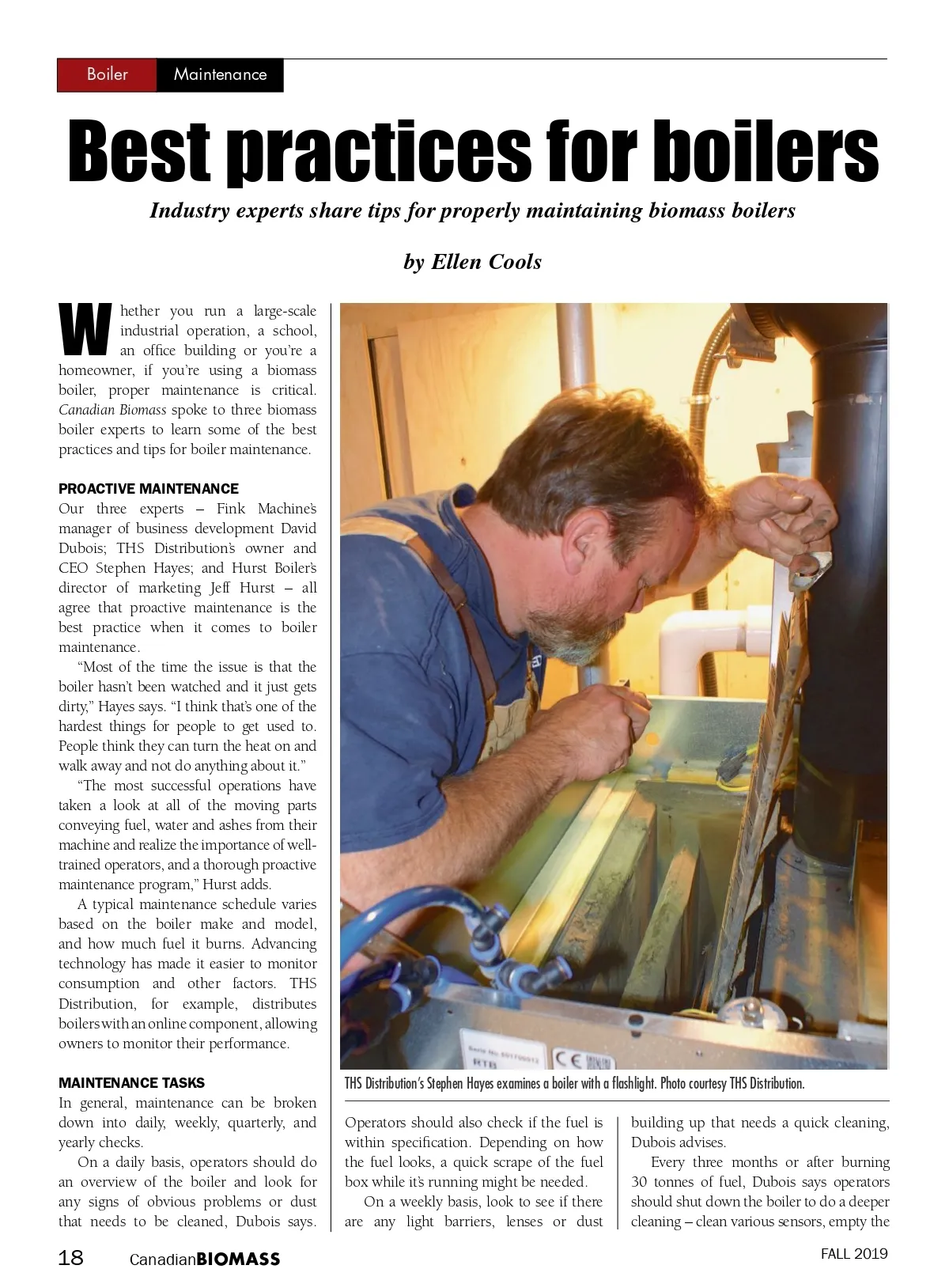
Boiler Maintenance Best practices for boilers Industry experts share tips for properly maintaining biomass boilers by Ellen Cools hether you run a large-scale industrial operation, a school, an office building or you’re a homeowner, if you’re using a biomass boiler, proper maintenance is critical. Canadian Biomass spoke to three biomass boiler experts to learn some of the best practices and tips for boiler maintenance. PROACTIVE MAINTENANCE W Our three experts – Fink Machine’s manager of business development David Dubois; THS Distribution’s owner and CEO Stephen Hayes; and Hurst Boiler’s director of marketing Jeff Hurst – all agree that proactive maintenance is the best practice when it comes to boiler maintenance. “Most of the time the issue is that the boiler hasn’t been watched and it just gets dirty,” Hayes says. “I think that’s one of the hardest things for people to get used to. People think they can turn the heat on and walk away and not do anything about it.” “The most successful operations have taken a look at all of the moving parts conveying fuel, water and ashes from their machine and realize the importance of well-trained operators, and a thorough proactive maintenance program,” Hurst adds. A typical maintenance schedule varies based on the boiler make and model, and how much fuel it burns. Advancing technology has made it easier to monitor consumption and other factors. THS Distribution, for example, distributes boilers with an online component, allowing owners to monitor their performance. MAINTENANCE TASKS THS Distribution’s Stephen Hayes examines a boiler with a flashlight. Photo courtesy THS Distribution. In general, maintenance can be broken down into daily, weekly, quarterly, and yearly checks. On a daily basis, operators should do an overview of the boiler and look for any signs of obvious problems or dust that needs to be cleaned, Dubois says. Operators should also check if the fuel is within specification. Depending on how the fuel looks, a quick scrape of the fuel box while it’s running might be needed. On a weekly basis, look to see if there are any light barriers, lenses or dust building up that needs a quick cleaning, Dubois advises. Every three months or after burning 30 tonnes of fuel, Dubois says operators should shut down the boiler to do a deeper cleaning – clean various sensors, empty the FALL 2019 18 Canadian BIOMASS
Canadian Biomass Fall 2019: Page 18