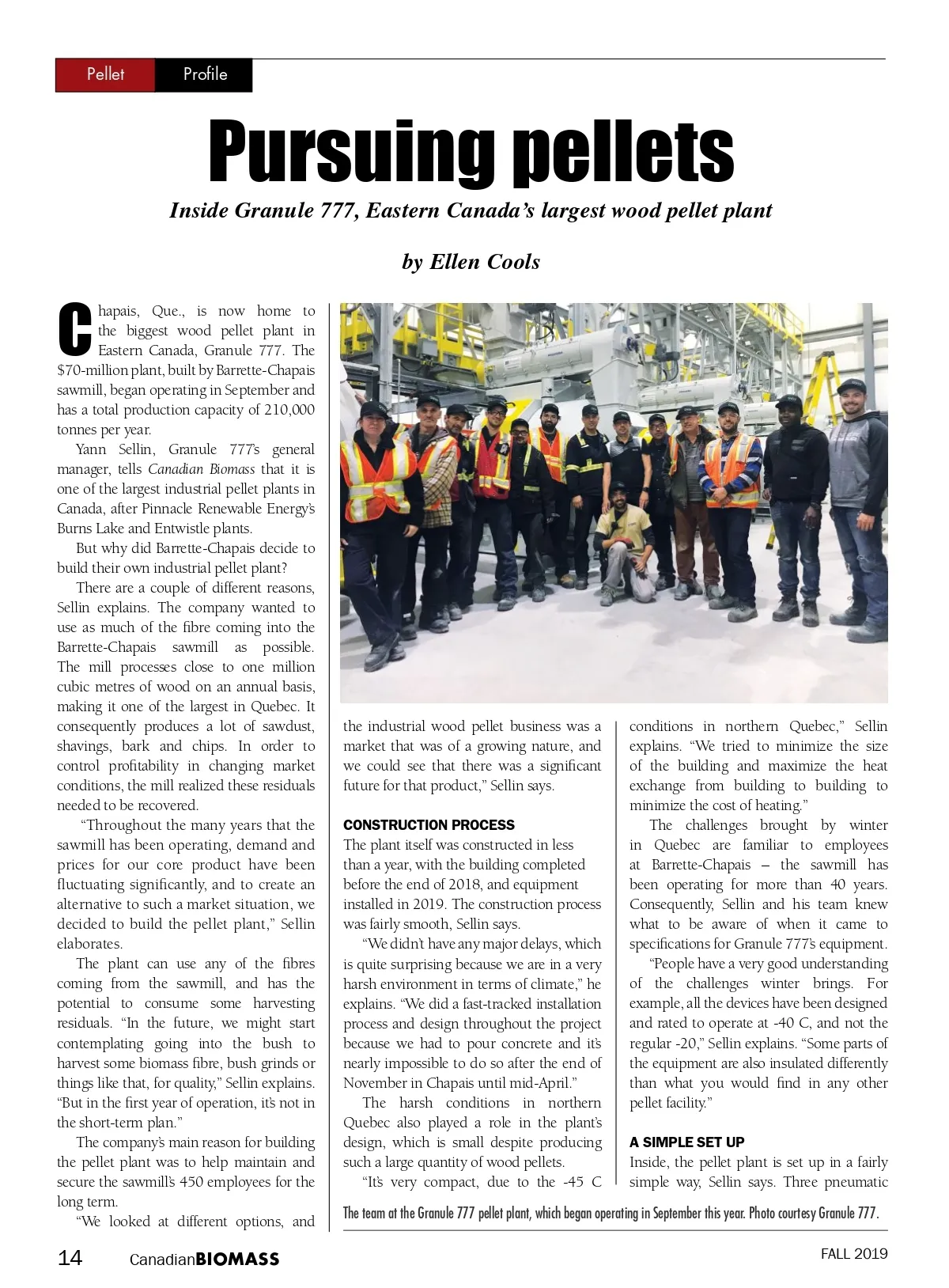
Pellet Profile Inside Granule 777, Eastern Canada’s largest wood pellet plant by Ellen Cools hapais, Que., is now home to the biggest wood pellet plant in Eastern Canada, Granule 777. The $70-million plant, built by Barrette-Chapais sawmill, began operating in September and has a total production capacity of 210,000 tonnes per year. Yann Sellin, Granule 777’s general manager, tells Canadian Biomass that it is one of the largest industrial pellet plants in Canada, after Pinnacle Renewable Energy’s Burns Lake and Entwistle plants. But why did Barrette-Chapais decide to build their own industrial pellet plant? There are a couple of different reasons, Sellin explains. The company wanted to use as much of the fibre coming into the Barrette-Chapais sawmill as possible. The mill processes close to one million cubic metres of wood on an annual basis, making it one of the largest in Quebec. It consequently produces a lot of sawdust, shavings, bark and chips. In order to control profitability in changing market conditions, the mill realized these residuals needed to be recovered. “Throughout the many years that the sawmill has been operating, demand and prices for our core product have been fluctuating significantly, and to create an alternative to such a market situation, we decided to build the pellet plant,” Sellin elaborates. The plant can use any of the fibres coming from the sawmill, and has the potential to consume some harvesting residuals. “In the future, we might start contemplating going into the bush to harvest some biomass fibre, bush grinds or things like that, for quality,” Sellin explains. “But in the first year of operation, it’s not in the short-term plan.” The company’s main reason for building the pellet plant was to help maintain and secure the sawmill’s 450 employees for the long term. “We looked at different options, and Pursuing pellets C the industrial wood pellet business was a market that was of a growing nature, and we could see that there was a significant future for that product,” Sellin says. CONSTRUCTION PROCESS The plant itself was constructed in less than a year, with the building completed before the end of 2018, and equipment installed in 2019. The construction process was fairly smooth, Sellin says. “We didn’t have any major delays, which is quite surprising because we are in a very harsh environment in terms of climate,” he explains. “We did a fast-tracked installation process and design throughout the project because we had to pour concrete and it’s nearly impossible to do so after the end of November in Chapais until mid-April.” The harsh conditions in northern Quebec also played a role in the plant’s design, which is small despite producing such a large quantity of wood pellets. “It’s very compact, due to the -45 C conditions in northern Quebec,” Sellin explains. “We tried to minimize the size of the building and maximize the heat exchange from building to building to minimize the cost of heating.” The challenges brought by winter in Quebec are familiar to employees at Barrette-Chapais – the sawmill has been operating for more than 40 years. Consequently, Sellin and his team knew what to be aware of when it came to specifications for Granule 777’s equipment. “People have a very good understanding of the challenges winter brings. For example, all the devices have been designed and rated to operate at -40 C, and not the regular -20,” Sellin explains. “Some parts of the equipment are also insulated differently than what you would find in any other pellet facility.” A SIMPLE SET UP Inside, the pellet plant is set up in a fairly simple way, Sellin says. Three pneumatic The team at the Granule 777 pellet plant, which began operating in September this year. Photo courtesy Granule 777. FALL 2019 14 Canadian BIOMASS
Canadian Biomass Fall 2019: Page 14