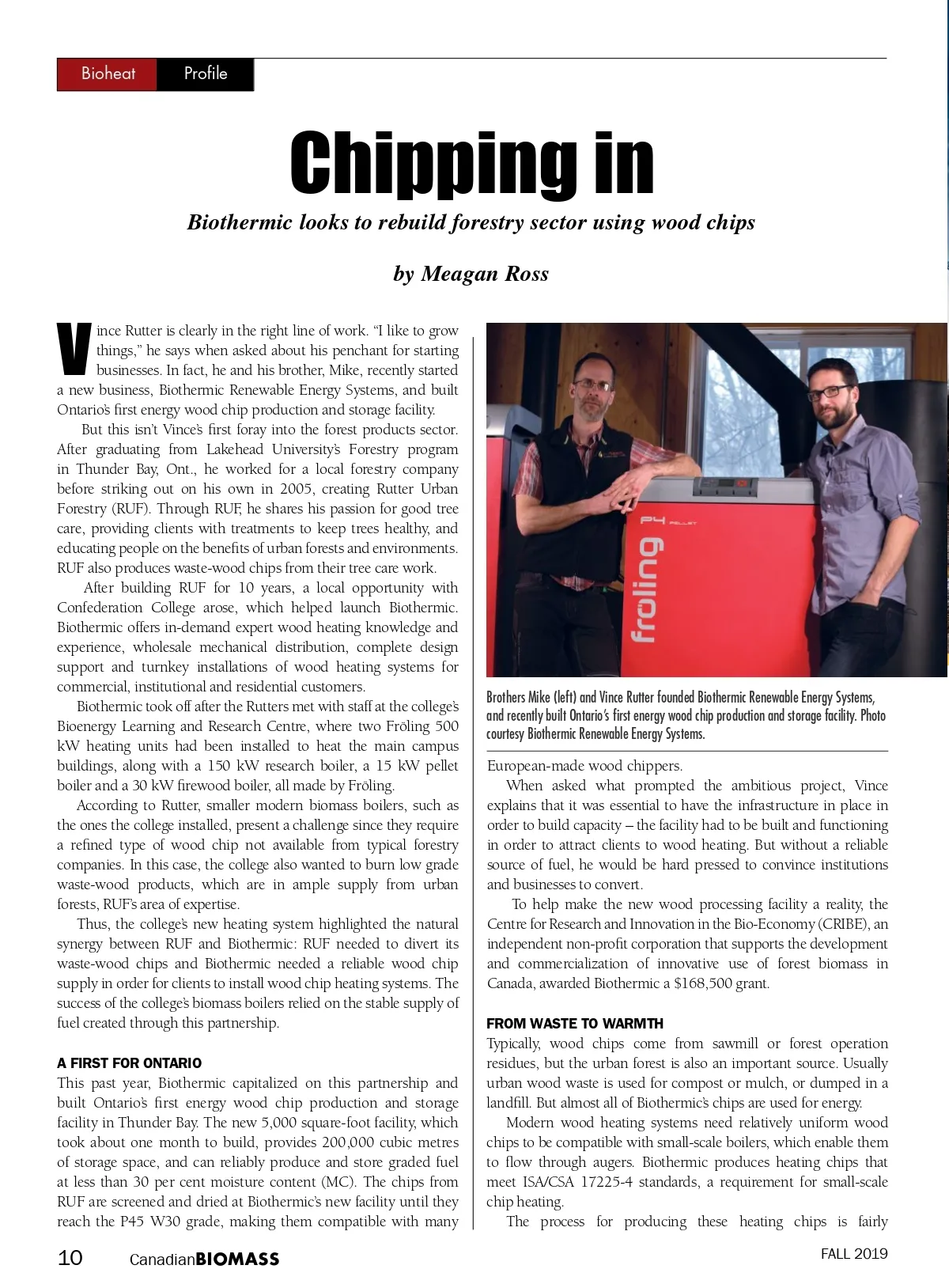
Bioheat Profile Biothermic looks to rebuild forestry sector using wood chips by Meagan Ross ince Rutter is clearly in the right line of work. “I like to grow things,” he says when asked about his penchant for starting businesses. In fact, he and his brother, Mike, recently started a new business, Biothermic Renewable Energy Systems, and built Ontario’s first energy wood chip production and storage facility. But this isn’t Vince’s first foray into the forest products sector. After graduating from Lakehead University’s Forestry program in Thunder Bay, Ont., he worked for a local forestry company before striking out on his own in 2005, creating Rutter Urban Forestry (RUF). Through RUF , he shares his passion for good tree care, providing clients with treatments to keep trees healthy, and educating people on the benefits of urban forests and environments. RUF also produces waste-wood chips from their tree care work. After building RUF for 10 years, a local opportunity with Confederation College arose, which helped launch Biothermic. Biothermic offers in-demand expert wood heating knowledge and experience, wholesale mechanical distribution, complete design support and turnkey installations of wood heating systems for commercial, institutional and residential customers. Biothermic took off after the Rutters met with staff at the college’s Bioenergy Learning and Research Centre, where two Fröling 500 kW heating units had been installed to heat the main campus buildings, along with a 150 kW research boiler, a 15 kW pellet boiler and a 30 kW firewood boiler, all made by Fröling. According to Rutter, smaller modern biomass boilers, such as the ones the college installed, present a challenge since they require a refined type of wood chip not available from typical forestry companies. In this case, the college also wanted to burn low grade waste-wood products, which are in ample supply from urban forests, RUF’s area of expertise. Thus, the college’s new heating system highlighted the natural synergy between RUF and Biothermic: RUF needed to divert its waste-wood chips and Biothermic needed a reliable wood chip supply in order for clients to install wood chip heating systems. The success of the college’s biomass boilers relied on the stable supply of fuel created through this partnership. A FIRST FOR ONTARIO Chipping in V Brothers Mike (left) and Vince Rutter founded Biothermic Renewable Energy Systems, and recently built Ontario’s first energy wood chip production and storage facility. Photo courtesy Biothermic Renewable Energy Systems. European-made wood chippers. When asked what prompted the ambitious project, Vince explains that it was essential to have the infrastructure in place in order to build capacity – the facility had to be built and functioning in order to attract clients to wood heating. But without a reliable source of fuel, he would be hard pressed to convince institutions and businesses to convert. To help make the new wood processing facility a reality, the Centre for Research and Innovation in the Bio-Economy (CRIBE), an independent non-profit corporation that supports the development and commercialization of innovative use of forest biomass in Canada, awarded Biothermic a $168,500 grant. FROM WASTE TO WARMTH This past year, Biothermic capitalized on this partnership and built Ontario’s first energy wood chip production and storage facility in Thunder Bay. The new 5,000 square-foot facility, which took about one month to build, provides 200,000 cubic metres of storage space, and can reliably produce and store graded fuel at less than 30 per cent moisture content (MC). The chips from RUF are screened and dried at Biothermic’s new facility until they reach the P45 W30 grade, making them compatible with many Typically, wood chips come from sawmill or forest operation residues, but the urban forest is also an important source. Usually urban wood waste is used for compost or mulch, or dumped in a landfill. But almost all of Biothermic’s chips are used for energy. Modern wood heating systems need relatively uniform wood chips to be compatible with small-scale boilers, which enable them to flow through augers. Biothermic produces heating chips that meet ISA/CSA 17225-4 standards, a requirement for small-scale chip heating. The process for producing these heating chips is fairly FALL 2019 10 Canadian BIOMASS
Canadian Biomass Fall 2019: Page 10