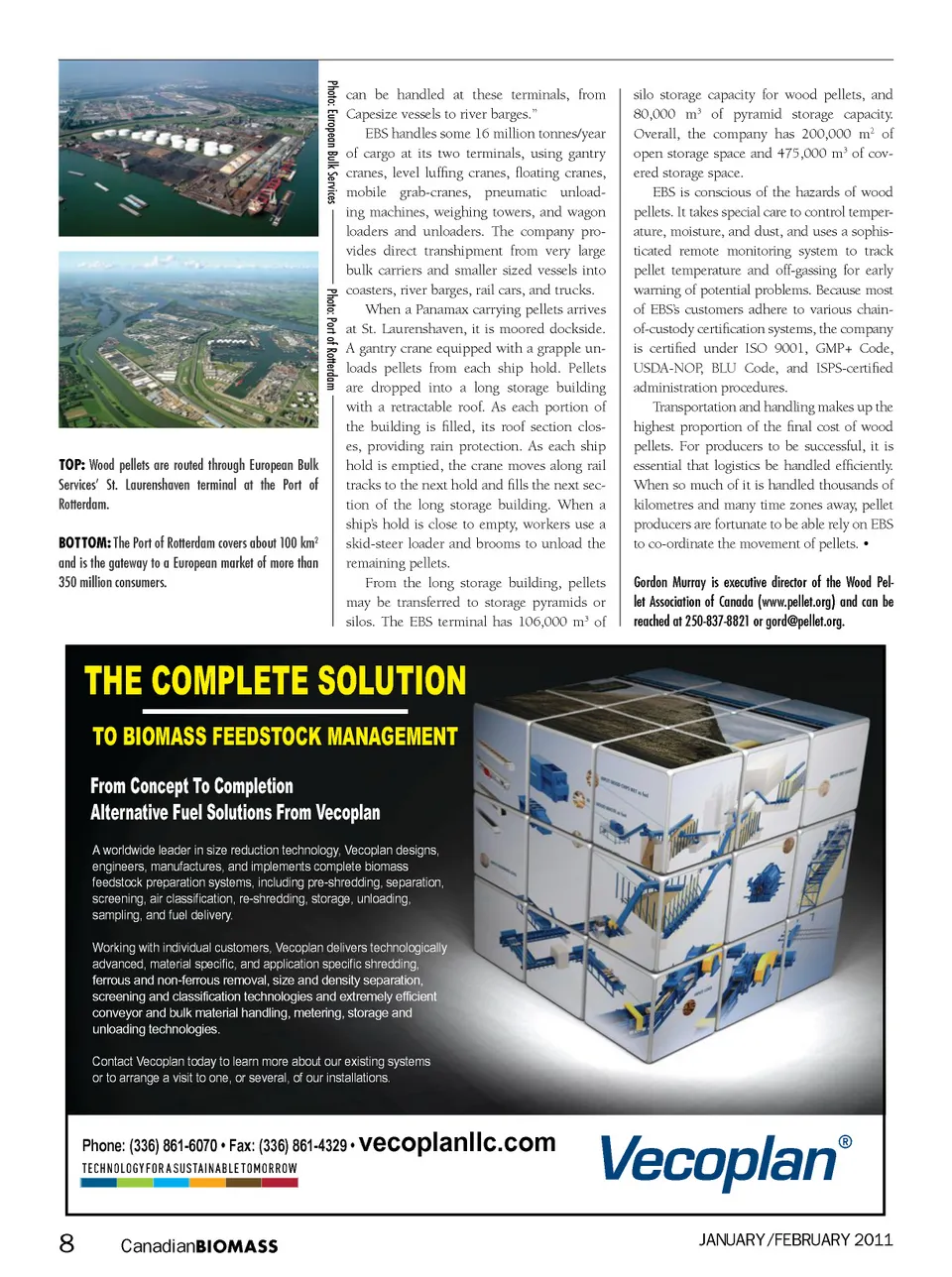
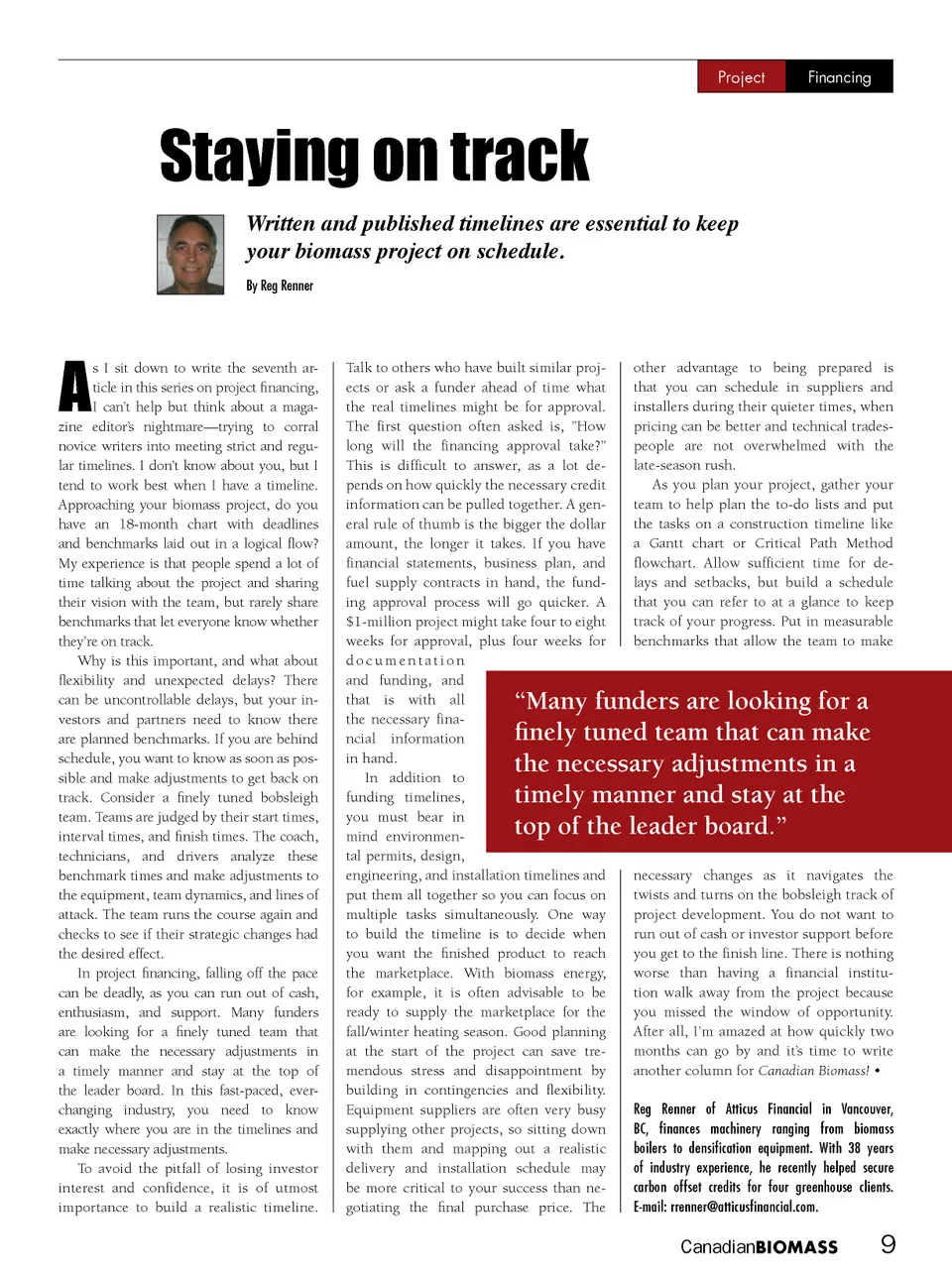
Photo: European Bulk Services Photo: Port of Rotterdam TOP: Wood pellets are routed through European Bulk Services’ St. Laurenshaven terminal at the Port of Rotterdam. BOTTOM: The Port of Rotterdam covers about 100 km 2 and is the gateway to a European market of more than 350 million consumers. can be handled at these terminals, from Capesize vessels to river barges.” EBS handles some 16 million tonnes/year of cargo at its two terminals, using gantry cranes, level luffing cranes, floating cranes, mobile grab-cranes, pneumatic unload-ing machines, weighing towers, and wagon loaders and unloaders. The company pro-vides direct transhipment from very large bulk carriers and smaller sized vessels into coasters, river barges, rail cars, and trucks. When a Panamax carrying pellets arrives at St. Laurenshaven, it is moored dockside. A gantry crane equipped with a grapple un-loads pellets from each ship hold. Pellets are dropped into a long storage building with a retractable roof. As each portion of the building is filled, its roof section clos-es, providing rain protection. As each ship hold is emptied, the crane moves along rail tracks to the next hold and fills the next sec-tion of the long storage building. When a ship’s hold is close to empty, workers use a skid-steer loader and brooms to unload the remaining pellets. From the long storage building, pellets may be transferred to storage pyramids or silos. The EBS terminal has 106,000 m 3 of silo storage capacity for wood pellets, and 80,000 m 3 of pyramid storage capacity. Overall, the company has 200,000 m 2 of open storage space and 475,000 m 3 of cov-ered storage space. EBS is conscious of the hazards of wood pellets. It takes special care to control temper-ature, moisture, and dust, and uses a sophis-ticated remote monitoring system to track pellet temperature and off-gassing for early warning of potential problems. Because most of EBS’s customers adhere to various chain-of-custody certification systems, the company is certified under ISO 9001, GMP+ Code, USDA-NOP, BLU Code, and ISPS-certified administration procedures. Transportation and handling makes up the highest proportion of the final cost of wood pellets. For producers to be successful, it is essential that logistics be handled efficiently. When so much of it is handled thousands of kilometres and many time zones away, pellet producers are fortunate to be able rely on EBS to co-ordinate the movement of pellets. • Gordon Murray is executive director of the Wood Pel-let Association of Canada (www.pellet.org) and can be reached at 250-837-8821 or [email protected]. THE COMPLETE SOLUTION TO BIOMASS FEEDSTOCK MANAGEMENT From Concept To Completion Alternative Fuel Solutions From Vecoplan A worldwide leader in size reduction technology, Vecoplan designs, engineers, manufactures, and implements complete biomass feedstock preparation systems, including pre-shredding, separation, screening, air classification, re-shredding, storage, unloading, sampling, and fuel delivery. Working with individual customers, Vecoplan delivers technologically advanced, material specific, and application specific shredding, ferrous and non-ferrous removal, size and density separation, screening and classification technologies and extremely efficient conveyor and bulk material handling, metering, storage and unloading technologies. Contact Vecoplan today to learn more about our existing systems or to arrange a visit to one, or several, of our installations. Phone: (336) 861-6070 • Fax: (336) 861-4329 • vecoplanllc.com 8 Canadian BIOMASS JANUARY/FEBRUARY 2011
Canadian Biomass January/February 2011: Page 8