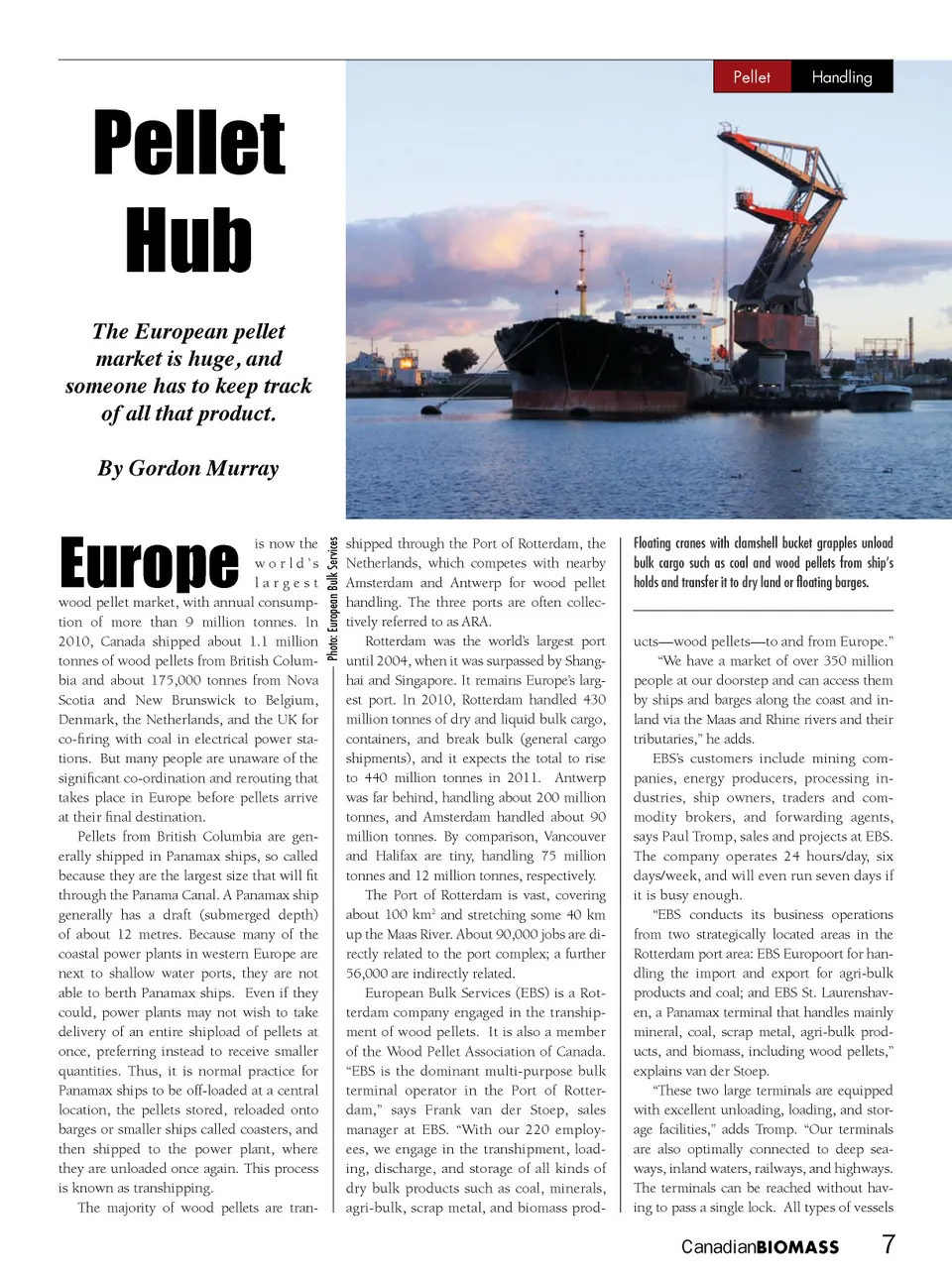
Pellet Hub The European pellet market is huge, and someone has to keep track of all that product. By Gordon Murray Photo: European Bulk Services Pellet Handling Europe is now the w o r l d ’s largest wood pellet market, with annual consump-tion of more than 9 million tonnes. In 2010, Canada shipped about 1.1 million tonnes of wood pellets from British Colum-bia and about 175,000 tonnes from Nova Scotia and New Brunswick to Belgium, Denmark, the Netherlands, and the UK for co-firing with coal in electrical power sta-tions. But many people are unaware of the significant co-ordination and rerouting that takes place in Europe before pellets arrive at their final destination. Pellets from British Columbia are gen-erally shipped in Panamax ships, so called because they are the largest size that will fit through the Panama Canal. A Panamax ship generally has a draft (submerged depth) of about 12 metres. Because many of the coastal power plants in western Europe are next to shallow water ports, they are not able to berth Panamax ships. Even if they could, power plants may not wish to take delivery of an entire shipload of pellets at once, preferring instead to receive smaller quantities. Thus, it is normal practice for Panamax ships to be off-loaded at a central location, the pellets stored, reloaded onto barges or smaller ships called coasters, and then shipped to the power plant, where they are unloaded once again. This process is known as transhipping. The majority of wood pellets are tran-shipped through the Port of Rotterdam, the Netherlands, which competes with nearby Amsterdam and Antwerp for wood pellet handling. The three ports are often collec-tively referred to as ARA. Rotterdam was the world’s largest port until 2004, when it was surpassed by Shang-hai and Singapore. It remains Europe’s larg-est port. In 2010, Rotterdam handled 430 million tonnes of dry and liquid bulk cargo, containers, and break bulk (general cargo shipments), and it expects the total to rise to 440 million tonnes in 2011. Antwerp was far behind, handling about 200 million tonnes, and Amsterdam handled about 90 million tonnes. By comparison, Vancouver and Halifax are tiny, handling 75 million tonnes and 12 million tonnes, respectively. The Port of Rotterdam is vast, covering about 100 km 2 and stretching some 40 km up the Maas River. About 90,000 jobs are di-rectly related to the port complex; a further 56,000 are indirectly related. European Bulk Services (EBS) is a Rot-terdam company engaged in the tranship-ment of wood pellets. It is also a member of the Wood Pellet Association of Canada. “EBS is the dominant multi-purpose bulk terminal operator in the Port of Rotter-dam,” says Frank van der Stoep, sales manager at EBS. “With our 220 employ-ees, we engage in the transhipment, load-ing, discharge, and storage of all kinds of dry bulk products such as coal, minerals, agri-bulk, scrap metal, and biomass prod-Floating cranes with clamshell bucket grapples unload bulk cargo such as coal and wood pellets from ship’s holds and transfer it to dry land or floating barges. ucts—wood pellets—to and from Europe.” “We have a market of over 350 million people at our doorstep and can access them by ships and barges along the coast and in-land via the Maas and Rhine rivers and their tributaries,” he adds. EBS’s customers include mining com-panies, energy producers, processing in-dustries, ship owners, traders and com-modity brokers, and forwarding agents, says Paul Tromp, sales and projects at EBS. The company operates 24 hours/day, six days/week, and will even run seven days if it is busy enough. “EBS conducts its business operations from two strategically located areas in the Rotterdam port area: EBS Europoort for han-dling the import and export for agri-bulk products and coal; and EBS St. Laurenshav-en, a Panamax terminal that handles mainly mineral, coal, scrap metal, agri-bulk prod-ucts, and biomass, including wood pellets,” explains van der Stoep. “These two large terminals are equipped with excellent unloading, loading, and stor-age facilities,” adds Tromp. “Our terminals are also optimally connected to deep sea-ways, inland waters, railways, and highways. The terminals can be reached without hav-ing to pass a single lock. All types of vessels Canadian BIOMASS 7
Canadian Biomass January/February 2011: Page 7