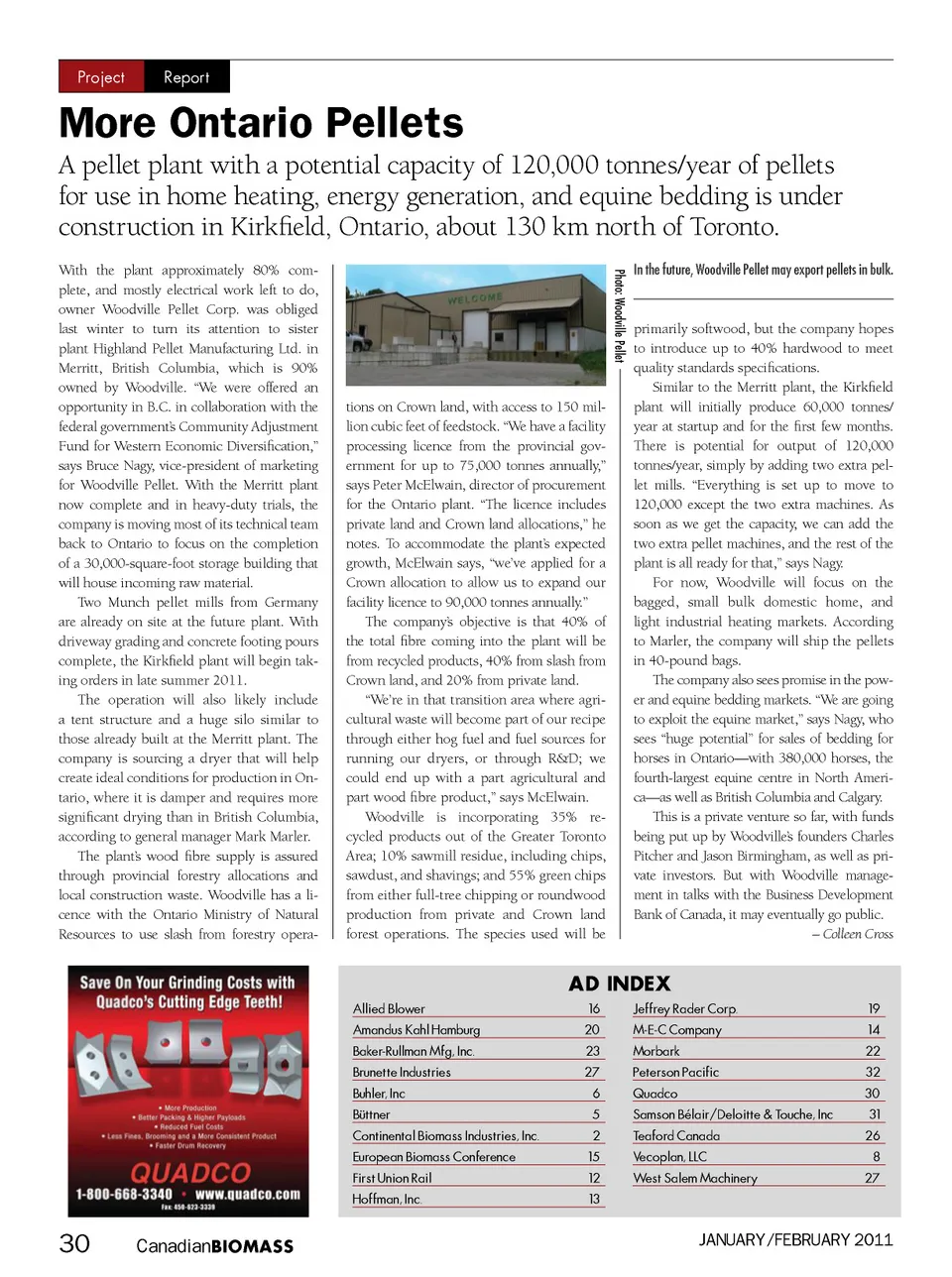
Project Report more ontario pellets A pellet plant with a potential capacity of 120,000 tonnes/year of pellets for use in home heating, energy generation, and equine bedding is under construction in Kirkfield, Ontario, about 130 km north of Toronto. With the plant approximately 80% com-plete, and mostly electrical work left to do, owner Woodville Pellet Corp. was obliged last winter to turn its attention to sister plant Highland Pellet Manufacturing Ltd. in Merritt, British Columbia, which is 90% owned by Woodville. “We were offered an opportunity in B.C. in collaboration with the federal government’s Community Adjustment Fund for Western Economic Diversification,” says Bruce Nagy, vice-president of marketing for Woodville Pellet. With the Merritt plant now complete and in heavy-duty trials, the company is moving most of its technical team back to Ontario to focus on the completion of a 30,000-square-foot storage building that will house incoming raw material. Two Munch pellet mills from Germany are already on site at the future plant. With driveway grading and concrete footing pours complete, the Kirkfield plant will begin tak-ing orders in late summer 2011. The operation will also likely include a tent structure and a huge silo similar to those already built at the Merritt plant. The company is sourcing a dryer that will help create ideal conditions for production in On-tario, where it is damper and requires more significant drying than in British Columbia, according to general manager Mark Marler. The plant’s wood fibre supply is assured through provincial forestry allocations and local construction waste. Woodville has a li-cence with the Ontario Ministry of Natural Resources to use slash from forestry opera-In the future, Woodville Pellet may export pellets in bulk. Photo: Woodville Pellet tions on Crown land, with access to 150 mil-lion cubic feet of feedstock. “We have a facility processing licence from the provincial gov-ernment for up to 75,000 tonnes annually,” says Peter McElwain, director of procurement for the Ontario plant. “The licence includes private land and Crown land allocations,” he notes. To accommodate the plant’s expected growth, McElwain says, “we’ve applied for a Crown allocation to allow us to expand our facility licence to 90,000 tonnes annually.” The company’s objective is that 40% of the total fibre coming into the plant will be from recycled products, 40% from slash from Crown land, and 20% from private land. “We’re in that transition area where agri-cultural waste will become part of our recipe through either hog fuel and fuel sources for running our dryers, or through R&D; we could end up with a part agricultural and part wood fibre product,” says McElwain. Woodville is incorporating 35% re-cycled products out of the Greater Toronto Area; 10% sawmill residue, including chips, sawdust, and shavings; and 55% green chips from either full-tree chipping or roundwood production from private and Crown land forest operations. The species used will be primarily softwood, but the company hopes to introduce up to 40% hardwood to meet quality standards specifications. Similar to the Merritt plant, the Kirkfield plant will initially produce 60,000 tonnes/ year at startup and for the first few months. There is potential for output of 120,000 tonnes/year, simply by adding two extra pel-let mills. “Everything is set up to move to 120,000 except the two extra machines. As soon as we get the capacity, we can add the two extra pellet machines, and the rest of the plant is all ready for that,” says Nagy. For now, Woodville will focus on the bagged, small bulk domestic home, and light industrial heating markets. According to Marler, the company will ship the pellets in 40-pound bags. The company also sees promise in the pow-er and equine bedding markets. “We are going to exploit the equine market,” says Nagy, who sees “huge potential” for sales of bedding for horses in Ontario—with 380,000 horses, the fourth-largest equine centre in North Ameri-ca—as well as British Columbia and Calgary. This is a private venture so far, with funds being put up by Woodville’s founders Charles Pitcher and Jason Birmingham, as well as pri-vate investors. But with Woodville manage-ment in talks with the Business Development Bank of Canada, it may eventually go public. – Colleen Cross AD INDEX Allied Blower Amandus Kahl Hamburg Baker-Rullman Mfg, Inc. Brunette Industries Buhler, Inc Büttner Continental Biomass Industries, Inc. European Biomass Conference First Union Rail Hoffman, Inc. 16 20 23 27 6 5 2 15 12 13 Jeffrey Rader Corp. M-E-C Company Morbark Peterson Pacific Quadco Samson Bélair/Deloitte & Touche, Inc Teaford Canada Vecoplan, LLC West Salem Machinery 19 14 22 32 30 31 26 8 27 30 Canadian BIOMASS JANUARY/FEBRUARY 2011
Canadian Biomass January/February 2011: Page 30