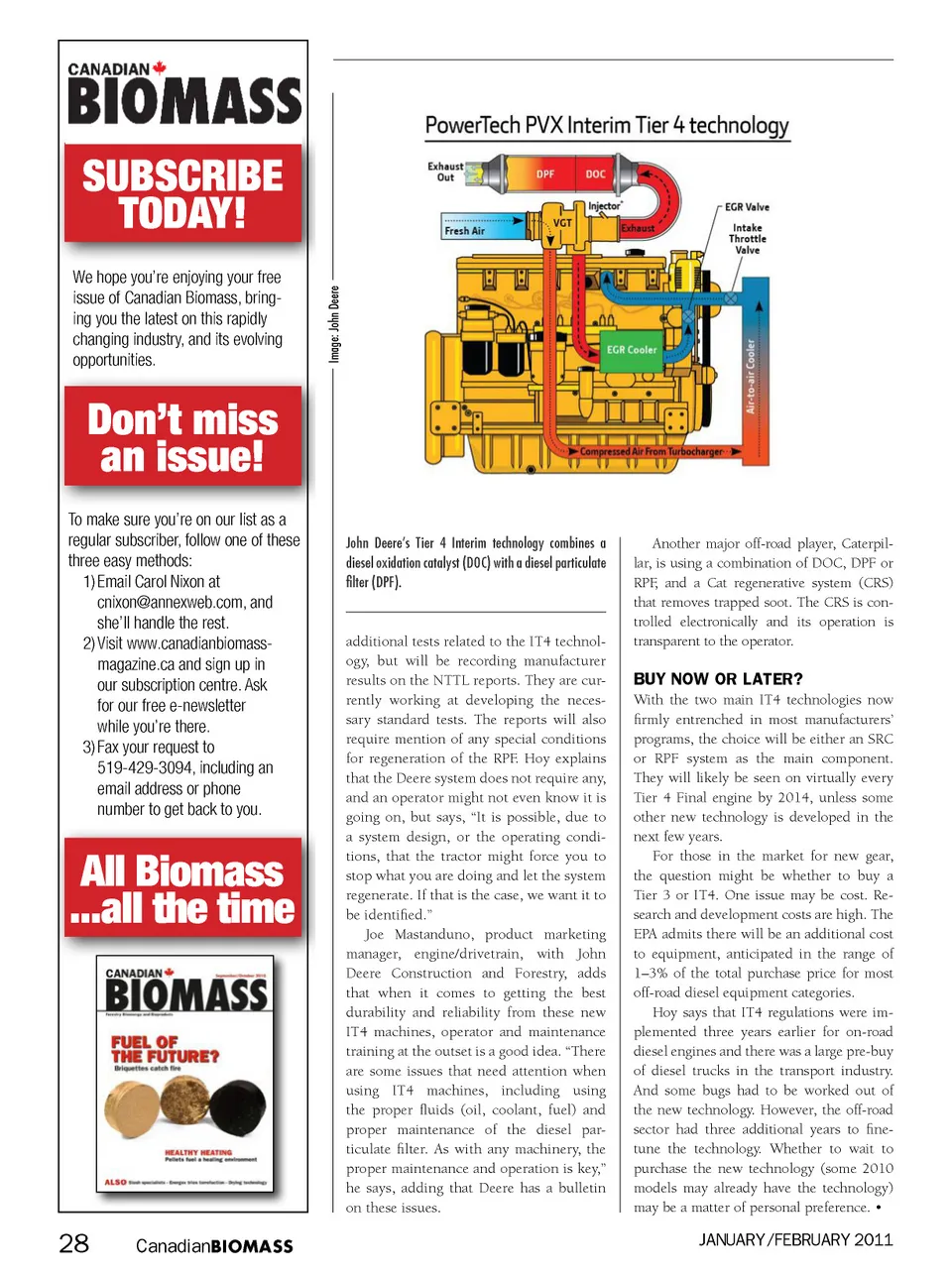
SUBSCRIBE TODAY! We hope you’re enjoying your free issue of Canadian Biomass, bring-ing you the latest on this rapidly changing industry, and its evolving opportunities. Image: John Deere Don’t miss an issue! To make sure you’re on our list as a regular subscriber, follow one of these three easy methods: 1) Email Carol Nixon at [email protected], and she’ll handle the rest. 2) Visit www.canadianbiomass-magazine.ca and sign up in our subscription centre. Ask for our free e-newsletter while you’re there. 3) Fax your request to 519-429-3094, including an email address or phone number to get back to you. John Deere’s T ier 4 Interim technology combines a diesel oxidation catalyst (DOC) with a diesel par ticulate filter (DPF). Another major off-road player, Caterpil-lar, is using a combination of DOC, DPF or RPF , and a Cat regenerative system (CRS) that removes trapped soot. The CRS is con-trolled electronically and its operation is transparent to the operator. Buy now or latEr? With the two main IT4 technologies now firmly entrenched in most manufacturers’ programs, the choice will be either an SRC or RPF system as the main component. They will likely be seen on virtually ever y Tier 4 Final engine by 2014, unless some other new technology is developed in the next few years. For those in the market for new gear, the question might be whether to buy a Tier 3 or IT4. One issue may be cost. Re-search and development costs are high. The EPA admits there will be an additional cost to equipment, anticipated in the range of 1–3% of the total purchase price for most off-road diesel equipment categories. Hoy says that IT4 regulations were im-plemented three years earlier for on-road diesel engines and there was a large pre-buy of diesel trucks in the transport industry. And some bugs had to be worked out of the new technology. However, the off-road sector had three additional years to fine-tune the technology. Whether to wait to purchase the new technology (some 2010 models may already have the technology) may be a matter of personal preference. • JANUARY/FEBRUARY 2011 All Biomass ...all the time a d d i t i o n a l t e s t s re l a t e d t o t h e I T 4 t e c h n o l -ogy, but will be recording manufacturer results on the NTTL reports. They are cur-re n t l y w o r k i n g a t d e v e l o p i n g t h e n e c e s -sary standard tests. The reports will also re q u i re m e n t i o n o f a n y s p e c i a l c o n d i t i o n s for regeneration of the RPF. Hoy explains that the Deere system does not require any, and an operator might not even know it is going on, but says, “It is possible, due to a system design, or the operating condi-tions, that the tractor might force you to s t o p w h a t y o u a re d o i n g a n d l e t t h e s y s t e m re g e n e r a t e . I f t h a t i s t h e c a s e , w e w a n t i t t o be identified.” Joe Mastanduno, product marketing manager, engine/drivetrain, with John Deere Construction and Forestry, adds that when it comes to getting the best durability and reliability from these new IT4 machines, operator and maintenance t r a i n i n g a t t h e o u t s e t i s a g o o d i d e a . “ T h e re a re s o m e i s s u e s t h a t n e e d a t t e n t i o n w h e n using IT4 machines, including using the proper fluids (oil, coolant, fuel) and proper maintenance of the diesel par-ticulate filter. As with any machinery, the proper maintenance and operation is key,” h e s a y s , a d d i n g t h a t D e e re h a s a b u l l e t i n on these issues. 28 Canadian BIOMASS 16/11/10 3:46 PM Cdn Biomass Subscription.indd 1
Canadian Biomass January/February 2011: Page 28