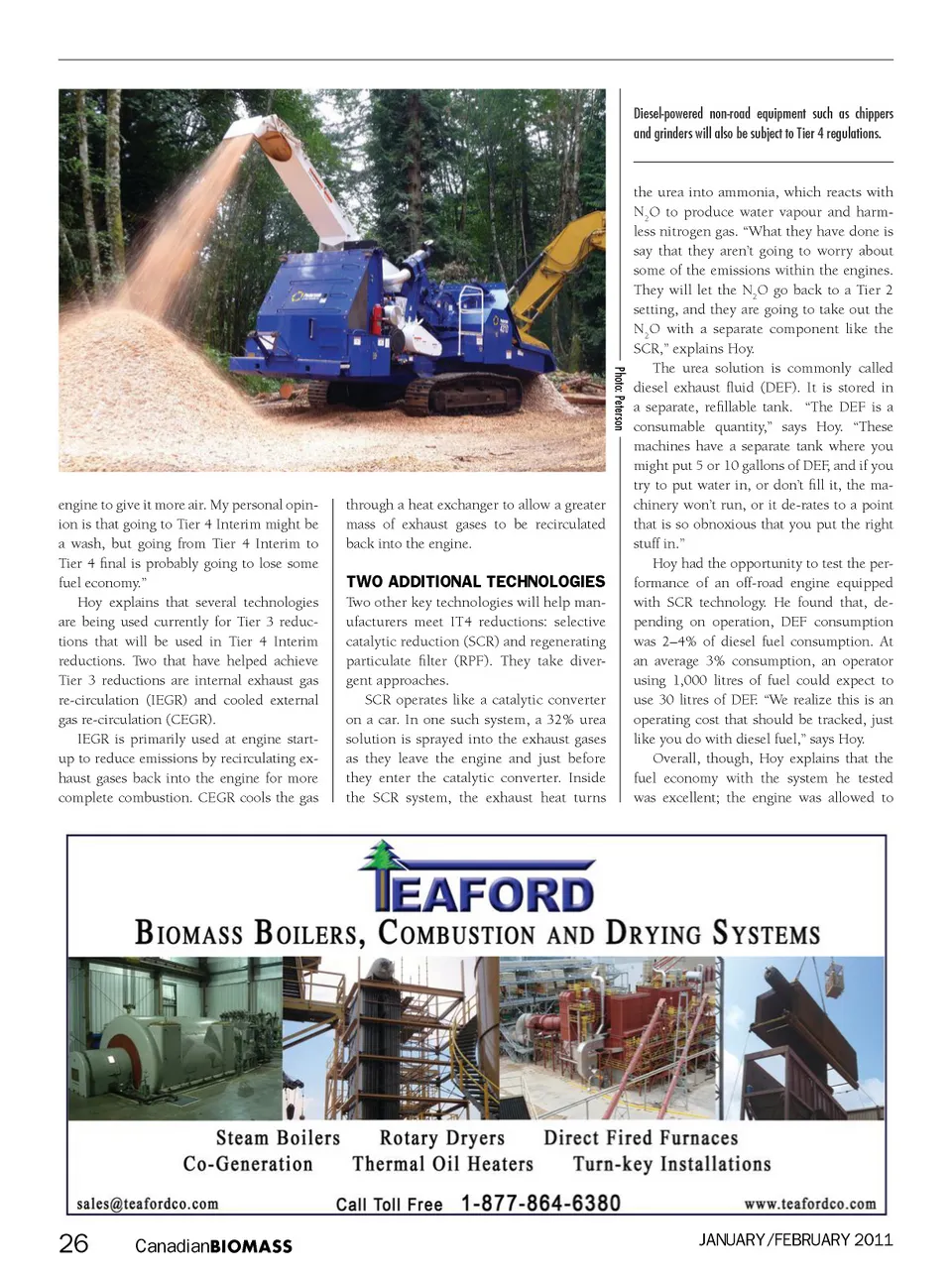
Diesel-powered non-road equipment such as chippers and grinders will also be subject to Tier 4 regulations. engine to give it more air. My personal opin-ion is that going to Tier 4 Interim might be a wash, but going from Tier 4 Interim to Tier 4 final is probably going to lose some fuel economy.” Hoy explains that several technologies are being used currently for Tier 3 reduc-tions that will be used in Tier 4 Interim reductions. Two that have helped achieve Tier 3 reductions are internal exhaust gas re-circulation (IEGR) and cooled external gas re-circulation (CEGR). IEGR is primarily used at engine start-up to reduce emissions by recirculating ex-haust gases back into the engine for more complete combustion. CEGR cools the gas through a heat exchanger to allow a greater mass of exhaust gases to be recirculated back into the engine. two additional tEchnologiEs Two other key technologies will help man-u f a c t u re r s m e e t I T 4 re d u c t i o n s : s e l e c t i v e c a t a l y t i c re d u c t i o n ( S C R ) a n d re g e n e r a t i n g particulate filter (RPF). They take diver-gent approaches. SCR operates like a catalytic converter on a car. In one such system, a 32% urea solution is sprayed into the exhaust gases a s t h e y l e a v e t h e e n g i n e a n d j u s t b e f o re they enter the catalytic converter. Inside the SCR system, the exhaust heat tur ns t h e u re a i n t o a m m o n i a , w h i c h re a c t s w i t h N 2 O to produce water vapour and harm-less nitrogen gas. “What they have done is say that they aren’t going to worry about some of the emissions within the engines. They will let the N 2 O go back to a Tier 2 s e t t i n g , a n d t h e y a re g o i n g t o t a k e o u t t h e N 2 O w i t h a s e p a r a t e c o m p o n e n t l i k e t h e SCR,” explains Hoy. The urea solution is commonly called diesel exhaust fluid (DEF). It is stored in a separate, refillable tank. “The DEF is a consumable quantity,” says Hoy. “These machines have a separate tank where you might put 5 or 10 gallons of DEF, and if you try to put water in, or don’t fill it, the ma-chinery won’t run, or it de-rates to a point that is so obnoxious that you put the right stuff in.” Hoy had the opportunity to test the per-formance of an off-road engine equipped with SCR technology. He found that, de-pending on operation, DEF consumption was 2–4% of diesel fuel consumption. At an average 3% consumption, an operator using 1,000 litres of fuel could expect to use 30 litres of DEF. “We realize this is an operating cost that should be tracked, just like you do with diesel fuel,” says Hoy. Overall, though, Hoy explains that the fuel economy with the system he tested was excellent; the engine was allowed to Photo: Peterson 26 Canadian BIOMASS JANUARY/FEBRUARY 2011
Canadian Biomass January/February 2011: Page 26