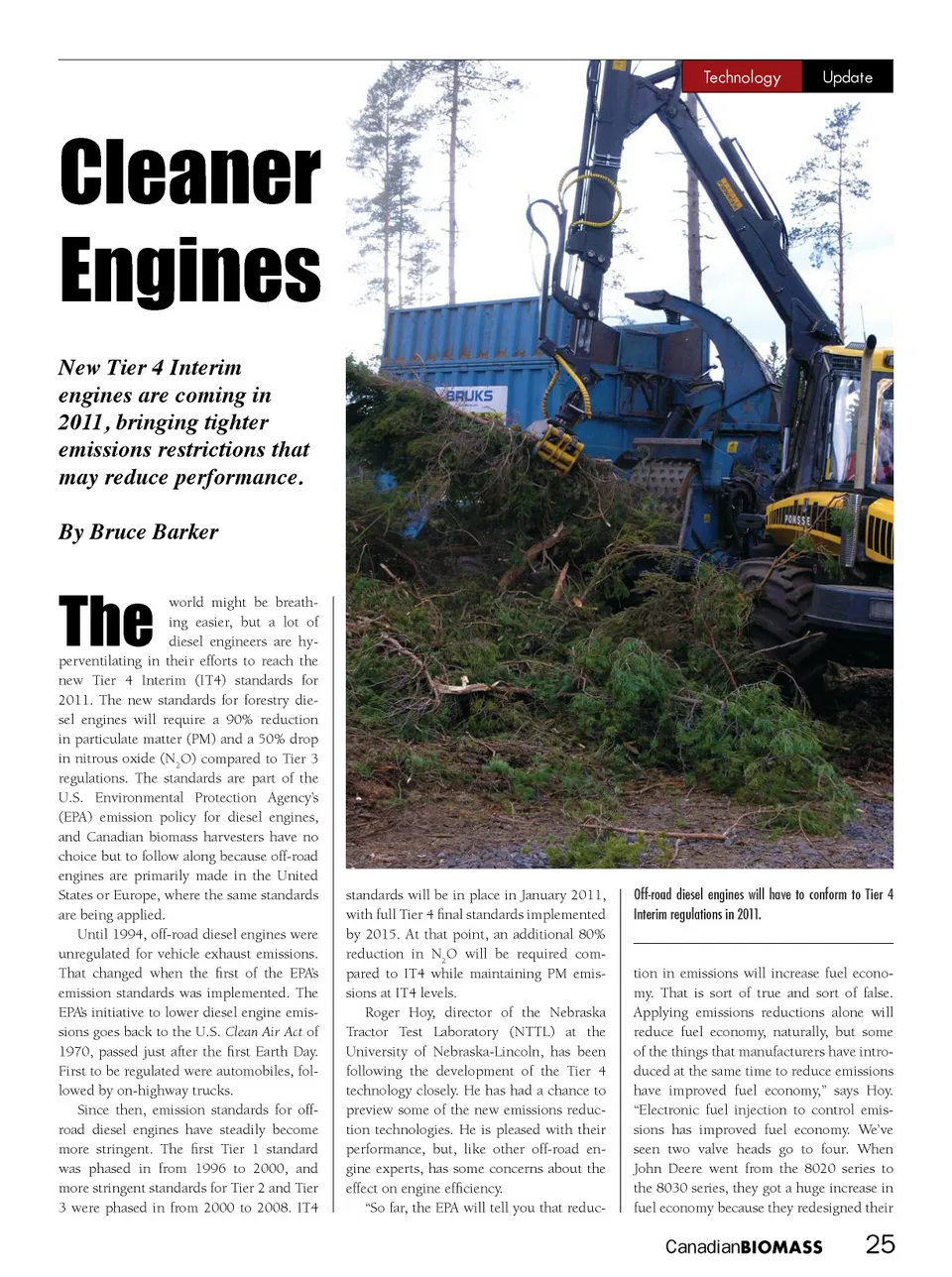
Technology Update Cleaner Engines New Tier 4 Interim engines are coming in 2011, bringing tighter emissions restrictions that may reduce performance. By Bruce Barker world might be breath-ing easier, but a lot of diesel engineers are hy-perventilating in their efforts to reach the new Tier 4 Interim (IT4) standards for 2011. The new standards for forestry die-sel engines will require a 90% reduction in particulate matter (PM) and a 50% drop in nitrous oxide (N 2 O) compared to Tier 3 regulations. The standards are part of the U.S. Environmental Protection Agency’s (EPA) emission policy for diesel engines, and Canadian biomass har vesters have no choice but to follow along because off-road engines are primarily made in the United States or Europe, where the same standards are being applied. Until 1994, off-road diesel engines were unregulated for vehicle exhaust emissions. That changed when the first of the EPA’s emission standards was implemented. The EPA’s initiative to lower diesel engine emis-sions goes back to the U.S. Clean Air Act of 1970, passed just after the first Earth Day. First to be regulated were automobiles, fol-lowed by on-highway trucks. Since then, emission standards for off-road diesel engines have steadily become more stringent. The first Tier 1 standard was phased in from 1996 to 2000, and more stringent standards for Tier 2 and Tier 3 were phased in from 2000 to 2008. IT4 the standards will be in place in January 2011, with full Tier 4 final standards implemented by 2015. At that point, an additional 80% reduction in N 2 O will be required com-pared to IT4 while maintaining PM emis-sions at IT4 levels. Roger Hoy, director of the Nebraska Tractor Test Laboratory (NTTL) at the University of Nebraska-Lincoln, has been following the development of the Tier 4 technology closely. He has had a chance to preview some of the new emissions reduc-tion technologies. He is pleased with their performance, but, like other off-road en-gine experts, has some concer ns about the effect on engine efficiency. “So far, the EPA will tell you that reduc-Off-road diesel engines will have to conform to Tier 4 Interim regulations in 2011. tion in emissions will increase fuel econo-my. That is sort of true and sort of false. Applying emissions reductions alone will reduce fuel economy, naturally, but some of the things that manufacturers have intro-duced at the same time to reduce emissions have improved fuel economy,” says Hoy. “Electronic fuel injection to control emis-sions has improved fuel economy. We’ve seen two valve heads go to four. When John Deere went from the 8020 series to the 8030 series, they got a huge increase in fuel economy because they redesigned their Canadian BIOMASS 25
Canadian Biomass January/February 2011: Page 25