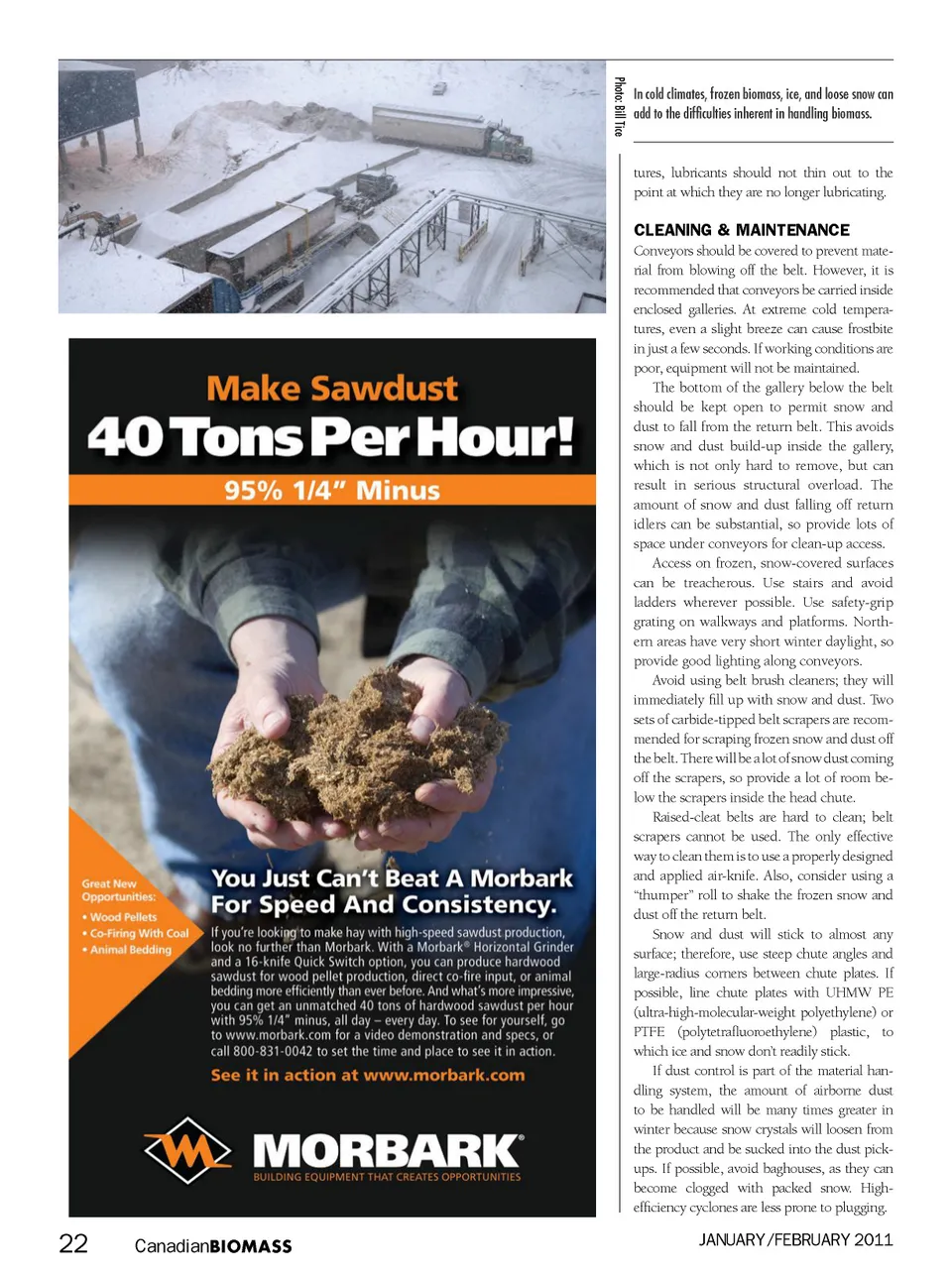
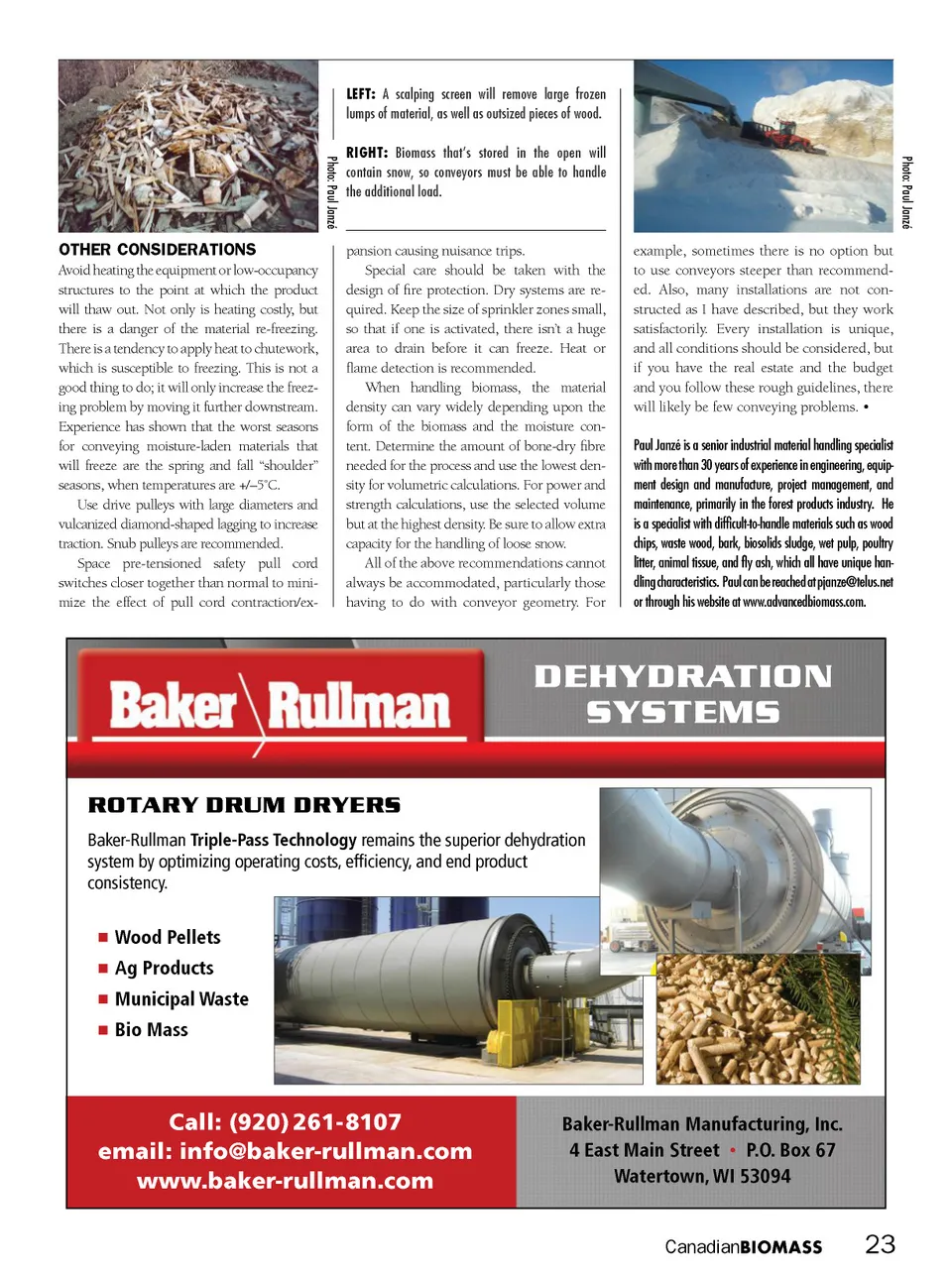
lEfT: A scalping screen will remove large frozen l u m p s o f m a t e r i a l , a s w e l l a s o u t s i z e d p i e c e s o f wo o d . RIGhT: Biomass that’s stored in the open will contain snow, so conveyor s must be able to handle the additional load. Photo: Paul Janzé Photo: Paul Janzé othEr considErations Avoid heating the equipment or low-occupancy structures to the point at which the product will thaw out. Not only is heating costly, but there is a danger of the material re-freezing. There is a tendency to apply heat to chutework, which is susceptible to freezing. This is not a good thing to do; it will only increase the freez-ing problem by moving it further downstream. Experience has shown that the worst seasons for conveying moisture-laden materials that will freeze are the spring and fall “shoulder” seasons, when temperatures are +/–5˚C. Use drive pulleys with large diameters and vulcanized diamond-shaped lagging to increase traction. Snub pulleys are recommended. Space pre-tensioned safety pull cord switches closer together than normal to mini-mize the effect of pull cord contraction/ex-pansion causing nuisance trips. Special care should be taken with the design of fire protection. Dry systems are re-quired. Keep the size of sprinkler zones small, so that if one is activated, there isn’t a huge area to drain before it can freeze. Heat or flame detection is recommended. When handling biomass, the material density can vary widely depending upon the form of the biomass and the moisture con-tent. Determine the amount of bone-dry fibre needed for the process and use the lowest den-sity for volumetric calculations. For power and strength calculations, use the selected volume but at the highest density. Be sure to allow extra capacity for the handling of loose snow. All of the above recommendations cannot always be accommodated, particularly those having to do with conveyor geometry. For example, sometimes there is no option but to use conveyors steeper than recommend-ed. Also, many installations are not con-structed as I have described, but they work satisfactorily. Every installation is unique, and all conditions should be considered, but if you have the real estate and the budget and you follow these rough guidelines, there will likely be few conveying problems. • Paul Janzé is a senior industrial material handling specialist with more than 30 years of experience in engineering, equip-ment design and manufacture, project management, and maintenance, primarily in the forest products industry. He is a specialist with difficult-to-handle materials such as wood chips, waste wood, bark, biosolids sludge, wet pulp, poultry litter, animal tissue, and fly ash, which all have unique han-dling characteristics. Paul can be reached at [email protected] or through his website at www.advancedbiomass.com. D E H Y D R AT I O N S YS TEMS R O TA R Y D R U M D R Y E R S Baker-Rullman Triple-Pass Technology remains the superior dehydration system by optimizing operating costs, efficiency, and end product consistency. n n n n Wood Pellets Ag Products Municipal Waste Bio Mass Call: (920) 261-8107 email: [email protected] www.baker-rullman.com Baker-Rullman Manufacturing, Inc. 4 East Main Street • P.O. Box 67 Watertown, WI 53094 Canadian BIOMASS 23
Canadian Biomass January/February 2011: Page 23