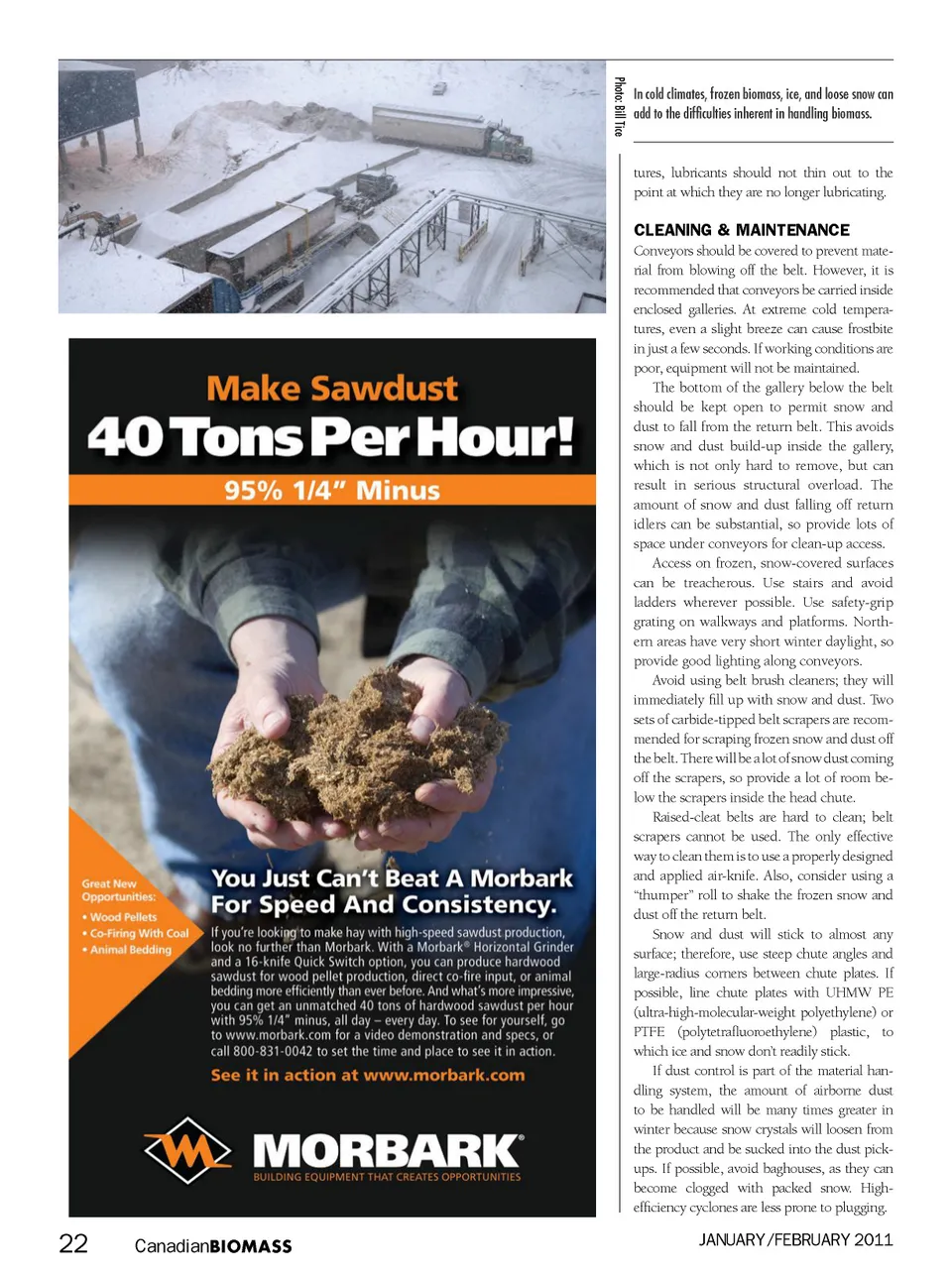
Photo: Bill Tice In cold climates, frozen biomass, ice, and loose snow can add to the difficulties inherent in handling biomass. tures, lubricants should not thin out to the point at which they are no longer lubricating. clEaning & maintEnancE Conveyors should be covered to prevent mate-rial from blowing off the belt. However, it is recommended that conveyors be carried inside enclosed galleries. At extreme cold tempera-tures, even a slight breeze can cause frostbite in just a few seconds. If working conditions are poor, equipment will not be maintained. The bottom of the gallery below the belt should be kept open to permit snow and dust to fall from the return belt. This avoids snow and dust build-up inside the gallery, which is not only hard to remove, but can result in serious structural overload. The amount of snow and dust falling off return idlers can be substantial, so provide lots of space under conveyors for clean-up access. Access on frozen, snow-covered surfaces can be treacherous. Use stairs and avoid ladders wherever possible. Use safety-grip grating on walkways and platforms. North-ern areas have very short winter daylight, so provide good lighting along conveyors. Avoid using belt brush cleaners; they will immediately fill up with snow and dust. Two sets of carbide-tipped belt scrapers are recom-mended for scraping frozen snow and dust off the belt. There will be a lot of snow dust coming off the scrapers, so provide a lot of room be-low the scrapers inside the head chute. Raised-cleat belts are hard to clean; belt scrapers cannot be used. The only effective way to clean them is to use a properly designed and applied air-knife. Also, consider using a “thumper” roll to shake the frozen snow and dust off the return belt. Snow and dust will stick to almost any surface; therefore, use steep chute angles and large-radius corners between chute plates. If possible, line chute plates with UHMW PE (ultra-high-molecular-weight polyethylene) or PTFE (polytetrafluoroethylene) plastic, to which ice and snow don’t readily stick. If dust control is part of the material han-dling system, the amount of airborne dust to be handled will be many times greater in winter because snow crystals will loosen from the product and be sucked into the dust pick-ups. If possible, avoid baghouses, as they can become clogged with packed snow. High-efficiency cyclones are less prone to plugging. 22 Canadian BIOMASS JANUARY/FEBRUARY 2011
Canadian Biomass January/February 2011: Page 22