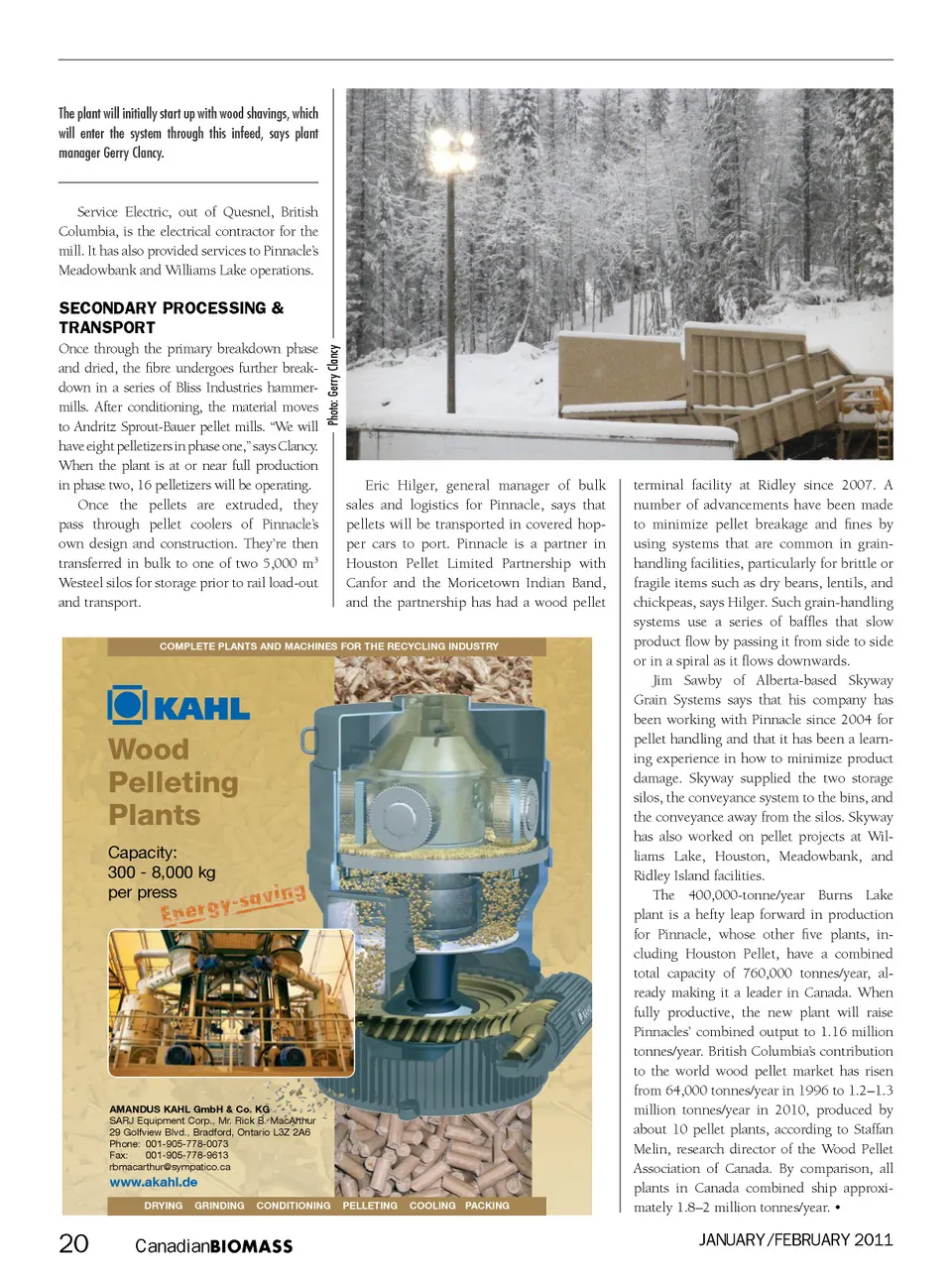
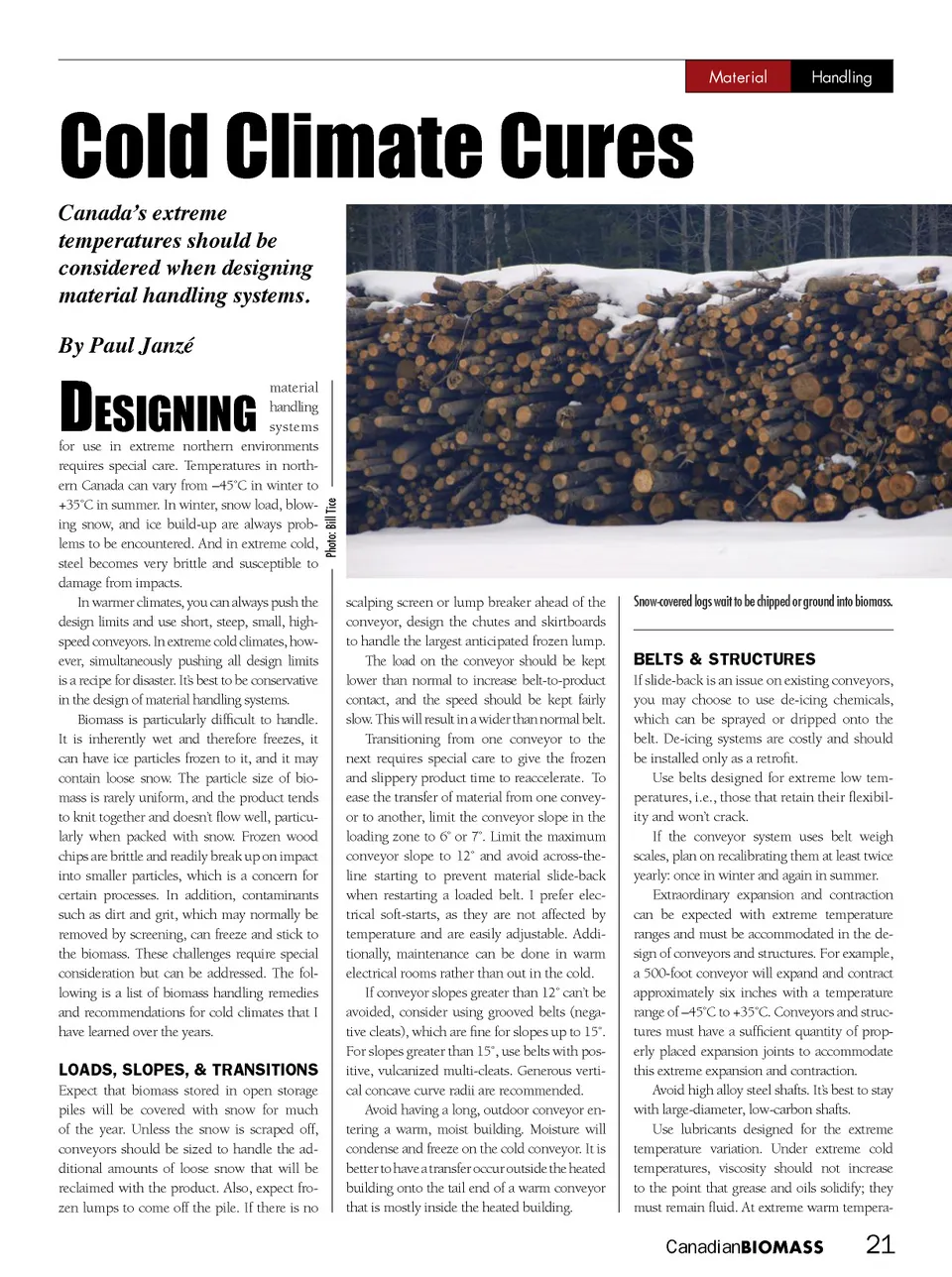
Cold Climate Cures Canada’s extreme temperatures should be considered when designing material handling systems. By Paul Janzé material handling systems for use in extreme northern environments requires special care. Temperatures in north-ern Canada can vary from –45˚C in winter to +35˚C in summer. In winter, snow load, blow-ing snow, and ice build-up are always prob-lems to be encountered. And in extreme cold, steel becomes very brittle and susceptible to damage from impacts. In warmer climates, you can always push the design limits and use short, steep, small, high-speed conveyors. In extreme cold climates, how-ever, simultaneously pushing all design limits is a recipe for disaster. It’s best to be conservative in the design of material handling systems. Biomass is particularly difficult to handle. It is inherently wet and therefore freezes, it can have ice particles frozen to it, and it may contain loose snow. The particle size of bio-mass is rarely uniform, and the product tends to knit together and doesn’t flow well, particu-larly when packed with snow. Frozen wood chips are brittle and readily break up on impact into smaller particles, which is a concern for certain processes. In addition, contaminants such as dirt and grit, which may normally be removed by screening, can freeze and stick to the biomass. These challenges require special consideration but can be addressed. The fol-lowing is a list of biomass handling remedies and recommendations for cold climates that I have learned over the years. loads, slopEs, & transitions Expect that biomass stored in open storage piles will be covered with snow for much of the year. Unless the snow is scraped off, conveyors should be sized to handle the ad-ditional amounts of loose snow that will be reclaimed with the product. Also, expect fro-zen lumps to come off the pile. If there is no Material Handling D esigning Photo: Bill Tice scalping screen or lump breaker ahead of the conveyor, design the chutes and skirtboards to handle the largest anticipated frozen lump. The load on the conveyor should be kept lower than normal to increase belt-to-product contact, and the speed should be kept fairly slow. This will result in a wider than normal belt. Transitioning from one conveyor to the next requires special care to give the frozen and slippery product time to reaccelerate. To ease the transfer of material from one convey-or to another, limit the conveyor slope in the loading zone to 6˚ or 7˚. Limit the maximum conveyor slope to 12˚ and avoid across-the-line starting to prevent material slide-back when restarting a loaded belt. I prefer elec-trical soft-starts, as they are not affected by temperature and are easily adjustable. Addi-tionally, maintenance can be done in warm electrical rooms rather than out in the cold. If conveyor slopes greater than 12˚ can’t be avoided, consider using grooved belts (nega-tive cleats), which are fine for slopes up to 15˚. For slopes greater than 15˚, use belts with pos-itive, vulcanized multi-cleats. Generous verti-cal concave curve radii are recommended. Avoid having a long, outdoor conveyor en-tering a warm, moist building. Moisture will condense and freeze on the cold conveyor. It is better to have a transfer occur outside the heated building onto the tail end of a warm conveyor that is mostly inside the heated building. Snow-covered logs wait to be chipped or ground into biomass. BElts & structurEs If slide-back is an issue on existing conveyors, you may choose to use de-icing chemicals, which can be sprayed or dripped onto the belt. De-icing systems are costly and should be installed only as a retrofit. Use belts designed for extreme low tem-peratures, i.e., those that retain their flexibil-ity and won’t crack. If the conveyor system uses belt weigh scales, plan on recalibrating them at least twice yearly: once in winter and again in summer. Extraordinary expansion and contraction can be expected with extreme temperature ranges and must be accommodated in the de-sign of conveyors and structures. For example, a 500-foot conveyor will expand and contract approximately six inches with a temperature range of –45˚C to +35˚C. Conveyors and struc-tures must have a sufficient quantity of prop-erly placed expansion joints to accommodate this extreme expansion and contraction. Avoid high alloy steel shafts. It’s best to stay with large-diameter, low-carbon shafts. Use lubricants designed for the extreme temperature variation. Under extreme cold temperatures, viscosity should not increase to the point that grease and oils solidify; they must remain fluid. At extreme warm tempera-Canadian BIOMASS 21
Canadian Biomass January/February 2011: Page 21