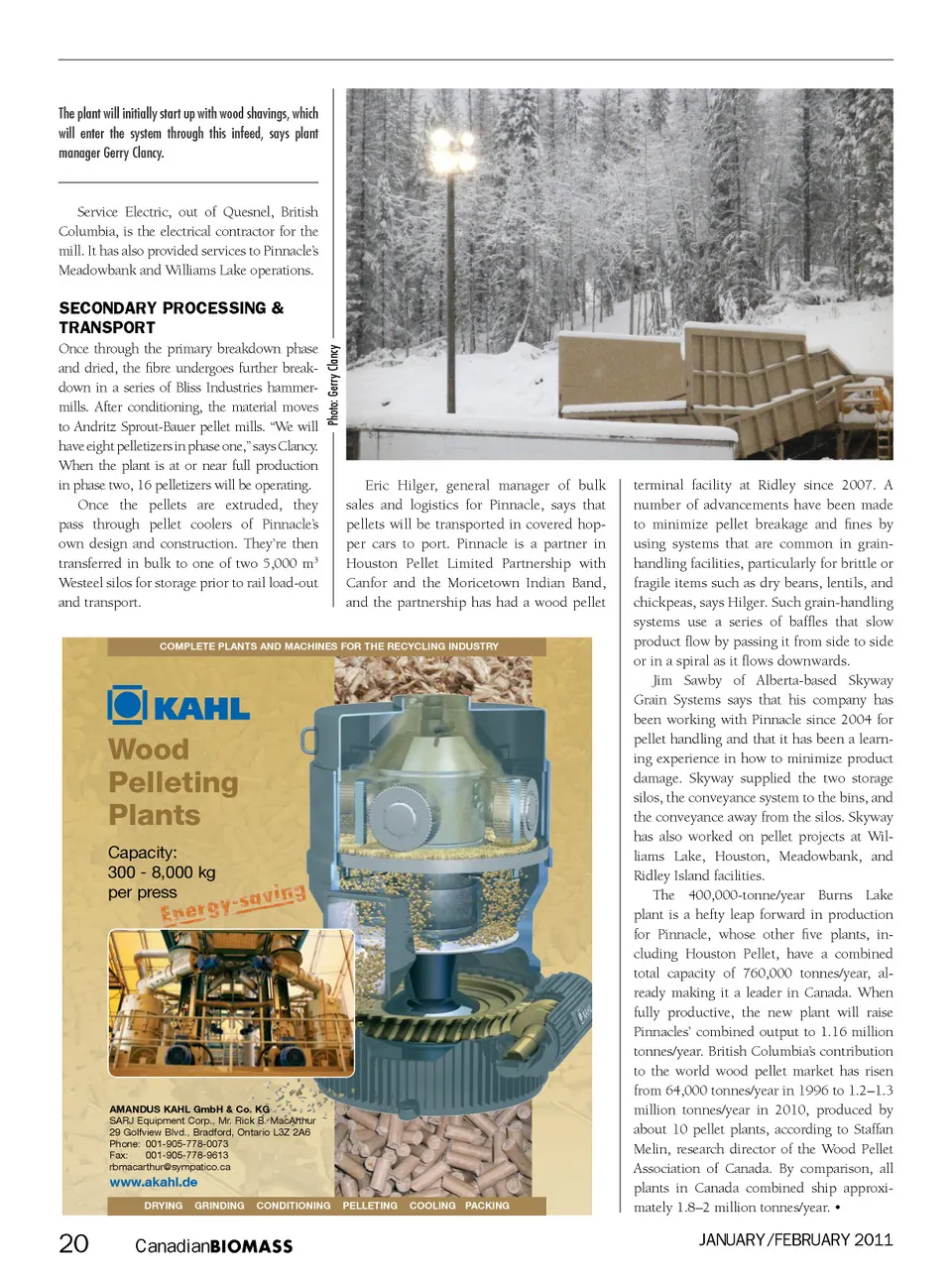
The plant will initially start up with wood shavings, which will enter the system through this infeed, says plant manager Gerry Clancy. Service Electric, out of Quesnel, British Columbia, is the electrical contractor for the mill. It has also provided services to Pinnacle’s Meadowbank and Williams Lake operations. sEcondary procEssing & transport Once through the primary breakdown phase and dried, the fibre undergoes further break-down in a series of Bliss Industries hammer-mills. After conditioning, the material moves to Andritz Sprout-Bauer pellet mills. “We will have eight pelletizers in phase one,” says Clancy. When the plant is at or near full production in phase two, 16 pelletizers will be operating. Once the pellets are extruded, they pass through pellet coolers of Pinnacle’s own design and construction. They’re then transferred in bulk to one of two 5,000 m 3 Westeel silos for storage prior to rail load-out and transport. Photo: Gerry Clancy Eric Hilger, general manager of bulk sales and logistics for Pinnacle, says that pellets will be transported in covered hop-per cars to port. Pinnacle is a partner in Houston Pellet Limited Partnership with Canfor and the Moricetown Indian Band, and the partnership has had a wood pellet COMPLETE PLANTS AND MACHINES FOR THE RECYCLING INDUSTRY Wood Pelleting Plants Capacity: 300 -8,000 kg per press AMANDUS KAHL GmbH & Co. KG SARJ Equipment Corp., Mr. Rick B. MacArthur 29 Golfview Blvd., Bradford, Ontario L3Z 2A6 Phone: 001-905-778-0073 Fax: 001-905-778-9613 [email protected] www.akahl.de DRYING GRINDING CONDITIONING PELLETING COOLING PACKING terminal facility at Ridley since 2007. A number of advancements have been made to minimize pellet breakage and fines by using systems that are common in grain-handling facilities, particularly for brittle or fragile items such as dr y beans, lentils, and chickpeas, says Hilger. Such grain-handling systems use a series of baffles that slow product flow by passing it from side to side or in a spiral as it flows downwards. Jim Sawby of Alberta-based Skyway Grain Systems says that his company has been working with Pinnacle since 2004 for pellet handling and that it has been a learn-ing experience in how to minimize product damage. Skyway supplied the two storage silos, the conveyance system to the bins, and the conveyance away from the silos. Skyway has also worked on pellet projects at Wil-liams Lake, Houston, Meadowbank, and Ridley Island facilities. The 400,000-tonne/year Burns Lake plant is a hefty leap forward in production for Pinnacle, whose other five plants, in-cluding Houston Pellet, have a combined total capacity of 760,000 tonnes/year, al-ready making it a leader in Canada. When fully productive, the new plant will raise Pinnacles’ combined output to 1.16 million tonnes/year. British Columbia’s contribution to the world wood pellet market has risen from 64,000 tonnes/year in 1996 to 1.2–1.3 million tonnes/year in 2010, produced by about 10 pellet plants, according to Staffan Melin, research director of the Wood Pellet Association of Canada. By comparison, all plants in Canada combined ship approxi-mately 1.8–2 million tonnes/year. • JANUARY/FEBRUARY 2011 20 Canadian BIOMASS
Canadian Biomass January/February 2011: Page 20