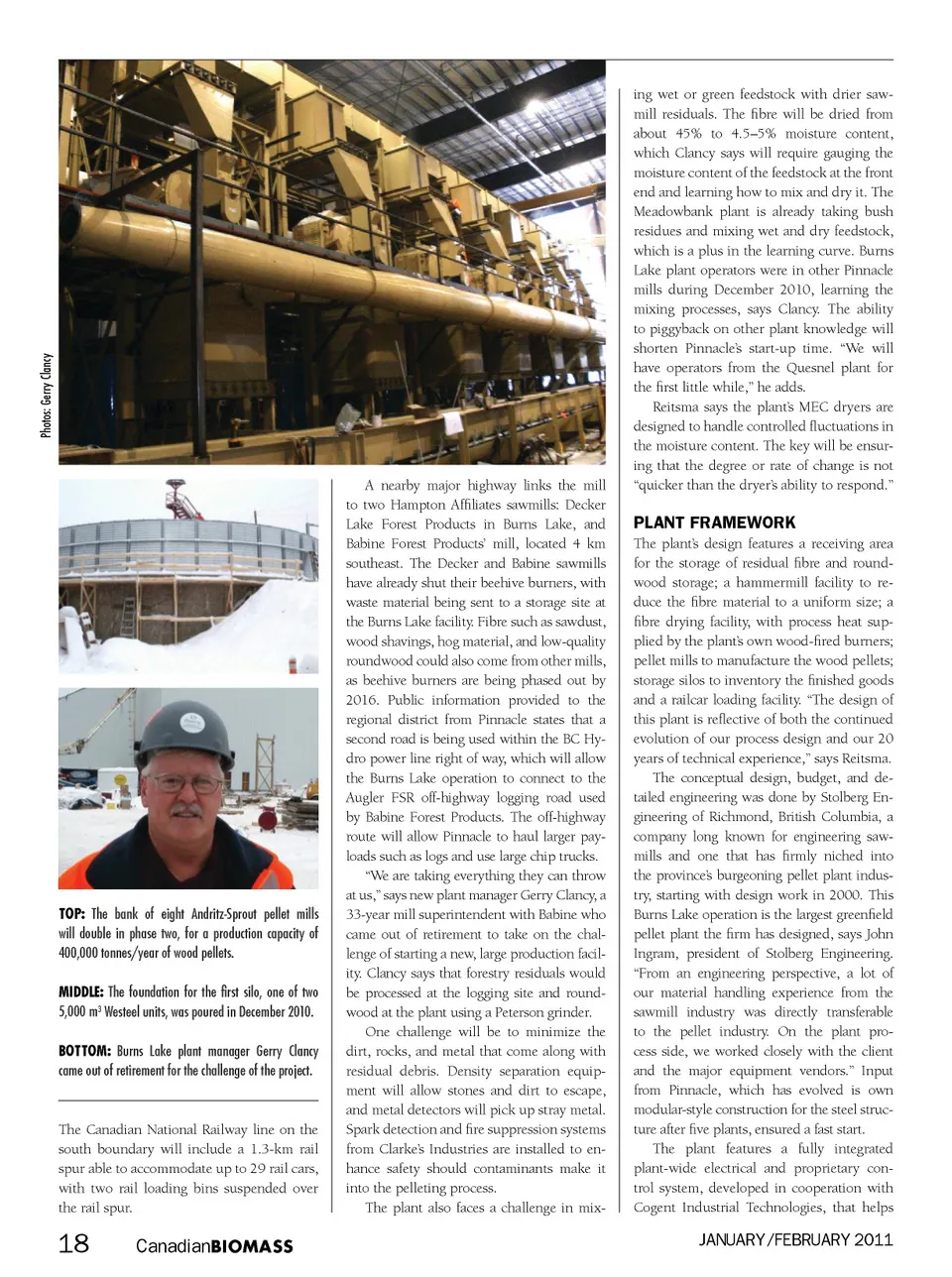
TOP: The bank of eight Andritz-Sprout pellet mills will double in phase two, for a production capacity of 400,000 tonnes/year of wood pellets. MIDDlE: The foundation for the first silo, one of two 5,000 m 3 Westeel units, was poured in December 2010. BOTTOM: Burns Lake plant manager Gerry Clancy came out of retirement for the challenge of the project. The Canadian National Railway line on the south boundary will include a 1.3-km rail spur able to accommodate up to 29 rail cars, with two rail loading bins suspended over the rail spur. A nearby major highway links the mill to two Hampton Affiliates sawmills: Decker Lake Forest Products in Burns Lake, and Babine Forest Products’ mill, located 4 km southeast. The Decker and Babine sawmills have already shut their beehive burners, with waste material being sent to a storage site at the Burns Lake facility. Fibre such as sawdust, wood shavings, hog material, and low-quality roundwood could also come from other mills, as beehive burners are being phased out by 2016. Public information provided to the regional district from Pinnacle states that a second road is being used within the BC Hy-dro power line right of way, which will allow the Burns Lake operation to connect to the Augler FSR off-highway logging road used by Babine Forest Products. The off-highway route will allow Pinnacle to haul larger pay-loads such as logs and use large chip trucks. “We are taking everything they can throw at us,” says new plant manager Gerry Clancy, a 33-year mill superintendent with Babine who came out of retirement to take on the chal-lenge of starting a new, large production facil-ity. Clancy says that forestry residuals would be processed at the logging site and round-wood at the plant using a Peterson grinder. One challenge will be to minimize the dirt, rocks, and metal that come along with residual debris. Density separation equip-ment will allow stones and dirt to escape, and metal detectors will pick up stray metal. Spark detection and fire suppression systems from Clarke’s Industries are installed to en-hance safety should contaminants make it into the pelleting process. The plant also faces a challenge in mix-ing wet or green feedstock with drier saw-mill residuals. The fibre will be dried from about 45% to 4.5–5% moisture content, which Clancy says will require gauging the moisture content of the feedstock at the front end and learning how to mix and dry it. The Meadowbank plant is already taking bush residues and mixing wet and dry feedstock, which is a plus in the learning curve. Burns Lake plant operators were in other Pinnacle mills during December 2010, learning the mixing processes, says Clancy. The ability to piggyback on other plant knowledge will shorten Pinnacle’s start-up time. “We will have operators from the Quesnel plant for the first little while,” he adds. Reitsma says the plant’s MEC dryers are designed to handle controlled fluctuations in the moisture content. The key will be ensur-ing that the degree or rate of change is not “quicker than the dryer’s ability to respond.” plant framEwork The plant’s design features a receiving area for the storage of residual fibre and round-wood storage; a hammermill facility to re-duce the fibre material to a uniform size; a fibre drying facility, with process heat sup-plied by the plant’s own wood-fired burners; pellet mills to manufacture the wood pellets; storage silos to inventory the finished goods and a railcar loading facility. “The design of this plant is reflective of both the continued evolution of our process design and our 20 years of technical experience,” says Reitsma. The conceptual design, budget, and de-tailed engineering was done by Stolberg En-gineering of Richmond, British Columbia, a company long known for engineering saw-mills and one that has firmly niched into the province’s burgeoning pellet plant indus-try, starting with design work in 2000. This Burns Lake operation is the largest greenfield pellet plant the firm has designed, says John Ingram, president of Stolberg Engineering. “From an engineering perspective, a lot of our material handling experience from the sawmill industry was directly transferable to the pellet industry. On the plant pro-cess side, we worked closely with the client and the major equipment vendors.” Input from Pinnacle, which has evolved is own modular-style construction for the steel struc-ture after five plants, ensured a fast start. The plant features a fully integrated plant-wide electrical and proprietary con-trol system, developed in cooperation with Cogent Industrial Technologies, that helps JANUARY/FEBRUARY 2011 Photos: Gerry Clancy 18 Canadian BIOMASS
Canadian Biomass January/February 2011: Page 18