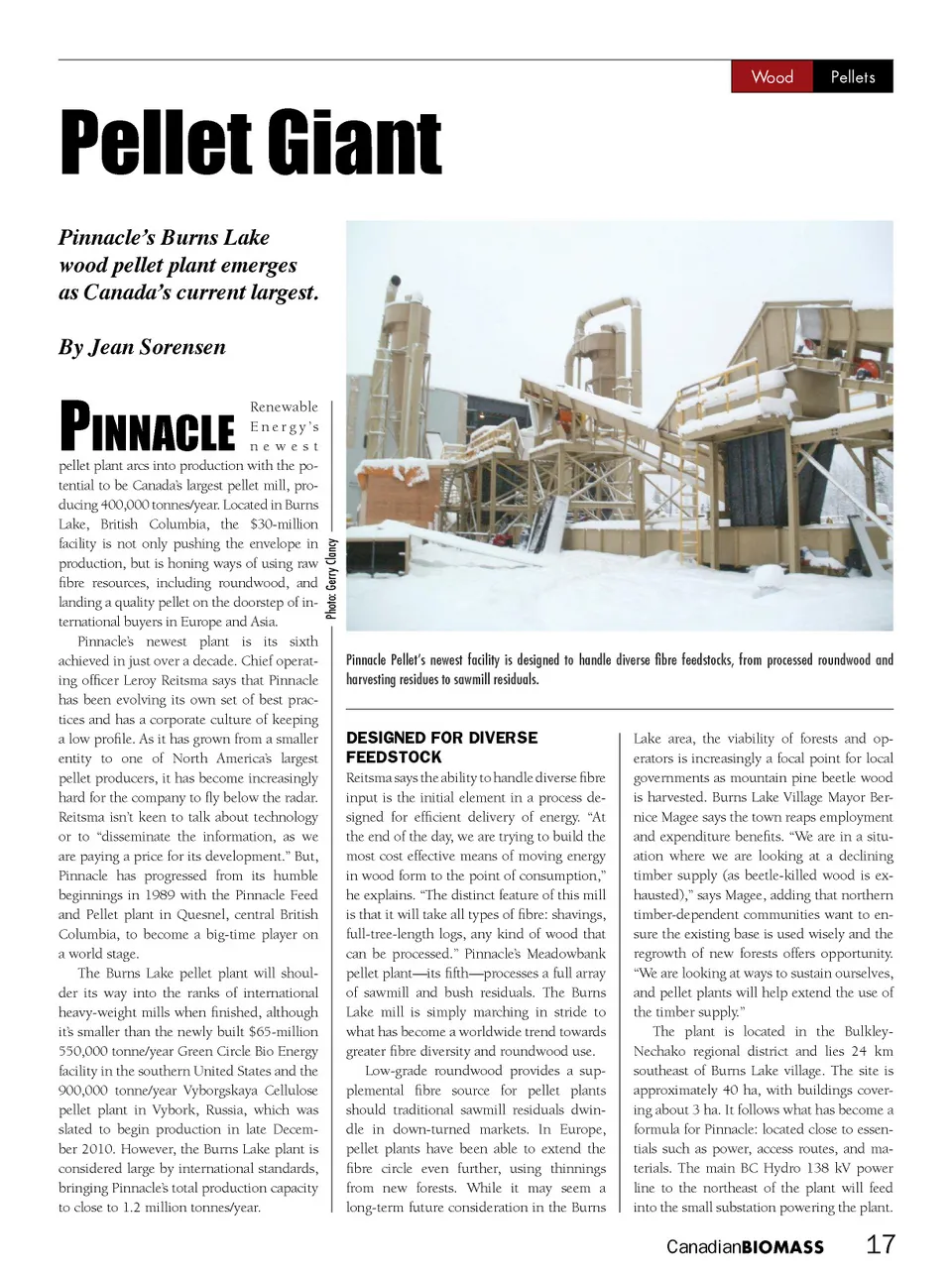
Pellet Giant Pinnacle’s Burns Lake wood pellet plant emerges as Canada’s current largest. By Jean Sorensen Renewable E n e r g y ’s newest pellet plant arcs into production with the po-tential to be Canada’s largest pellet mill, pro-ducing 400,000 tonnes/year. Located in Burns Lake, British Columbia, the $30-million facility is not only pushing the envelope in production, but is honing ways of using raw fibre resources, including roundwood, and landing a quality pellet on the doorstep of in-ternational buyers in Europe and Asia. Pinnacle’s newest plant is its sixth achieved in just over a decade. Chief operat-ing officer Leroy Reitsma says that Pinnacle has been evolving its own set of best prac-tices and has a corporate culture of keeping a low profile. As it has grown from a smaller entity to one of North America’s largest pellet producers, it has become increasingly hard for the company to fly below the radar. Reitsma isn’t keen to talk about technology or to “disseminate the information, as we are paying a price for its development.” But, Pinnacle has progressed from its humble beginnings in 1989 with the Pinnacle Feed and Pellet plant in Quesnel, central British Columbia, to become a big-time player on a world stage. The Burns Lake pellet plant will shoul-der its way into the ranks of international heavy-weight mills when finished, although it’s smaller than the newly built $65-million 550,000 tonne/year Green Circle Bio Energy facility in the southern United States and the 900,000 tonne/year Vyborgskaya Cellulose pellet plant in Vybork, Russia, which was slated to begin production in late Decem-ber 2010. However, the Burns Lake plant is considered large by international standards, bringing Pinnacle’s total production capacity to close to 1.2 million tonnes/year. Wood Pellets P innacle Photo: Gerry Clancy Pinnacle Pellet’s newest facility is designed to handle diverse fibre feedstocks, from processed roundwood and h a r ve s t i n g r e s i d u e s t o s a w m i l l r e s i d u a l s . dEsignEd for divErsE fEEdstock Reitsma says the ability to handle diverse fibre input is the initial element in a process de-signed for efficient delivery of energy. “At the end of the day, we are trying to build the most cost effective means of moving energy in wood form to the point of consumption,” he explains. “The distinct feature of this mill is that it will take all types of fibre: shavings, full-tree-length logs, any kind of wood that can be processed.” Pinnacle’s Meadowbank pellet plant—its fifth—processes a full array of sawmill and bush residuals. The Burns Lake mill is simply marching in stride to what has become a worldwide trend towards greater fibre diversity and roundwood use. Low-grade roundwood provides a sup-plemental fibre source for pellet plants should traditional sawmill residuals dwin-dle in down-turned markets. In Europe, pellet plants have been able to extend the fibre circle even further, using thinnings from new forests. While it may seem a long-term future consideration in the Burns Lake area, the viability of forests and op-erators is increasingly a focal point for local governments as mountain pine beetle wood is harvested. Burns Lake Village Mayor Ber-nice Magee says the town reaps employment and expenditure benefits. “We are in a situ-ation where we are looking at a declining timber supply (as beetle-killed wood is ex-hausted),” says Magee, adding that northern timber-dependent communities want to en-sure the existing base is used wisely and the regrowth of new forests offers opportunity. “We are looking at ways to sustain ourselves, and pellet plants will help extend the use of the timber supply.” The plant is located in the Bulkley-Nechako regional district and lies 24 km southeast of Burns Lake village. The site is approximately 40 ha, with buildings cover-ing about 3 ha. It follows what has become a formula for Pinnacle: located close to essen-tials such as power, access routes, and ma-terials. The main BC Hydro 138 kV power line to the northeast of the plant will feed into the small substation powering the plant. Canadian BIOMASS 17
Canadian Biomass January/February 2011: Page 17