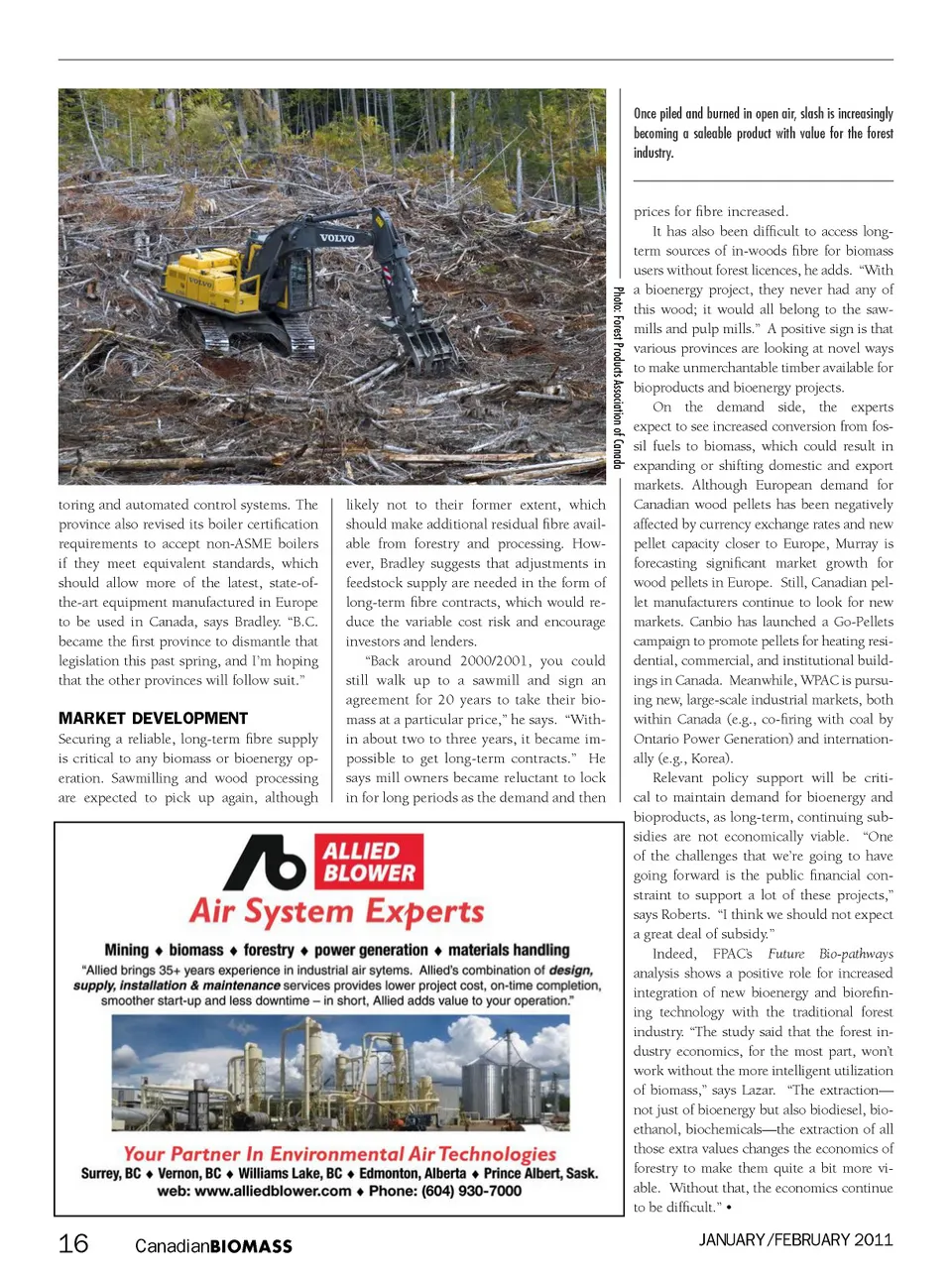
Once piled and burned in open air, slash is increasingly becoming a saleable product with value for the forest industry. toring and automated control systems. The province also revised its boiler certification requirements to accept non-ASME boilers if they meet equivalent standards, which should allow more of the latest, state-of-the-art equipment manufactured in Europe to be used in Canada, says Bradley. “B.C. became the first province to dismantle that legislation this past spring, and I’m hoping that the other provinces will follow suit.” markEt dEvElopmEnt Securing a reliable, long-term fibre supply is critical to any biomass or bioenergy op-eration. Sawmilling and wood processing are expected to pick up again, although likely not to their former extent, which should make additional residual fibre avail-able from forestry and processing. How-ever, Bradley suggests that adjustments in feedstock supply are needed in the form of long-term fibre contracts, which would re-duce the variable cost risk and encourage investors and lenders. “Back around 2000/2001, you could still walk up to a sawmill and sign an a g re e m e n t f o r 2 0 y e a r s t o t a k e t h e i r b i o -mass at a particular price,” he says. “With-i n a b o u t t w o t o t h re e y e a r s , i t b e c a m e i m -possible to get long-term contracts.” He s a y s m i l l o w n e r s b e c a m e re l u c t a n t t o l o c k in for long periods as the demand and then prices for fibre increased. It has also been difficult to access long-term sources of in-woods fibre for biomass users without forest licences, he adds. “With a bioenergy project, they never had any of this wood; it would all belong to the saw-mills and pulp mills.” A positive sign is that various provinces are looking at novel ways to make unmerchantable timber available for bioproducts and bioenergy projects. On the demand side, the experts expect to see increased conversion from fos-sil fuels to biomass, which could result in expanding or shifting domestic and export markets. Although European demand for Canadian wood pellets has been negatively affected by currency exchange rates and new pellet capacity closer to Europe, Murray is forecasting significant market growth for wood pellets in Europe. Still, Canadian pel-let manufacturers continue to look for new markets. Canbio has launched a Go-Pellets campaign to promote pellets for heating resi-dential, commercial, and institutional build-ings in Canada. Meanwhile, WPAC is pursu-ing new, large-scale industrial markets, both within Canada (e.g., co-firing with coal by Ontario Power Generation) and internation-ally (e.g., Korea). Relevant policy support will be criti-cal to maintain demand for bioenergy and bioproducts, as long-term, continuing sub-sidies are not economically viable. “One of the challenges that we’re going to have going forward is the public financial con-straint to support a lot of these projects,” says Roberts. “I think we should not expect a great deal of subsidy.” Indeed, FPAC’s Future Bio-pathways analysis shows a positive role for increased integration of new bioenergy and biorefin-ing technology with the traditional forest industry. “The study said that the forest in-dustry economics, for the most part, won’t work without the more intelligent utilization of biomass,” says Lazar. “The extraction— not just of bioenergy but also biodiesel, bio-ethanol, biochemicals—the extraction of all those extra values changes the economics of forestry to make them quite a bit more vi-able. Without that, the economics continue to be difficult.” • JANUARY/FEBRUARY 2011 Photo: Forest Products Association of Canada 16 Canadian BIOMASS
Canadian Biomass January/February 2011: Page 16