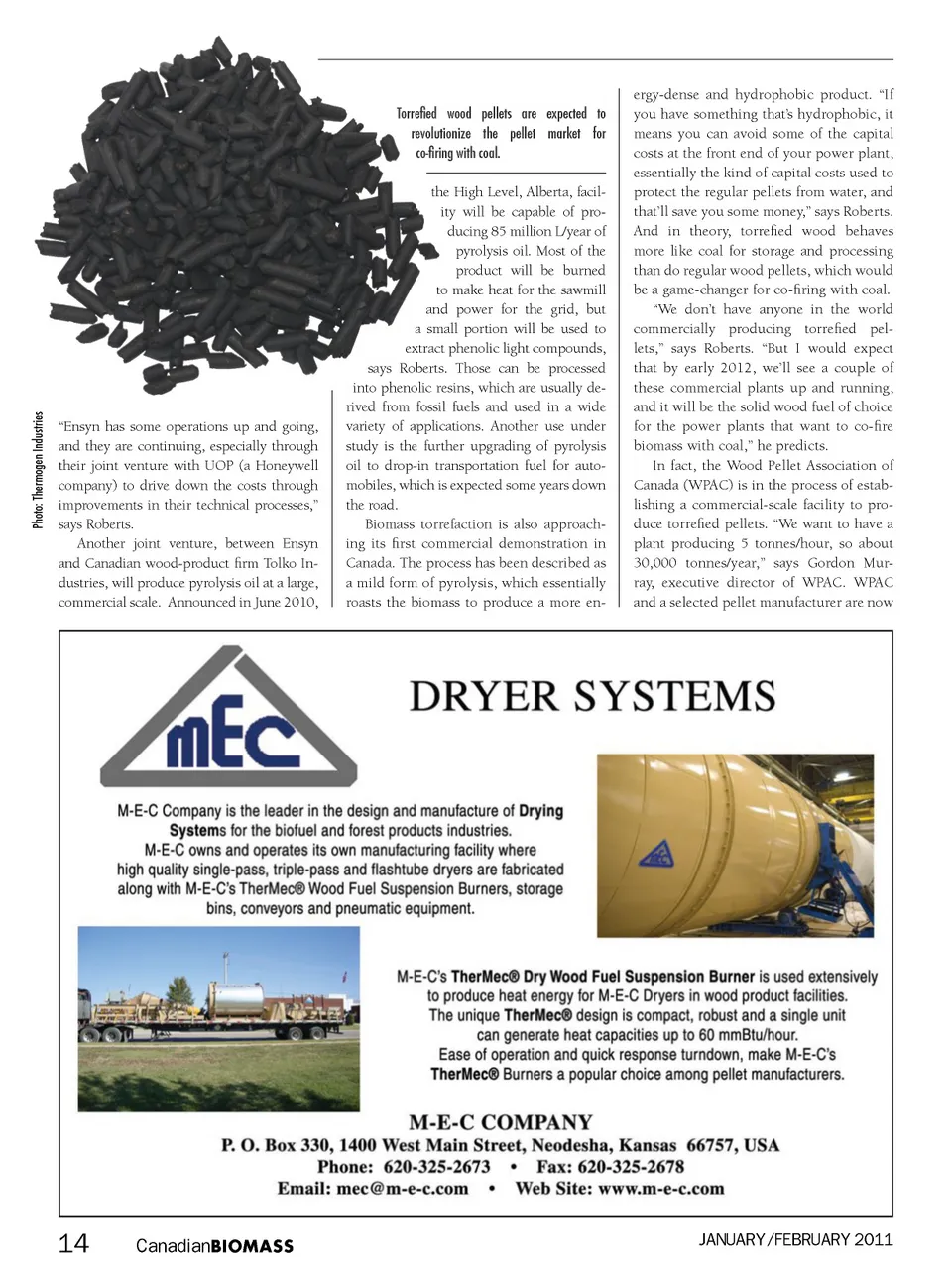
Torrefied wood pellets are expected to revolutionize the pellet market for co-firing with coal. the High Level, Alberta, facil-ity will be capable of pro-ducing 85 million L/year of pyrolysis oil. Most of the product will be burned to make heat for the sawmill and power for the grid, but a small portion will be used to extract phenolic light compounds, says Roberts. Those can be processed into phenolic resins, which are usually de-rived from fossil fuels and used in a wide variety of applications. Another use under study is the further upgrading of pyrolysis oil to drop-in transportation fuel for auto-mobiles, which is expected some years down the road. Biomass torrefaction is also approach-ing its first commercial demonstration in Canada. The process has been described as a mild form of pyrolysis, which essentially roasts the biomass to produce a more en-“Ensyn has some operations up and going, and they are continuing, especially through their joint venture with UOP (a Honeywell company) to drive down the costs through improvements in their technical processes,” says Roberts. Another joint venture, between Ensyn and Canadian wood-product firm Tolko In-dustries, will produce pyrolysis oil at a large, commercial scale. Announced in June 2010, ergy-dense and hydrophobic product. “If you have something that’s hydrophobic, it means you can avoid some of the capital costs at the front end of your power plant, essentially the kind of capital costs used to protect the regular pellets from water, and that’ll save you some money,” says Roberts. And in theory, torrefied wood behaves more like coal for storage and processing t h a n d o re g u l a r w o o d p e l l e t s , w h i c h w o u l d be a game-changer for co-firing with coal. “We don’t have anyone in the world commercially producing torrefied pel-lets,” says Roberts. “But I would expect that by early 2012, we’ll see a couple of these commercial plants up and running, and it will be the solid wood fuel of choice for the power plants that want to co-fire b i o m a s s w i t h c o a l , ” h e p re d i c t s . In fact, the Wood Pellet Association of Canada (WPAC) is in the process of estab-lishing a commercial-scale facility to pro-duce torrefied pellets. “We want to have a plant producing 5 tonnes/hour, so about 30,000 tonnes/year,” says Gordon Mur-ray, executive director of WPAC. WPAC a n d a s e l e c t e d p e l l e t m a n u f a c t u re r a re n o w Photo: Thermogen Industries 14 Canadian BIOMASS JANUARY/FEBRUARY 2011
Canadian Biomass January/February 2011: Page 14