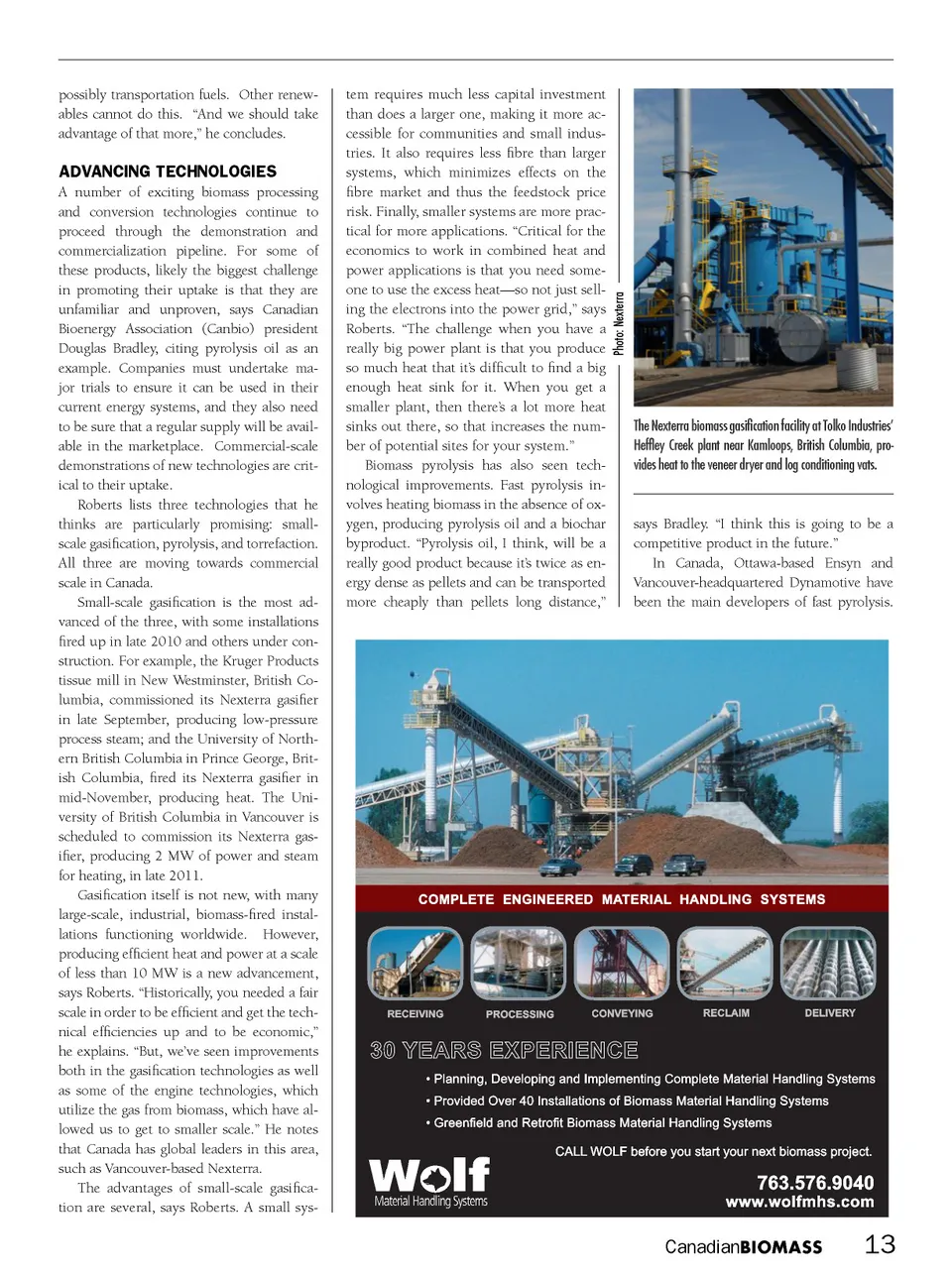
possibly transportation fuels. Other renew-ables cannot do this. “And we should take advantage of that more,” he concludes. advancing tEchnologiEs A number of exciting biomass processing and conversion technologies continue to proceed through the demonstration and commercialization pipeline. For some of these products, likely the biggest challenge in promoting their uptake is that they are unfamiliar and unproven, says Canadian Bioenergy Association (Canbio) president Douglas Bradley, citing pyrolysis oil as an example. Companies must undertake ma-jor trials to ensure it can be used in their current energy systems, and they also need to be sure that a regular supply will be avail-able in the marketplace. Commercial-scale demonstrations of new technologies are crit-ical to their uptake. Roberts lists three technologies that he thinks are particularly promising: small-scale gasification, pyrolysis, and torrefaction. All three are moving towards commercial scale in Canada. Small-scale gasification is the most ad-vanced of the three, with some installations fired up in late 2010 and others under con-struction. For example, the Kruger Products tissue mill in New Westminster, British Co-lumbia, commissioned its Nexterra gasifier in late September, producing low-pressure process steam; and the University of North-ern British Columbia in Prince George, Brit-ish Columbia, fired its Nexterra gasifier in mid-November, producing heat. The Uni-versity of British Columbia in Vancouver is scheduled to commission its Nexterra gas-ifier, producing 2 MW of power and steam for heating, in late 2011. Gasification itself is not new, with many large-scale, industrial, biomass-fired instal-lations functioning worldwide. However, producing efficient heat and power at a scale of less than 10 MW is a new advancement, says Roberts. “Historically, you needed a fair scale in order to be efficient and get the tech-nical efficiencies up and to be economic,” he explains. “But, we’ve seen improvements both in the gasification technologies as well as some of the engine technologies, which utilize the gas from biomass, which have al-lowed us to get to smaller scale.” He notes that Canada has global leaders in this area, such as Vancouver-based Nexterra. The advantages of small-scale gasifica-tion are several, says Roberts. A small sys-tem requires much less capital investment than does a larger one, making it more ac-cessible for communities and small indus-tries. It also requires less fibre than larger systems, which minimizes effects on the fibre market and thus the feedstock price risk. Finally, smaller systems are more prac-tical for more applications. “Critical for the economics to work in combined heat and power applications is that you need some-one to use the excess heat—so not just sell -ing the electrons into the power grid,” says Roberts. “The challenge when you have a really big power plant is that you produce so much heat that it’s difficult to find a big enough heat sink for it. When you get a smaller plant, then there’s a lot more heat sinks out there, so that increases the num-ber of potential sites for your system.” Biomass pyrolysis has also seen tech-nological improvements. Fast pyrolysis in-volves heating biomass in the absence of ox-ygen, producing pyrolysis oil and a biochar byproduct. “Pyrolysis oil, I think, will be a really good product because it’s twice as en-ergy dense as pellets and can be transported more cheaply than pellets long distance,” Photo: Nexterra The Nexterra biomass gasification facility at Tolko Industries’ Heffley Creek plant near Kamloops, British Columbia, pro-vides heat to the veneer dryer and log conditioning vats. says Bradley. “I think this is going to be a competitive product in the future.” In Canada, Ottawa-based Ensyn and Vancouver-headquartered Dynamotive have been the main developers of fast pyrolysis. Canadian BIOMASS 13
Canadian Biomass January/February 2011: Page 13