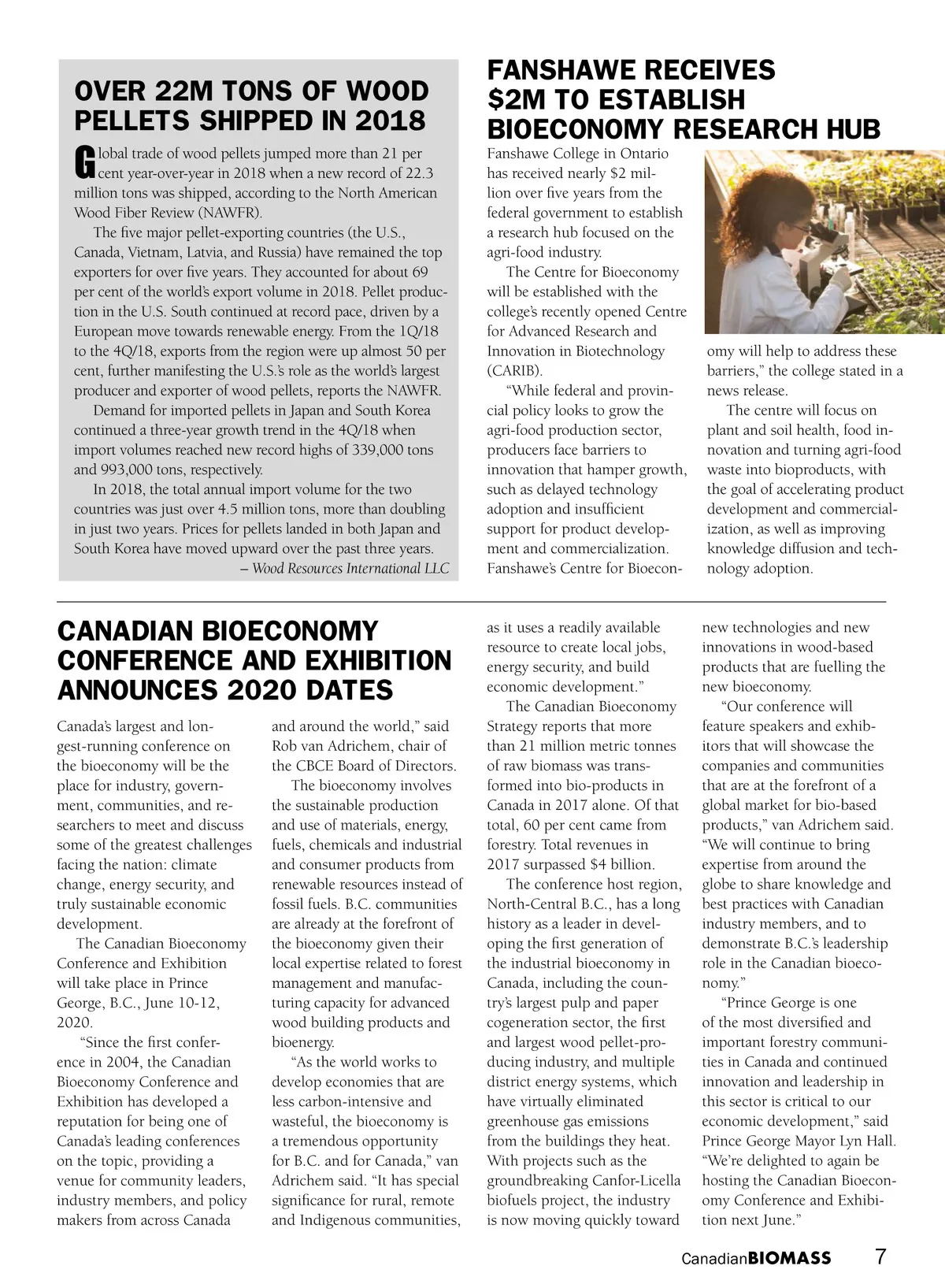
OVER 22M TONS OF WOOD PELLETS SHIPPED IN 2018 G FANSHAWE RECEIVES $2M TO ESTABLISH BIOECONOMY RESEARCH HUB Fanshawe College in Ontario has received nearly $2 mil-lion over five years from the federal government to establish a research hub focused on the agri-food industry. The Centre for Bioeconomy will be established with the college’s recently opened Centre for Advanced Research and Innovation in Biotechnology (CARIB). “While federal and provin-cial policy looks to grow the agri-food production sector, producers face barriers to innovation that hamper growth, such as delayed technology adoption and insufficient support for product develop-ment and commercialization. Fanshawe’s Centre for Bioecon-lobal trade of wood pellets jumped more than 21 per cent year-over-year in 2018 when a new record of 22.3 million tons was shipped, according to the North American Wood Fiber Review (NAWFR). The five major pellet-exporting countries (the U.S., Canada, Vietnam, Latvia, and Russia) have remained the top exporters for over five years. They accounted for about 69 per cent of the world’s export volume in 2018. Pellet produc-tion in the U.S. South continued at record pace, driven by a European move towards renewable energy. From the 1Q/18 to the 4Q/18, exports from the region were up almost 50 per cent, further manifesting the U.S.’s role as the world’s largest producer and exporter of wood pellets, reports the NAWFR. Demand for imported pellets in Japan and South Korea continued a three-year growth trend in the 4Q/18 when import volumes reached new record highs of 339,000 tons and 993,000 tons, respectively. In 2018, the total annual import volume for the two countries was just over 4.5 million tons, more than doubling in just two years. Prices for pellets landed in both Japan and South Korea have moved upward over the past three years. – Wood Resources International LLC omy will help to address these barriers,” the college stated in a news release. The centre will focus on plant and soil health, food in-novation and turning agri-food waste into bioproducts, with the goal of accelerating product development and commercial-ization, as well as improving knowledge diffusion and tech-nology adoption. CANADIAN BIOECONOMY CONFERENCE AND EXHIBITION ANNOUNCES 2020 DATES Canada’s largest and lon-gest-running conference on the bioeconomy will be the place for industry, govern-ment, communities, and re-searchers to meet and discuss some of the greatest challenges facing the nation: climate change, energy security, and truly sustainable economic development. The Canadian Bioeconomy Conference and Exhibition will take place in Prince George, B.C., June 10-12, 2020. “Since the first confer-ence in 2004, the Canadian Bioeconomy Conference and Exhibition has developed a reputation for being one of Canada’s leading conferences on the topic, providing a venue for community leaders, industry members, and policy makers from across Canada and around the world,” said Rob van Adrichem, chair of the CBCE Board of Directors. The bioeconomy involves the sustainable production and use of materials, energy, fuels, chemicals and industrial and consumer products from renewable resources instead of fossil fuels. B.C. communities are already at the forefront of the bioeconomy given their local expertise related to forest management and manufac-turing capacity for advanced wood building products and bioenergy. “As the world works to develop economies that are less carbon-intensive and wasteful, the bioeconomy is a tremendous opportunity for B.C. and for Canada,” van Adrichem said. “It has special significance for rural, remote and Indigenous communities, as it uses a readily available resource to create local jobs, energy security, and build economic development.” The Canadian Bioeconomy Strategy reports that more than 21 million metric tonnes of raw biomass was trans-formed into bio-products in Canada in 2017 alone. Of that total, 60 per cent came from forestry. Total revenues in 2017 surpassed $4 billion. The conference host region, North-Central B.C., has a long history as a leader in devel-oping the first generation of the industrial bioeconomy in Canada, including the coun-try’s largest pulp and paper cogeneration sector, the first and largest wood pellet-pro-ducing industry, and multiple district energy systems, which have virtually eliminated greenhouse gas emissions from the buildings they heat. With projects such as the groundbreaking Canfor-Licella biofuels project, the industry is now moving quickly toward new technologies and new innovations in wood-based products that are fuelling the new bioeconomy. “Our conference will feature speakers and exhib-itors that will showcase the companies and communities that are at the forefront of a global market for bio-based products,” van Adrichem said. “We will continue to bring expertise from around the globe to share knowledge and best practices with Canadian industry members, and to demonstrate B.C.’s leadership role in the Canadian bioeco-nomy.” “Prince George is one of the most diversified and important forestry communi-ties in Canada and continued innovation and leadership in this sector is critical to our economic development,” said Prince George Mayor Lyn Hall. “We’re delighted to again be hosting the Canadian Bioecon-omy Conference and Exhibi-tion next June.” Canadian BIOMASS 7
Canadian Biomass Summer 2019: Page 7