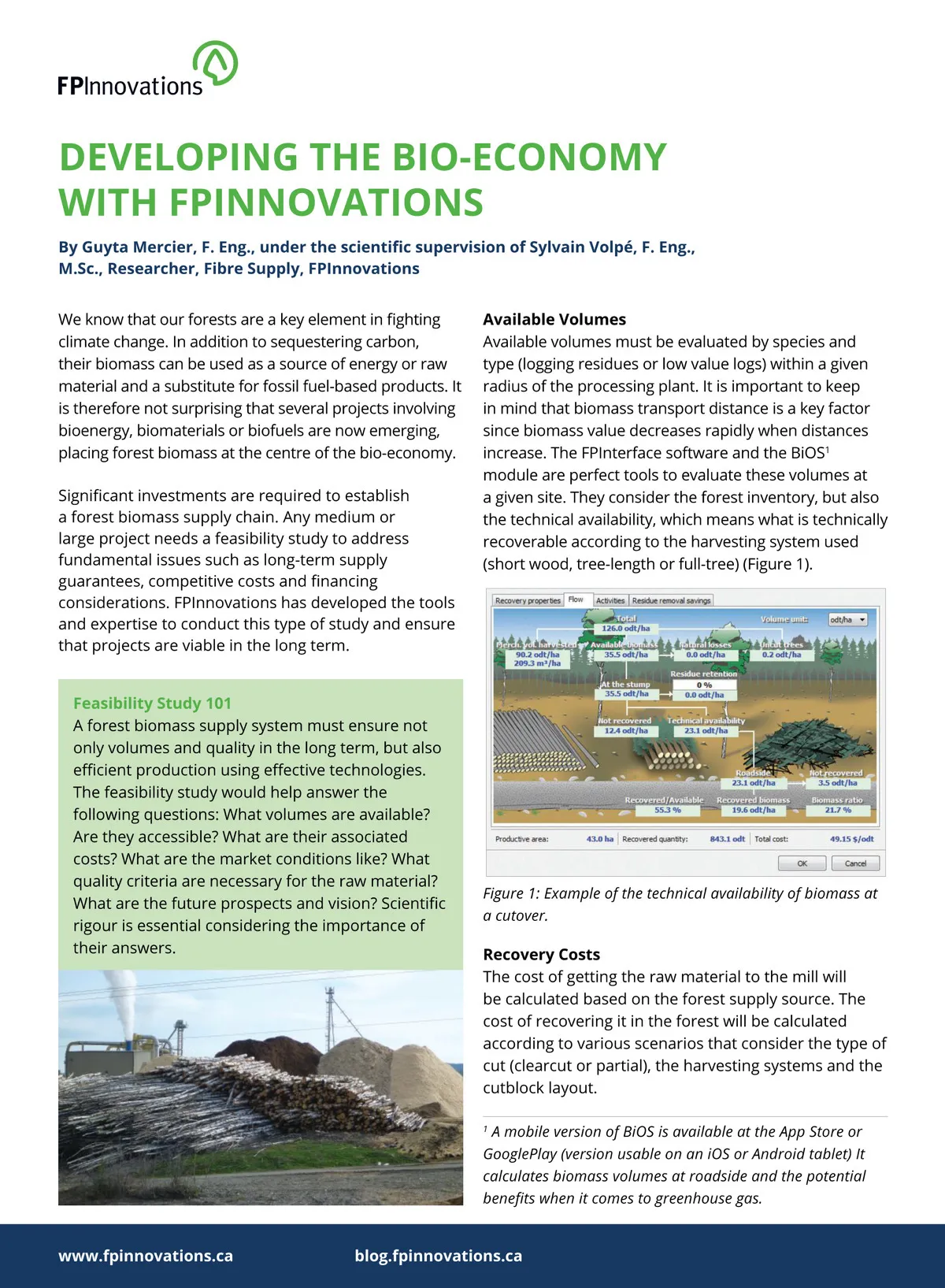
Will the recovery be integrated into current harvesting operations (preferable) or will it be done separately? How and where will the biomass be conditioned (shredded wood, wood chips, densification, pyrolysis)? Will it be in the forest or at the mill? What are the costs and benefits of each option? Added to these recovery costs are fees, diesel costs, road maintenance, transport logistics, indirect costs, etc. Environmental Impact When recovering biomass, it is important to consider environmental aspects such as soil fertility and biodiversity. Environmental impact assessments must therefore be conducted to determine what percentage can be taken and what mitigation measures are necessary. Furthermore, in a bio-economy, the carbon footprint must be evaluated. The carbon module, developed by FPInnovations, makes it possible to measure CO 2 emissions resulting from forest operations (harvesting, conditioning, transport) and also the carbon delivered to the mill (Figure 2). The table below gives a summary of the main challenges and elements that will make a forest biomass project successful for both users and suppliers. Various guides 2 developed by FPInnovations can help meet some of these challenges: 1) Best practices guide for harvesting, conditioning and storing, 2) Pile management guide, 3) Quality control guide. Users Suppliers Increase supply by expanding the supply chain by investing in the forest sector Recruit and retain specialized workers. Attract young entrepreneurs Supply raw material meeting the customer’s quality requirements: Moisture content, particle size, contamination Have a quality control system with clear guidelines, incentives and penalties Provide reliable delivery and raw material at competitive prices Diversify supply sources Establish a long-term partnership strategy with suppliers Ensure independence and security by owning part of the supply chain Have storage capacity and be able to support inventory costs Figure 2: Carbon module Use available and affordable quality wood fibre Market Study Lastly, a market study analyzes potential users, the competition, the prices offered and prospects for the product. Call on our experts: The researchers at FPInnovations are experienced and have been involved with major projects such as the BELT project in the Mauricie region and the iHUB project in Nova Scotia. For more information, please contact Sylvain Volpé at sylvain.volpe@ fpinnovations.ca or 514-782-4521. These guides can be downloaded from our website: www.fpinnovations.ca 2
Canadian Biomass Summer 2019: Page 29