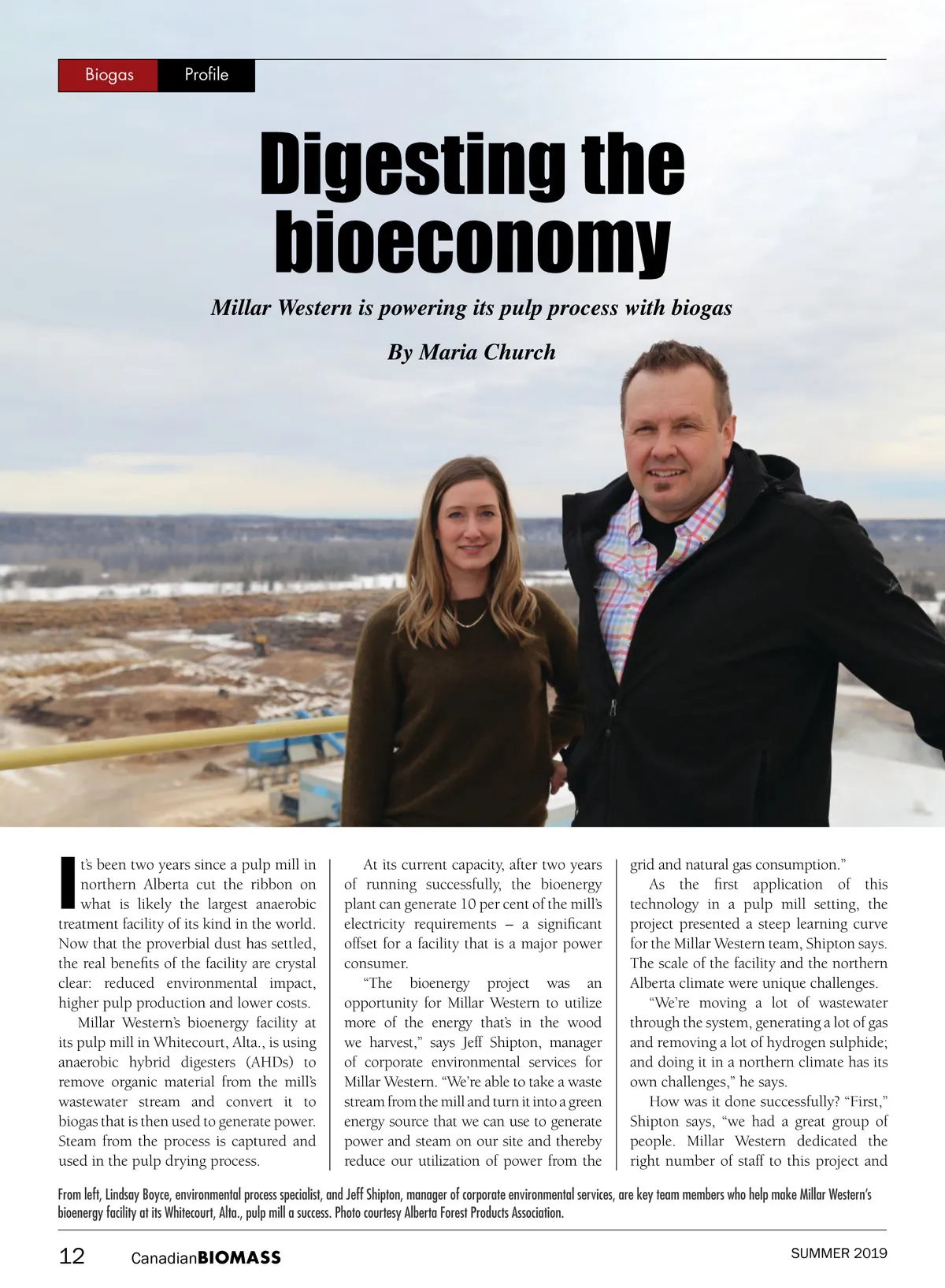
let us focus on start-up and optimization. “We also had the benefit of a good business environment. There’s a lot of cutting edge technology here. All the pulp and paper companies in the province are leading edge, committed to reinvesting in their businesses to improve their performance.” Shipton notes that all levels of government were supportive, with the project receiving funds from Natural Resources Canada’s Investments in Forest Industry Transformation (IFIT) program and from the Alberta ecoTrust program. “This project was a good example of how governments and industry can come together to solve some of these greenhouse gas issues,” he says. ZERO WASTE Millar Western’s Whitecourt operations – a two-hour drive northwest of the company’s Edmonton headquarters – include a sawmill, a pulp mill and woodlands operations. The company has a second sawmill in Fox Creek, Alta., and a remanufacturing facility in Acheson, just outside Edmonton. In all operations, Millar Western’s goal is to use the whole tree with zero waste. Logs are supplied to the Whitecourt mill site from woodlands certified to the SFI sustainable forest management standard and the PEFC and FSC chain-of-custody standards. The sawmill produces 330 million board feet of lumber annually, with all by-products used to create valuable products: wood chips are used in the company’s adjacent pulp mill and at a neighbouring newsprint facility; wood shavings and other residuals are transferred to a regional medium density fibreboard plant; and bark and other remaining wood waste is sent to a nearby biomass-fired power plant for conversion to green energy. The pulp mill produces around 320,000 air-dried metric tonnes per year. Millar Western launched the bioenergy project to utilize even more potential from the wood chips used in the pulp manufacturing process, and to further reduce the environmental impact from discharge of the pulp mill’s treated effluent into the Athabasca River. “Alberta has some of the most stringent regulations when it comes to industry effluent discharged back into the environment,” says Lindsay Boyce, environmental process specialist with Millar Western. Producing power from the effluent is a way to make use of material in the process that would otherwise go to waste, she says. “We use water in our process and we need to treat that water before it’s discharged into the environment. So we take organics that are in the wastewater and we use bacteria to treat the organics to bring the wastewater up to a quality that exceeds our permit requirements and minimizes impacts on the receiving waters. In the process of doing that, these bacteria produce methane. We take the methane gas and produce energy that we can use in the mill,” Boyce says. Millar Western cut the ribbon on the bioenergy project in late 2016. While the technology has been used in the oil and gas industry for some time, it was a novel application in a pulp mill, and is one of the world’s largest anaerobic digester treatment systems of its kind. Your Solution for Bulk Material Handling. Pellets Woodchips Hemp TRUCK DUMPERS TRAILER TIPPERS RECEIVING HOPPERS airoflex.com [email protected] 563-264-8066 Canadian BIOMASS CBM_HoffmanAiroflex_Summer19_CSA.indd 1 2019-07-02 1:12 PM 13
Canadian Biomass Summer 2019: Page 13