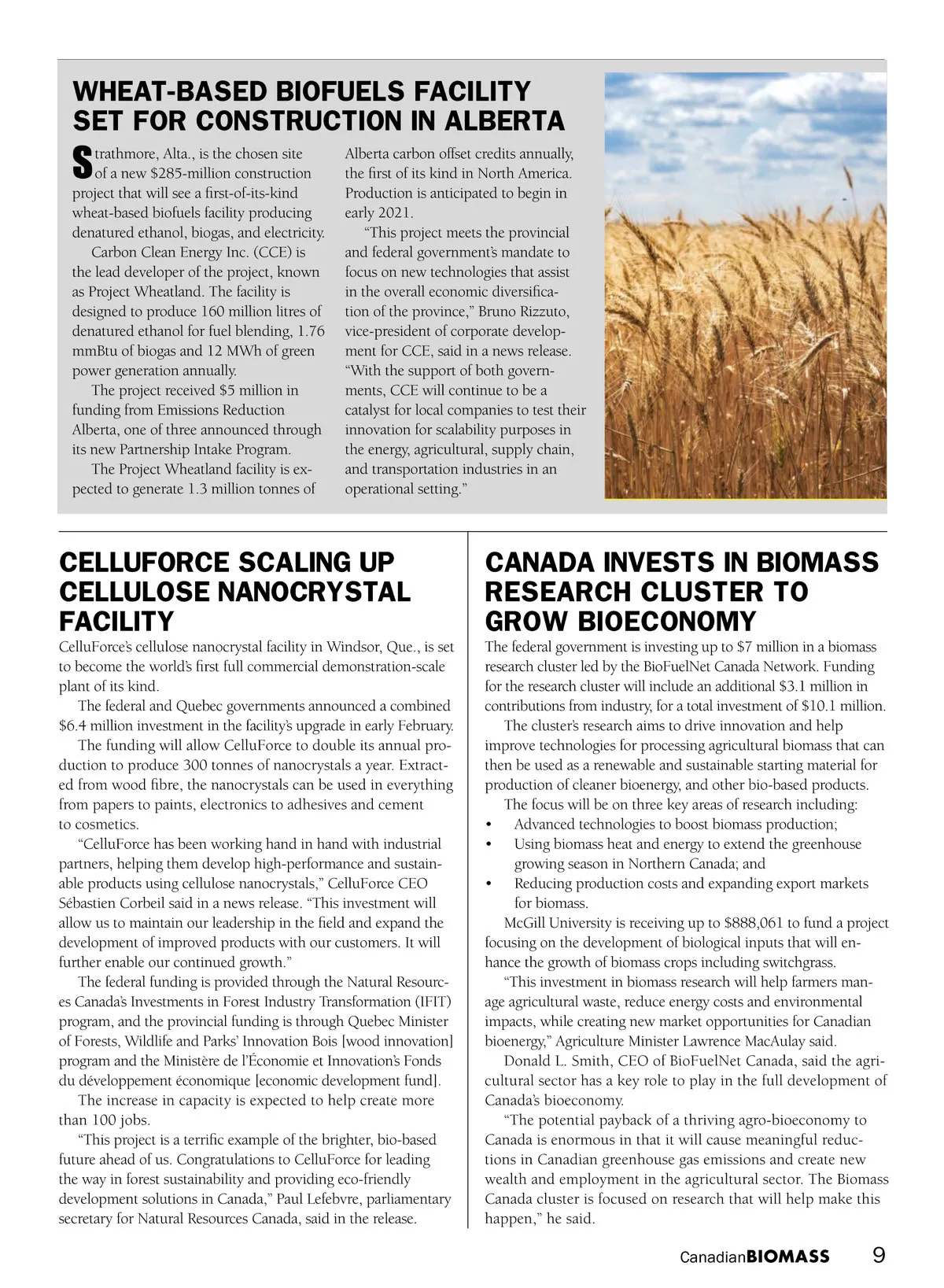
WHEAT-BASED BIOFUELS FACILITY SET FOR CONSTRUCTION IN ALBERTA S trathmore, Alta., is the chosen site of a new $285-million construction project that will see a first-of-its-kind wheat-based biofuels facility producing denatured ethanol, biogas, and electricity. Carbon Clean Energy Inc. (CCE) is the lead developer of the project, known as Project Wheatland. The facility is designed to produce 160 million litres of denatured ethanol for fuel blending, 1.76 mmBtu of biogas and 12 MWh of green power generation annually. The project received $5 million in funding from Emissions Reduction Alberta, one of three announced through its new Partnership Intake Program. The Project Wheatland facility is ex-pected to generate 1.3 million tonnes of Alberta carbon offset credits annually, the first of its kind in North America. Production is anticipated to begin in early 2021. “This project meets the provincial and federal government’s mandate to focus on new technologies that assist in the overall economic diversifica-tion of the province,” Bruno Rizzuto, vice-president of corporate develop-ment for CCE, said in a news release. “With the support of both govern-ments, CCE will continue to be a catalyst for local companies to test their innovation for scalability purposes in the energy, agricultural, supply chain, and transportation industries in an operational setting.” CELLUFORCE SCALING UP CELLULOSE NANOCRYSTAL FACILITY CelluForce’s cellulose nanocrystal facility in Windsor, Que., is set to become the world’s first full commercial demonstration-scale plant of its kind. The federal and Quebec governments announced a combined $6.4 million investment in the facility’s upgrade in early February. The funding will allow CelluForce to double its annual pro-duction to produce 300 tonnes of nanocrystals a year. Extract-ed from wood fibre, the nanocrystals can be used in everything from papers to paints, electronics to adhesives and cement to cosmetics. “CelluForce has been working hand in hand with industrial partners, helping them develop high-performance and sustain-able products using cellulose nanocrystals,” CelluForce CEO Sébastien Corbeil said in a news release. “This investment will allow us to maintain our leadership in the field and expand the development of improved products with our customers. It will further enable our continued growth.” The federal funding is provided through the Natural Resourc-es Canada’s Investments in Forest Industry Transformation (IFIT) program, and the provincial funding is through Quebec Minister of Forests, Wildlife and Parks’ Innovation Bois [wood innovation] program and the Ministère de l’Économie et Innovation’s Fonds du développement économique [economic development fund]. The increase in capacity is expected to help create more than 100 jobs. “This project is a terrific example of the brighter, bio-based future ahead of us. Congratulations to CelluForce for leading the way in forest sustainability and providing eco-friendly development solutions in Canada,” Paul Lefebvre, parliamentary secretary for Natural Resources Canada, said in the release. CANADA INVESTS IN BIOMASS RESEARCH CLUSTER TO GROW BIOECONOMY The federal government is investing up to $7 million in a biomass research cluster led by the BioFuelNet Canada Network. Funding for the research cluster will include an additional $3.1 million in contributions from industry, for a total investment of $10.1 million. The cluster’s research aims to drive innovation and help improve technologies for processing agricultural biomass that can then be used as a renewable and sustainable starting material for production of cleaner bioenergy, and other bio-based products. The focus will be on three key areas of research including: • Advanced technologies to boost biomass production; • Using biomass heat and energy to extend the greenhouse growing season in Northern Canada; and • Reducing production costs and expanding export markets for biomass. McGill University is receiving up to $888,061 to fund a project focusing on the development of biological inputs that will en-hance the growth of biomass crops including switchgrass. “This investment in biomass research will help farmers man-age agricultural waste, reduce energy costs and environmental impacts, while creating new market opportunities for Canadian bioenergy,” Agriculture Minister Lawrence MacAulay said. Donald L. Smith, CEO of BioFuelNet Canada, said the agri-cultural sector has a key role to play in the full development of Canada’s bioeconomy. “The potential payback of a thriving agro-bioeconomy to Canada is enormous in that it will cause meaningful reduc-tions in Canadian greenhouse gas emissions and create new wealth and employment in the agricultural sector. The Biomass Canada cluster is focused on research that will help make this happen,” he said. Canadian BIOMASS 9
Canadian Biomass Spring 2019: Page 9