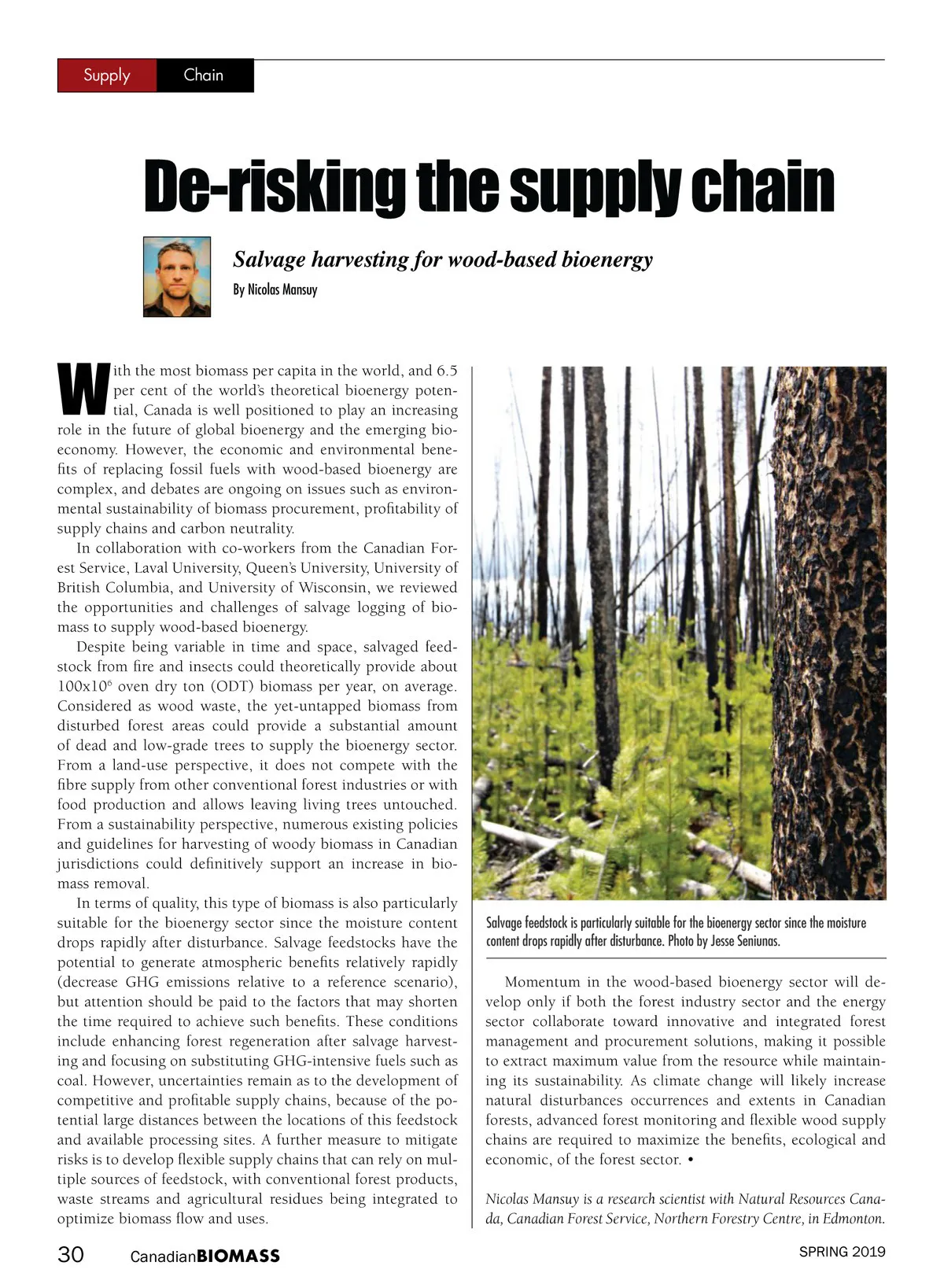
Supply Chain De-risking the supply chain Salvage harvesting for wood-based bioenergy By Nicolas Mansuy W ith the most biomass per capita in the world, and 6.5 per cent of the world’s theoretical bioenergy poten-tial, Canada is well positioned to play an increasing role in the future of global bioenergy and the emerging bio-economy. However, the economic and environmental bene-fits of replacing fossil fuels with wood-based bioenergy are complex, and debates are ongoing on issues such as environ-mental sustainability of biomass procurement, profitability of supply chains and carbon neutrality. In collaboration with co-workers from the Canadian For-est Service, Laval University, Queen’s University, University of British Columbia, and University of Wisconsin, we reviewed the opportunities and challenges of salvage logging of bio-mass to supply wood-based bioenergy. Despite being variable in time and space, salvaged feed-stock from fire and insects could theoretically provide about 100x10 6 oven dry ton (ODT) biomass per year, on average. Considered as wood waste, the yet-untapped biomass from disturbed forest areas could provide a substantial amount of dead and low-grade trees to supply the bioenergy sector. From a land-use perspective, it does not compete with the fibre supply from other conventional forest industries or with food production and allows leaving living trees untouched. From a sustainability perspective, numerous existing policies and guidelines for harvesting of woody biomass in Canadian jurisdictions could definitively support an increase in bio-mass removal. In terms of quality, this type of biomass is also particularly suitable for the bioenergy sector since the moisture content drops rapidly after disturbance. Salvage feedstocks have the potential to generate atmospheric benefits relatively rapidly (decrease GHG emissions relative to a reference scenario), but attention should be paid to the factors that may shorten the time required to achieve such benefits. These conditions include enhancing forest regeneration after salvage harvest-ing and focusing on substituting GHG-intensive fuels such as coal. However, uncertainties remain as to the development of competitive and profitable supply chains, because of the po-tential large distances between the locations of this feedstock and available processing sites. A further measure to mitigate risks is to develop flexible supply chains that can rely on mul-tiple sources of feedstock, with conventional forest products, waste streams and agricultural residues being integrated to optimize biomass flow and uses. Salvage feedstock is particularly suitable for the bioenergy sector since the moisture content drops rapidly after disturbance. Photo by Jesse Seniunas. Momentum in the wood-based bioenergy sector will de-velop only if both the forest industry sector and the energy sector collaborate toward innovative and integrated forest management and procurement solutions, making it possible to extract maximum value from the resource while maintain-ing its sustainability. As climate change will likely increase natural disturbances occurrences and extents in Canadian forests, advanced forest monitoring and flexible wood supply chains are required to maximize the benefits, ecological and economic, of the forest sector. • Nicolas Mansuy is a research scientist with Natural Resources Cana-da, Canadian Forest Service, Northern Forestry Centre, in Edmonton. SPRING 2019 30 Canadian BIOMASS
Canadian Biomass Spring 2019: Page 30