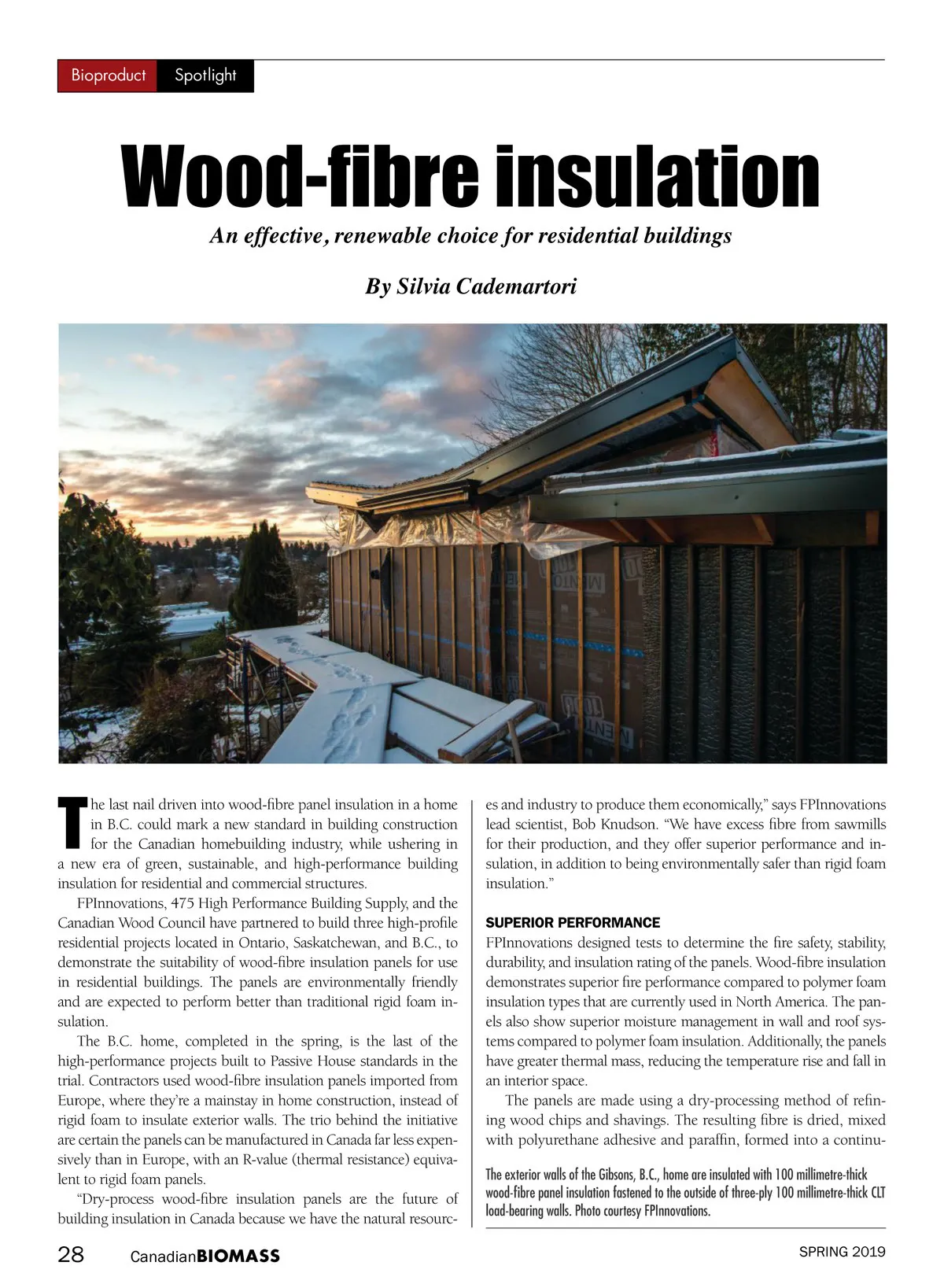
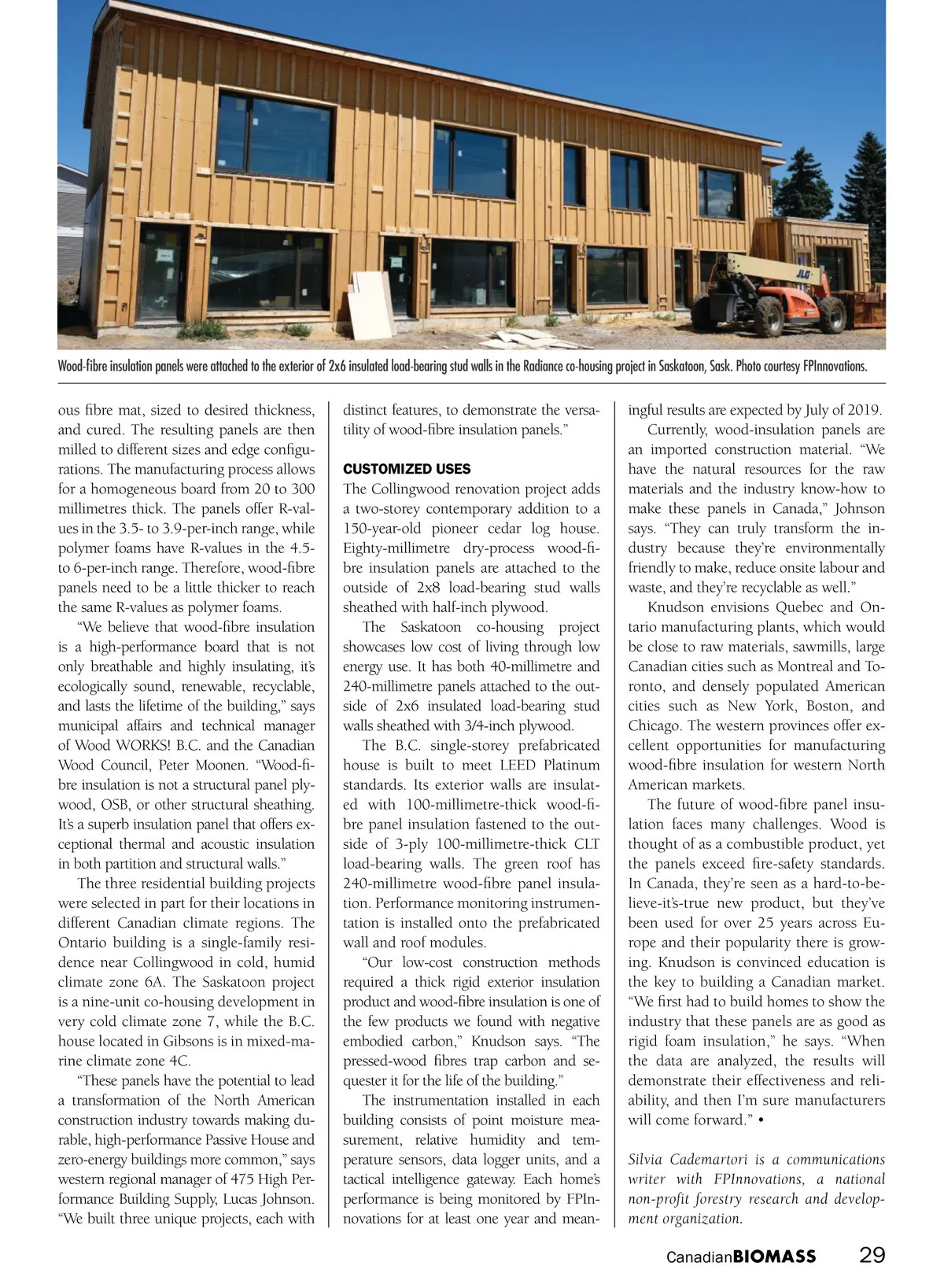
Wood-fibre insulation panels were attached to the exterior of 2x6 insulated load-bearing stud walls in the Radiance co-housing project in Saskatoon, Sask. Photo courtesy FPInnovations. ous fibre mat, sized to desired thickness, and cured. The resulting panels are then milled to different sizes and edge configu-rations. The manufacturing process allows for a homogeneous board from 20 to 300 millimetres thick. The panels offer R-val-ues in the 3.5-to 3.9-per-inch range, while polymer foams have R-values in the 4.5-to 6-per-inch range. Therefore, wood-fibre panels need to be a little thicker to reach the same R-values as polymer foams. “We believe that wood-fibre insulation is a high-performance board that is not only breathable and highly insulating, it’s ecologically sound, renewable, recyclable, and lasts the lifetime of the building,” says municipal affairs and technical manager of Wood WORKS! B.C. and the Canadian Wood Council, Peter Moonen. “Wood-fi-bre insulation is not a structural panel ply-wood, OSB, or other structural sheathing. It’s a superb insulation panel that offers ex-ceptional thermal and acoustic insulation in both partition and structural walls.” The three residential building projects were selected in part for their locations in different Canadian climate regions. The Ontario building is a single-family resi-dence near Collingwood in cold, humid climate zone 6A. The Saskatoon project is a nine-unit co-housing development in very cold climate zone 7, while the B.C. house located in Gibsons is in mixed-ma-rine climate zone 4C. “These panels have the potential to lead a transformation of the North American construction industry towards making du-rable, high-performance Passive House and zero-energy buildings more common,” says western regional manager of 475 High Per-formance Building Supply, Lucas Johnson. “We built three unique projects, each with distinct features, to demonstrate the versa-tility of wood-fibre insulation panels.” CUSTOMIZED USES The Collingwood renovation project adds a two-storey contemporary addition to a 150-year-old pioneer cedar log house. Eighty-millimetre dry-process wood-fi-bre insulation panels are attached to the outside of 2x8 load-bearing stud walls sheathed with half-inch plywood. The Saskatoon co-housing project showcases low cost of living through low energy use. It has both 40-millimetre and 240-millimetre panels attached to the out-side of 2x6 insulated load-bearing stud walls sheathed with 3/4-inch plywood. The B.C. single-storey prefabricated house is built to meet LEED Platinum standards. Its exterior walls are insulat-ed with 100-millimetre-thick wood-fi-bre panel insulation fastened to the out-side of 3-ply 100-millimetre-thick CLT load-bearing walls. The green roof has 240-millimetre wood-fibre panel insula-tion. Performance monitoring instrumen-tation is installed onto the prefabricated wall and roof modules. “Our low-cost construction methods required a thick rigid exterior insulation product and wood-fibre insulation is one of the few products we found with negative embodied carbon,” Knudson says. “The pressed-wood fibres trap carbon and se-quester it for the life of the building.” The instrumentation installed in each building consists of point moisture mea-surement, relative humidity and tem-perature sensors, data logger units, and a tactical intelligence gateway. Each home’s performance is being monitored by FPIn-novations for at least one year and mean-ingful results are expected by July of 2019. Currently, wood-insulation panels are an imported construction material. “We have the natural resources for the raw materials and the industry know-how to make these panels in Canada,” Johnson says. “They can truly transform the in-dustry because they’re environmentally friendly to make, reduce onsite labour and waste, and they’re recyclable as well.” Knudson envisions Quebec and On-tario manufacturing plants, which would be close to raw materials, sawmills, large Canadian cities such as Montreal and To-ronto, and densely populated American cities such as New York, Boston, and Chicago. The western provinces offer ex-cellent opportunities for manufacturing wood-fibre insulation for western North American markets. The future of wood-fibre panel insu-lation faces many challenges. Wood is thought of as a combustible product, yet the panels exceed fire-safety standards. In Canada, they’re seen as a hard-to-be-lieve-it’s-true new product, but they’ve been used for over 25 years across Eu-rope and their popularity there is grow-ing. Knudson is convinced education is the key to building a Canadian market. “We first had to build homes to show the industry that these panels are as good as rigid foam insulation,” he says. “When the data are analyzed, the results will demonstrate their effectiveness and reli-ability, and then I’m sure manufacturers will come forward.” • Silvia Cademartori is a communications writer with FPInnovations, a national non-profit forestry research and develop-ment organization. Canadian BIOMASS 29
Canadian Biomass Spring 2019: Page 29