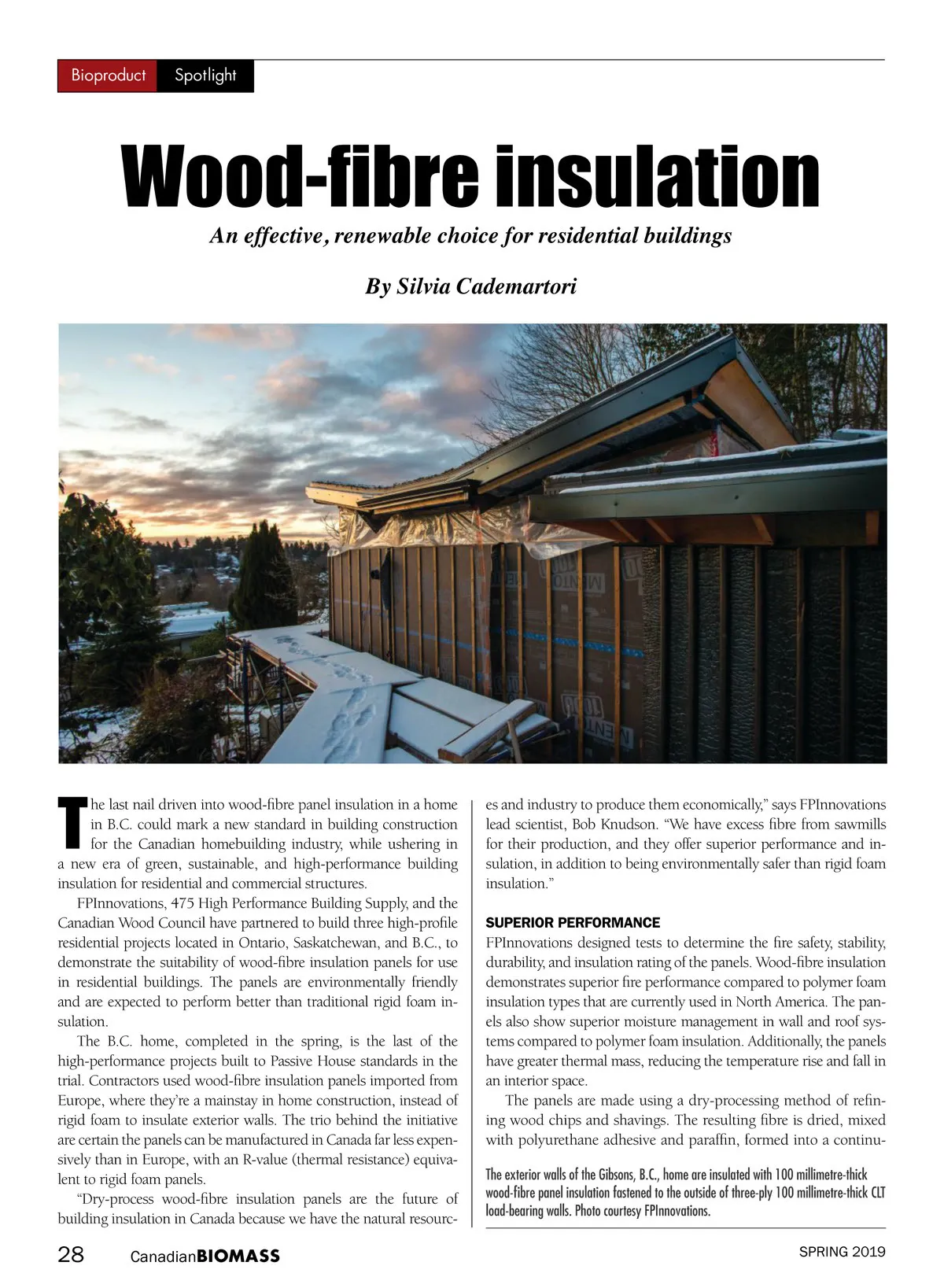
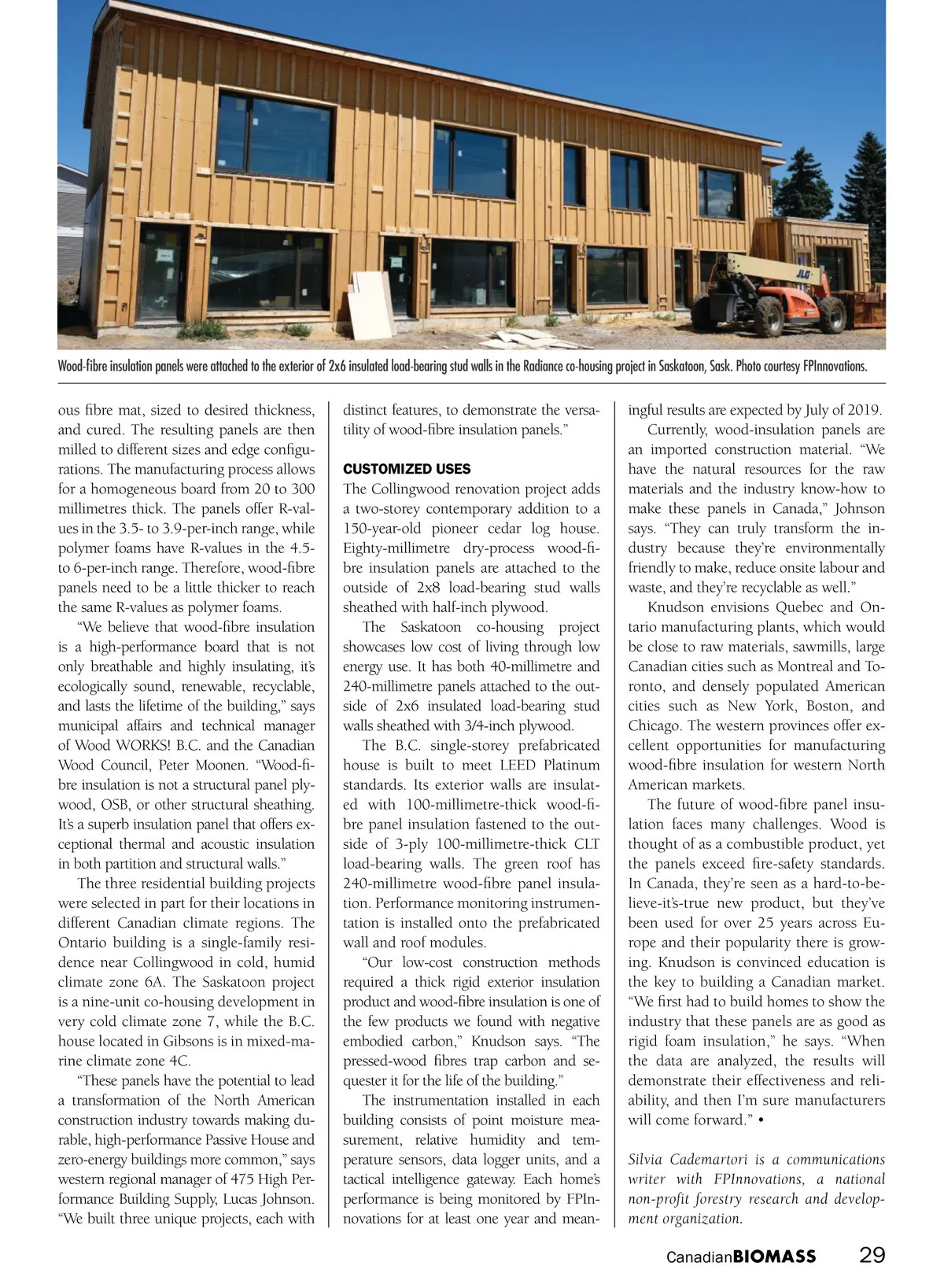
Bioproduct Spotlight Wood-fibre insulation An effective, renewable choice for residential buildings By Silvia Cademartori he last nail driven into wood-fibre panel insulation in a home in B.C. could mark a new standard in building construction for the Canadian homebuilding industry, while ushering in a new era of green, sustainable, and high-performance building insulation for residential and commercial structures. FPInnovations, 475 High Performance Building Supply, and the Canadian Wood Council have partnered to build three high-profile residential projects located in Ontario, Saskatchewan, and B.C., to demonstrate the suitability of wood-fibre insulation panels for use in residential buildings. The panels are environmentally friendly and are expected to perform better than traditional rigid foam in-sulation. The B.C. home, completed in the spring, is the last of the high-performance projects built to Passive House standards in the trial. Contractors used wood-fibre insulation panels imported from Europe, where they’re a mainstay in home construction, instead of rigid foam to insulate exterior walls. The trio behind the initiative are certain the panels can be manufactured in Canada far less expen-sively than in Europe, with an R-value (thermal resistance) equiva-lent to rigid foam panels. “Dry-process wood-fibre insulation panels are the future of building insulation in Canada because we have the natural resourc-T es and industry to produce them economically,” says FPInnovations lead scientist, Bob Knudson. “We have excess fibre from sawmills for their production, and they offer superior performance and in-sulation, in addition to being environmentally safer than rigid foam insulation.” SUPERIOR PERFORMANCE FPInnovations designed tests to determine the fire safety, stability, durability, and insulation rating of the panels. Wood-fibre insulation demonstrates superior fire performance compared to polymer foam insulation types that are currently used in North America. The pan-els also show superior moisture management in wall and roof sys-tems compared to polymer foam insulation. Additionally, the panels have greater thermal mass, reducing the temperature rise and fall in an interior space. The panels are made using a dry-processing method of refin-ing wood chips and shavings. The resulting fibre is dried, mixed with polyurethane adhesive and paraffin, formed into a continu-The exterior walls of the Gibsons, B.C., home are insulated with 100 millimetre-thick wood-fibre panel insulation fastened to the outside of three-ply 100 millimetre-thick CLT load-bearing walls. Photo courtesy FPInnovations. SPRING 2019 28 Canadian BIOMASS
Canadian Biomass Spring 2019: Page 28