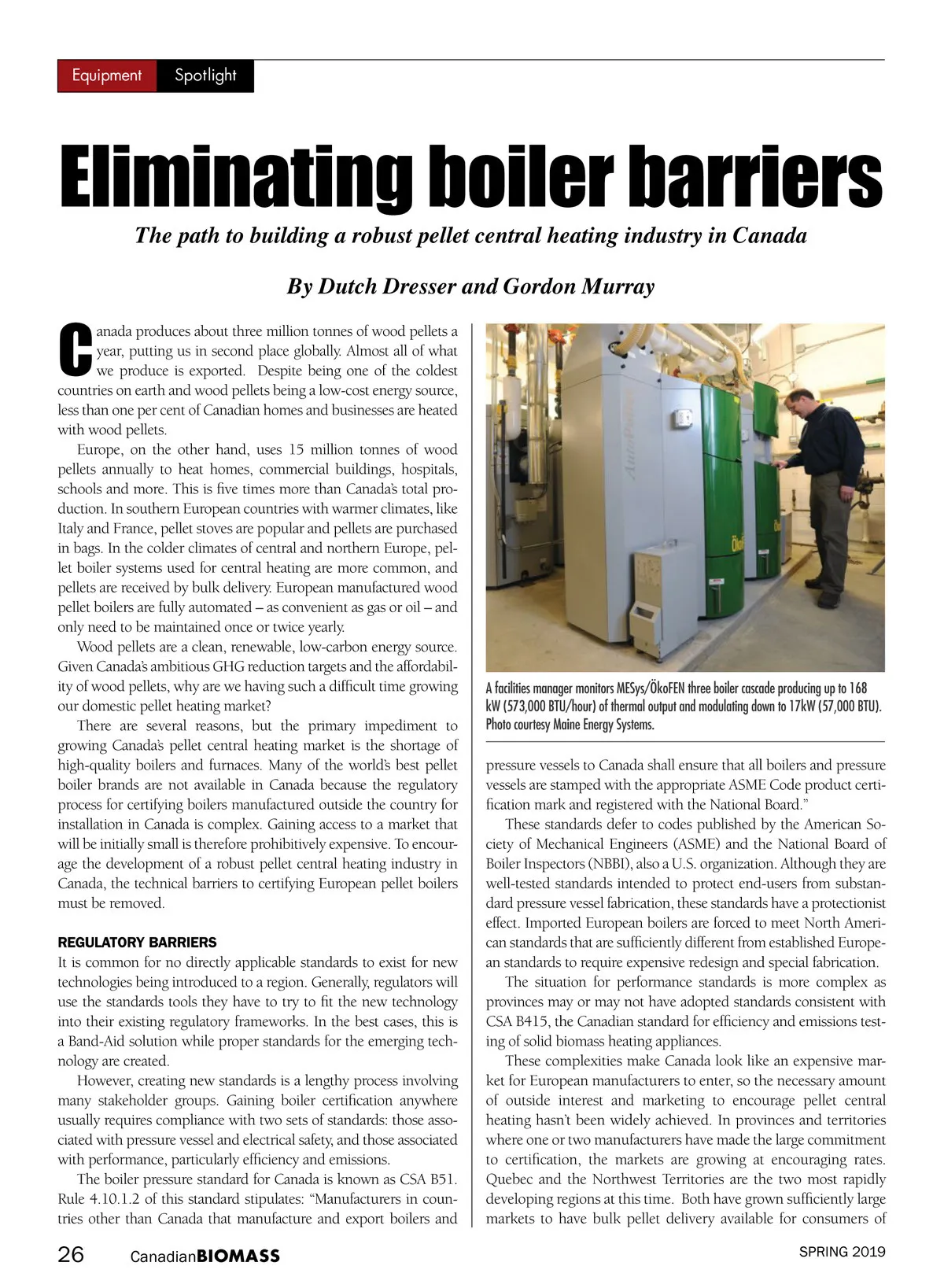
Equipment Spotlight Eliminating boiler barriers The path to building a robust pellet central heating industry in Canada By Dutch Dresser and Gordon Murray C anada produces about three million tonnes of wood pellets a year, putting us in second place globally. Almost all of what we produce is exported. Despite being one of the coldest countries on earth and wood pellets being a low-cost energy source, less than one per cent of Canadian homes and businesses are heated with wood pellets. Europe, on the other hand, uses 15 million tonnes of wood pellets annually to heat homes, commercial buildings, hospitals, schools and more. This is five times more than Canada’s total pro-duction. In southern European countries with warmer climates, like Italy and France, pellet stoves are popular and pellets are purchased in bags. In the colder climates of central and northern Europe, pel-let boiler systems used for central heating are more common, and pellets are received by bulk delivery. European manufactured wood pellet boilers are fully automated – as convenient as gas or oil – and only need to be maintained once or twice yearly. Wood pellets are a clean, renewable, low-carbon energy source. Given Canada’s ambitious GHG reduction targets and the affordabil-ity of wood pellets, why are we having such a difficult time growing our domestic pellet heating market? There are several reasons, but the primary impediment to growing Canada’s pellet central heating market is the shortage of high-quality boilers and furnaces. Many of the world’s best pellet boiler brands are not available in Canada because the regulatory process for certifying boilers manufactured outside the country for installation in Canada is complex. Gaining access to a market that will be initially small is therefore prohibitively expensive. To encour-age the development of a robust pellet central heating industry in Canada, the technical barriers to certifying European pellet boilers must be removed. A facilities manager monitors MESys/ÖkoFEN three boiler cascade producing up to 168 kW (573,000 BTU/hour) of thermal output and modulating down to 17kW (57,000 BTU). Photo courtesy Maine Energy Systems. REGULATORY BARRIERS It is common for no directly applicable standards to exist for new technologies being introduced to a region. Generally, regulators will use the standards tools they have to try to fit the new technology into their existing regulatory frameworks. In the best cases, this is a Band-Aid solution while proper standards for the emerging tech-nology are created. However, creating new standards is a lengthy process involving many stakeholder groups. Gaining boiler certification anywhere usually requires compliance with two sets of standards: those asso-ciated with pressure vessel and electrical safety, and those associated with performance, particularly efficiency and emissions. The boiler pressure standard for Canada is known as CSA B51. Rule 4.10.1.2 of this standard stipulates: “Manufacturers in coun-tries other than Canada that manufacture and export boilers and pressure vessels to Canada shall ensure that all boilers and pressure vessels are stamped with the appropriate ASME Code product certi-fication mark and registered with the National Board.” These standards defer to codes published by the American So-ciety of Mechanical Engineers (ASME) and the National Board of Boiler Inspectors (NBBI), also a U.S. organization. Although they are well-tested standards intended to protect end-users from substan-dard pressure vessel fabrication, these standards have a protectionist effect. Imported European boilers are forced to meet North Ameri-can standards that are sufficiently different from established Europe-an standards to require expensive redesign and special fabrication. The situation for performance standards is more complex as provinces may or may not have adopted standards consistent with CSA B415, the Canadian standard for efficiency and emissions test-ing of solid biomass heating appliances. These complexities make Canada look like an expensive mar-ket for European manufacturers to enter, so the necessary amount of outside interest and marketing to encourage pellet central heating hasn’t been widely achieved. In provinces and territories where one or two manufacturers have made the large commitment to certification, the markets are growing at encouraging rates. Quebec and the Northwest Territories are the two most rapidly developing regions at this time. Both have grown sufficiently large markets to have bulk pellet delivery available for consumers of SPRING 2019 26 Canadian BIOMASS
Canadian Biomass Spring 2019: Page 26