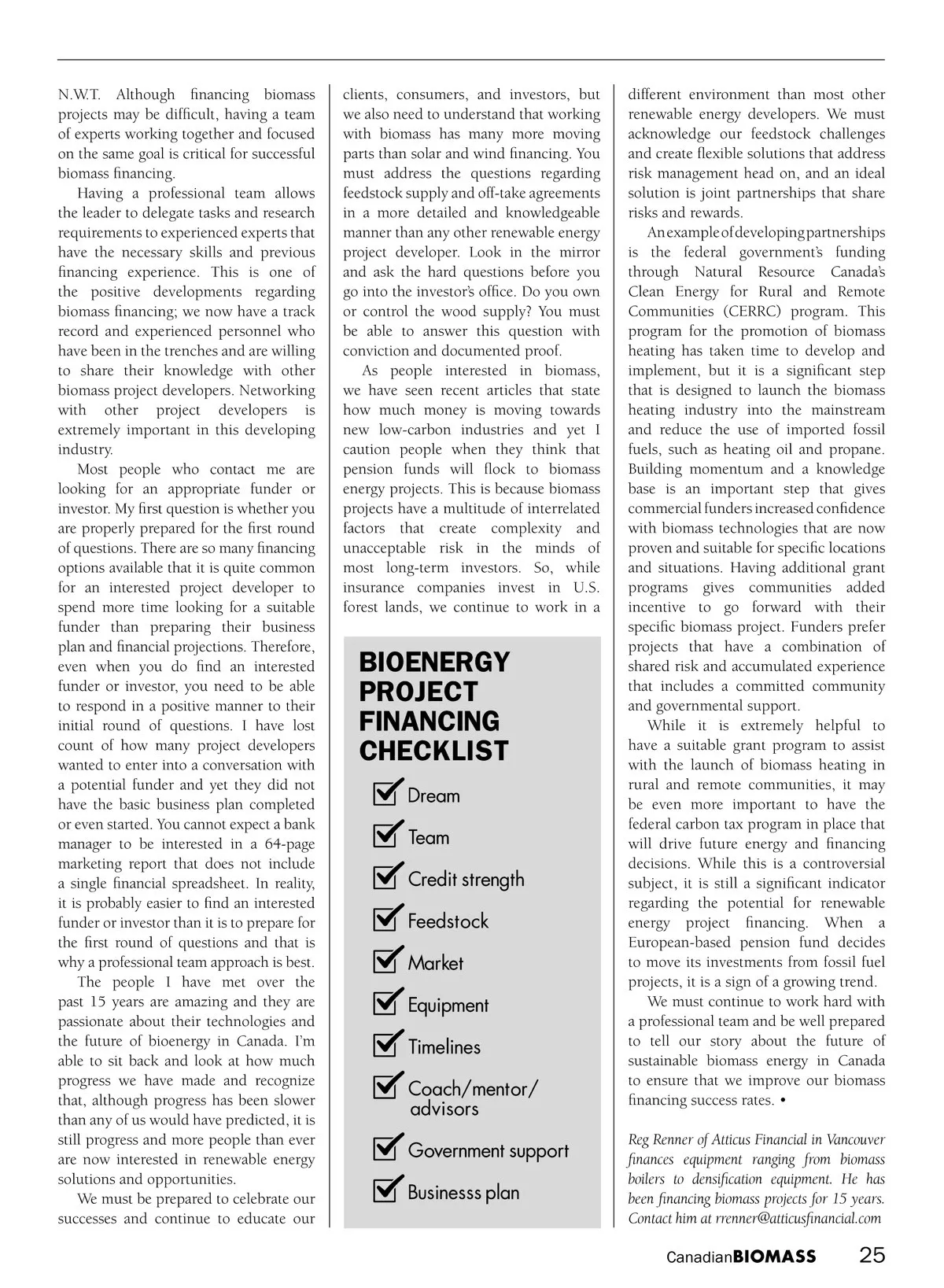
N.W.T. Although financing biomass projects may be difficult, having a team of experts working together and focused on the same goal is critical for successful biomass financing. Having a professional team allows the leader to delegate tasks and research requirements to experienced experts that have the necessary skills and previous financing experience. This is one of the positive developments regarding biomass financing; we now have a track record and experienced personnel who have been in the trenches and are willing to share their knowledge with other biomass project developers. Networking with other project developers is extremely important in this developing industry. Most people who contact me are looking for an appropriate funder or investor. My first question is whether you are properly prepared for the first round of questions. There are so many financing options available that it is quite common for an interested project developer to spend more time looking for a suitable funder than preparing their business plan and financial projections. Therefore, even when you do find an interested funder or investor, you need to be able to respond in a positive manner to their initial round of questions. I have lost count of how many project developers wanted to enter into a conversation with a potential funder and yet they did not have the basic business plan completed or even started. You cannot expect a bank manager to be interested in a 64-page marketing report that does not include a single financial spreadsheet. In reality, it is probably easier to find an interested funder or investor than it is to prepare for the first round of questions and that is why a professional team approach is best. The people I have met over the past 15 years are amazing and they are passionate about their technologies and the future of bioenergy in Canada. I’m able to sit back and look at how much progress we have made and recognize that, although progress has been slower than any of us would have predicted, it is still progress and more people than ever are now interested in renewable energy solutions and opportunities. We must be prepared to celebrate our successes and continue to educate our clients, consumers, and investors, but we also need to understand that working with biomass has many more moving parts than solar and wind financing. You must address the questions regarding feedstock supply and off-take agreements in a more detailed and knowledgeable manner than any other renewable energy project developer. Look in the mirror and ask the hard questions before you go into the investor’s office. Do you own or control the wood supply? You must be able to answer this question with conviction and documented proof. As people interested in biomass, we have seen recent articles that state how much money is moving towards new low-carbon industries and yet I caution people when they think that pension funds will flock to biomass energy projects. This is because biomass projects have a multitude of interrelated factors that create complexity and unacceptable risk in the minds of most long-term investors. So, while insurance companies invest in U.S. forest lands, we continue to work in a BIOENERGY PROJECT FINANCING CHECKLIST Dream Team Credit strength Feedstock Market Equipment Timelines Coach/mentor/ advisors Government support Businesss plan different environment than most other renewable energy developers. We must acknowledge our feedstock challenges and create flexible solutions that address risk management head on, and an ideal solution is joint partnerships that share risks and rewards. An example of developing partnerships is the federal government’s funding through Natural Resource Canada’s Clean Energy for Rural and Remote Communities (CERRC) program. This program for the promotion of biomass heating has taken time to develop and implement, but it is a significant step that is designed to launch the biomass heating industry into the mainstream and reduce the use of imported fossil fuels, such as heating oil and propane. Building momentum and a knowledge base is an important step that gives commercial funders increased confidence with biomass technologies that are now proven and suitable for specific locations and situations. Having additional grant programs gives communities added incentive to go forward with their specific biomass project. Funders prefer projects that have a combination of shared risk and accumulated experience that includes a committed community and governmental support. While it is extremely helpful to have a suitable grant program to assist with the launch of biomass heating in rural and remote communities, it may be even more important to have the federal carbon tax program in place that will drive future energy and financing decisions. While this is a controversial subject, it is still a significant indicator regarding the potential for renewable energy project financing. When a European-based pension fund decides to move its investments from fossil fuel projects, it is a sign of a growing trend. We must continue to work hard with a professional team and be well prepared to tell our story about the future of sustainable biomass energy in Canada to ensure that we improve our biomass financing success rates. • Reg Renner of Atticus Financial in Vancouver finances equipment ranging from biomass boilers to densification equipment. He has been financing biomass projects for 15 years. Contact him at [email protected] Canadian BIOMASS 25
Canadian Biomass Spring 2019: Page 25