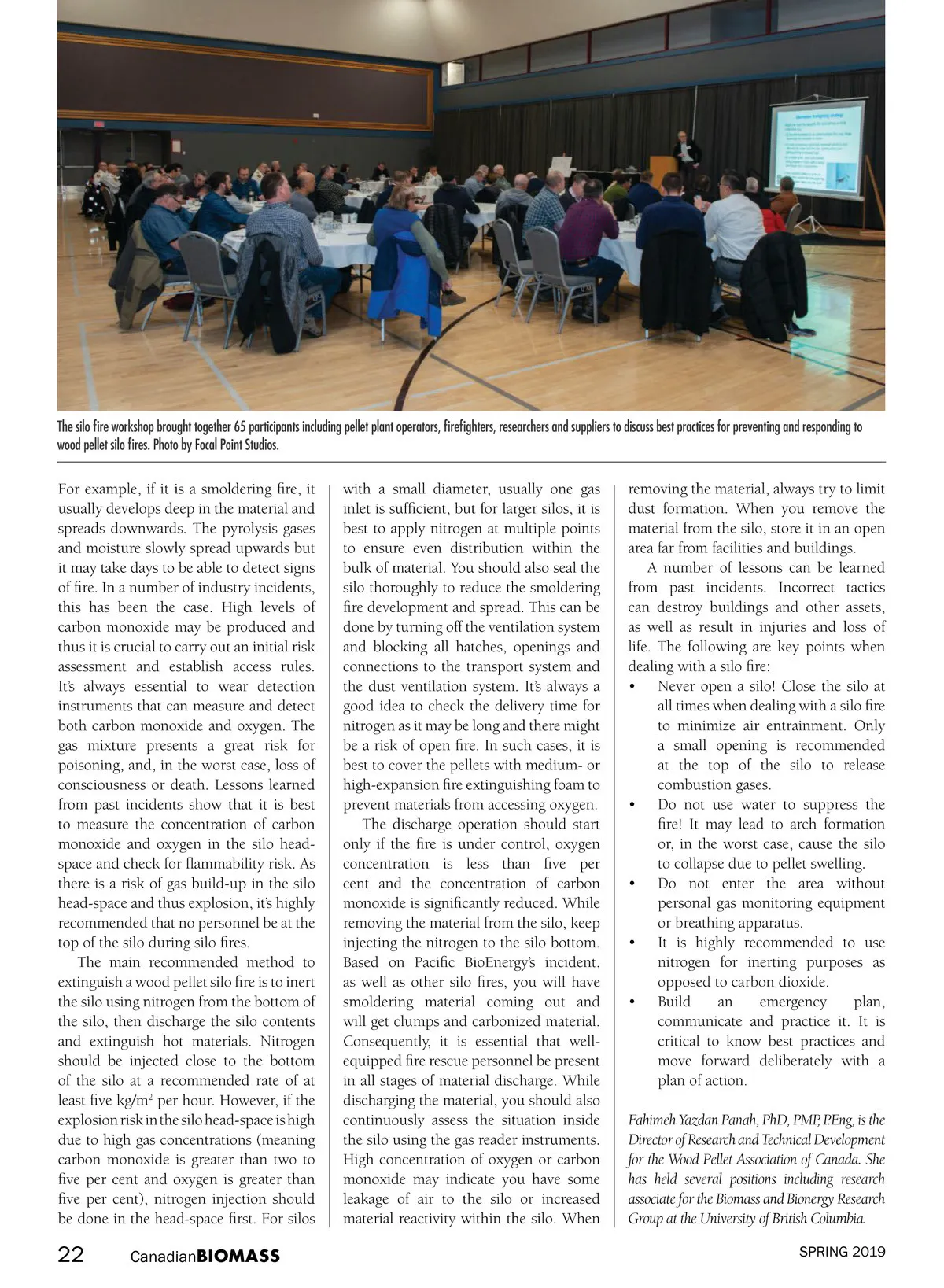
The silo fire workshop brought together 65 participants including pellet plant operators, firefighters, researchers and suppliers to discuss best practices for preventing and responding to wood pellet silo fires. Photo by Focal Point Studios. For example, if it is a smoldering fire, it usually develops deep in the material and spreads downwards. The pyrolysis gases and moisture slowly spread upwards but it may take days to be able to detect signs of fire. In a number of industry incidents, this has been the case. High levels of carbon monoxide may be produced and thus it is crucial to carry out an initial risk assessment and establish access rules. It’s always essential to wear detection instruments that can measure and detect both carbon monoxide and oxygen. The gas mixture presents a great risk for poisoning, and, in the worst case, loss of consciousness or death. Lessons learned from past incidents show that it is best to measure the concentration of carbon monoxide and oxygen in the silo head-space and check for flammability risk. As there is a risk of gas build-up in the silo head-space and thus explosion, it’s highly recommended that no personnel be at the top of the silo during silo fires. The main recommended method to extinguish a wood pellet silo fire is to inert the silo using nitrogen from the bottom of the silo, then discharge the silo contents and extinguish hot materials. Nitrogen should be injected close to the bottom of the silo at a recommended rate of at least five kg/m 2 per hour. However, if the explosion risk in the silo head-space is high due to high gas concentrations (meaning carbon monoxide is greater than two to five per cent and oxygen is greater than five per cent), nitrogen injection should be done in the head-space first. For silos with a small diameter, usually one gas inlet is sufficient, but for larger silos, it is best to apply nitrogen at multiple points to ensure even distribution within the bulk of material. You should also seal the silo thoroughly to reduce the smoldering fire development and spread. This can be done by turning off the ventilation system and blocking all hatches, openings and connections to the transport system and the dust ventilation system. It’s always a good idea to check the delivery time for nitrogen as it may be long and there might be a risk of open fire. In such cases, it is best to cover the pellets with medium-or high-expansion fire extinguishing foam to prevent materials from accessing oxygen. The discharge operation should start only if the fire is under control, oxygen concentration is less than five per cent and the concentration of carbon monoxide is significantly reduced. While removing the material from the silo, keep injecting the nitrogen to the silo bottom. Based on Pacific BioEnergy’s incident, as well as other silo fires, you will have smoldering material coming out and will get clumps and carbonized material. Consequently, it is essential that well-equipped fire rescue personnel be present in all stages of material discharge. While discharging the material, you should also continuously assess the situation inside the silo using the gas reader instruments. High concentration of oxygen or carbon monoxide may indicate you have some leakage of air to the silo or increased material reactivity within the silo. When removing the material, always try to limit dust formation. When you remove the material from the silo, store it in an open area far from facilities and buildings. A number of lessons can be learned from past incidents. Incorrect tactics can destroy buildings and other assets, as well as result in injuries and loss of life. The following are key points when dealing with a silo fire: • Never open a silo! Close the silo at all times when dealing with a silo fire to minimize air entrainment. Only a small opening is recommended at the top of the silo to release combustion gases. • Do not use water to suppress the fire! It may lead to arch formation or, in the worst case, cause the silo to collapse due to pellet swelling. • Do not enter the area without personal gas monitoring equipment or breathing apparatus. • It is highly recommended to use nitrogen for inerting purposes as opposed to carbon dioxide. an emergency plan, • Build communicate and practice it. It is critical to know best practices and move forward deliberately with a plan of action. Fahimeh Yazdan Panah, PhD, PMP , P .Eng, is the Director of Research and Technical Development for the Wood Pellet Association of Canada. She has held several positions including research associate for the Biomass and Bionergy Research Group at the University of British Columbia. SPRING 2019 22 Canadian BIOMASS
Canadian Biomass Spring 2019: Page 22