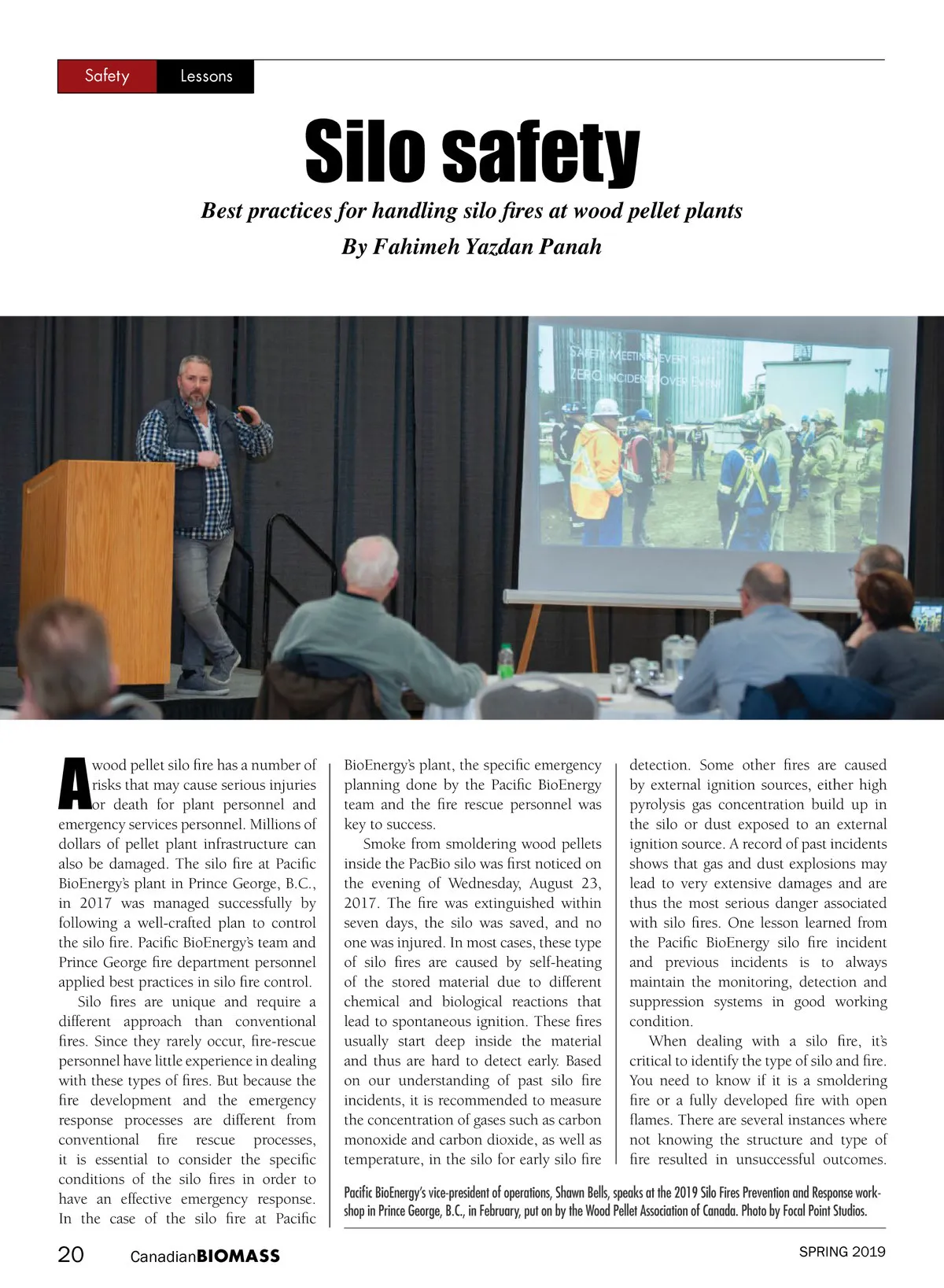
Safety Lessons Best practices for handling silo fires at wood pellet plants By Fahimeh Yazdan Panah Silo safety wood pellet silo fire has a number of risks that may cause serious injuries or death for plant personnel and emergency services personnel. Millions of dollars of pellet plant infrastructure can also be damaged. The silo fire at Pacific BioEnergy’s plant in Prince George, B.C., in 2017 was managed successfully by following a well-crafted plan to control the silo fire. Pacific BioEnergy’s team and Prince George fire department personnel applied best practices in silo fire control. Silo fires are unique and require a different approach than conventional fires. Since they rarely occur, fire-rescue personnel have little experience in dealing with these types of fires. But because the fire development and the emergency response processes are different from conventional fire rescue processes, it is essential to consider the specific conditions of the silo fires in order to have an effective emergency response. In the case of the silo fire at Pacific A BioEnergy’s plant, the specific emergency planning done by the Pacific BioEnergy team and the fire rescue personnel was key to success. Smoke from smoldering wood pellets inside the PacBio silo was first noticed on the evening of Wednesday, August 23, 2017. The fire was extinguished within seven days, the silo was saved, and no one was injured. In most cases, these type of silo fires are caused by self-heating of the stored material due to different chemical and biological reactions that lead to spontaneous ignition. These fires usually start deep inside the material and thus are hard to detect early. Based on our understanding of past silo fire incidents, it is recommended to measure the concentration of gases such as carbon monoxide and carbon dioxide, as well as temperature, in the silo for early silo fire detection. Some other fires are caused by external ignition sources, either high pyrolysis gas concentration build up in the silo or dust exposed to an external ignition source. A record of past incidents shows that gas and dust explosions may lead to very extensive damages and are thus the most serious danger associated with silo fires. One lesson learned from the Pacific BioEnergy silo fire incident and previous incidents is to always maintain the monitoring, detection and suppression systems in good working condition. When dealing with a silo fire, it’s critical to identify the type of silo and fire. You need to know if it is a smoldering fire or a fully developed fire with open flames. There are several instances where not knowing the structure and type of fire resulted in unsuccessful outcomes. Pacific BioEnergy’s vice-president of operations, Shawn Bells, speaks at the 2019 Silo Fires Prevention and Response work-shop in Prince George, B.C., in February, put on by the Wood Pellet Association of Canada. Photo by Focal Point Studios. SPRING 2019 20 Canadian BIOMASS
Canadian Biomass Spring 2019: Page 20