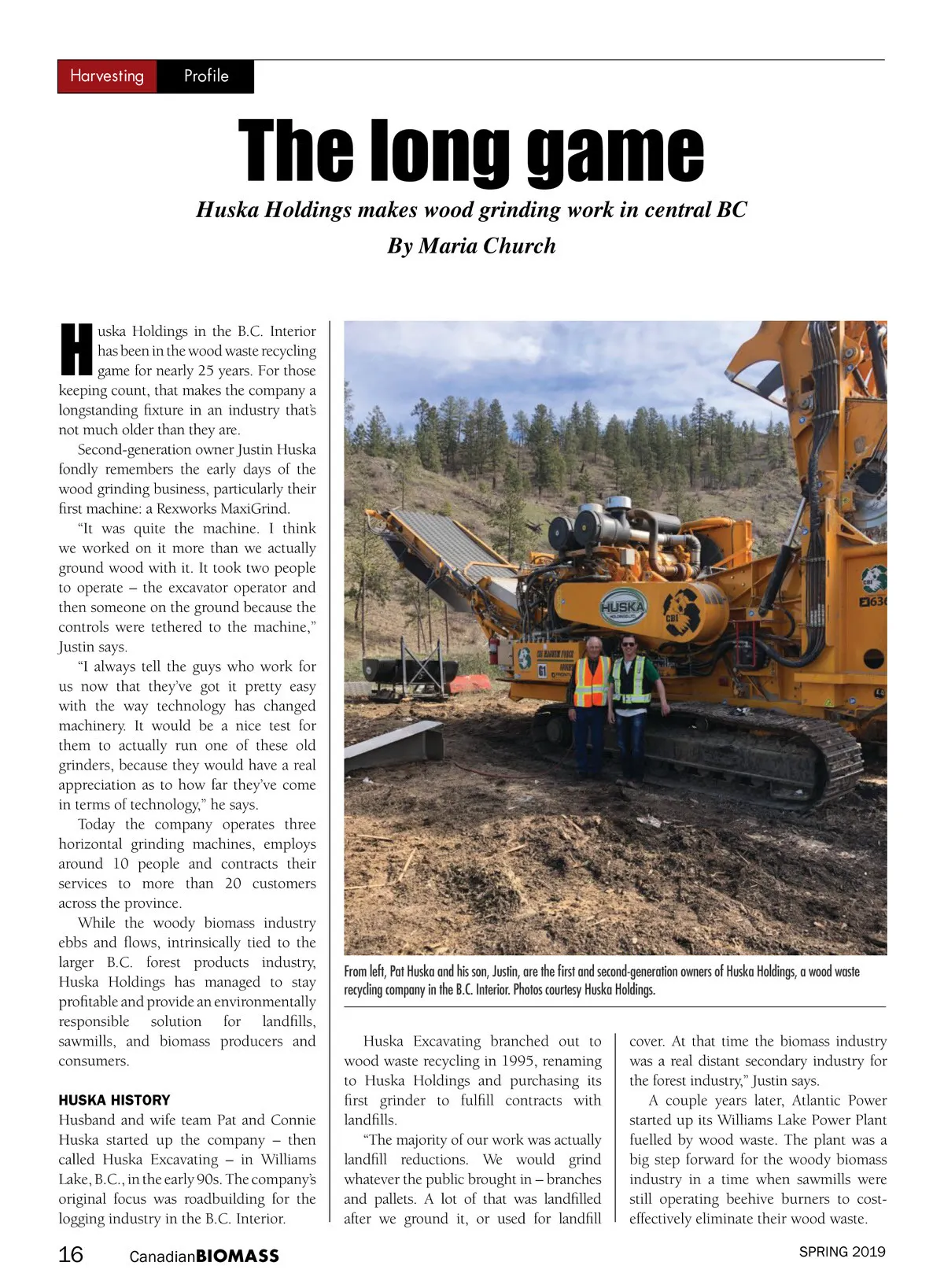
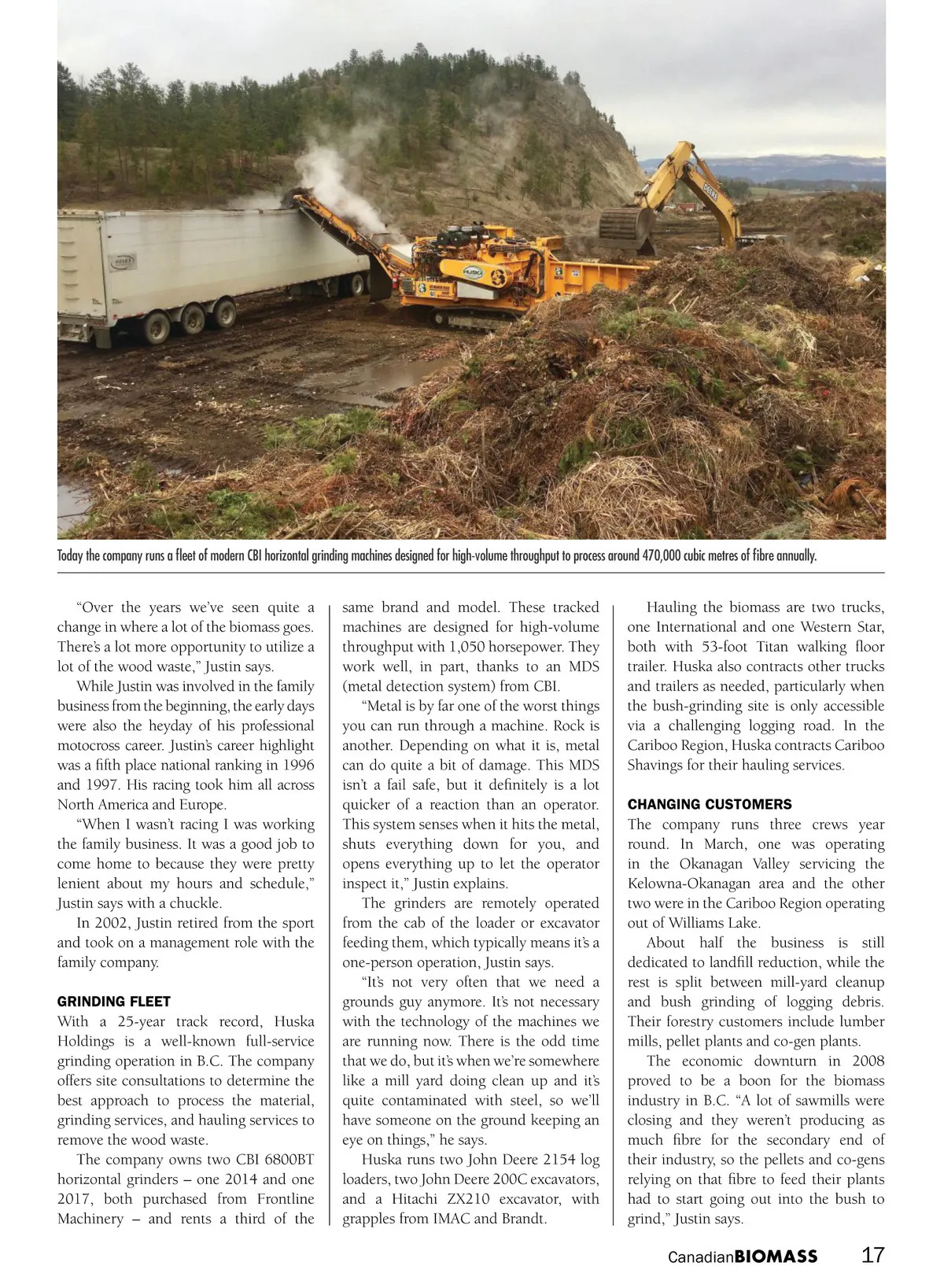
Today the company runs a fleet of modern CBI horizontal grinding machines designed for high-volume throughput to process around 470,000 cubic metres of fibre annually. “Over the years we’ve seen quite a change in where a lot of the biomass goes. There’s a lot more opportunity to utilize a lot of the wood waste,” Justin says. While Justin was involved in the family business from the beginning, the early days were also the heyday of his professional motocross career. Justin’s career highlight was a fifth place national ranking in 1996 and 1997. His racing took him all across North America and Europe. “When I wasn’t racing I was working the family business. It was a good job to come home to because they were pretty lenient about my hours and schedule,” Justin says with a chuckle. In 2002, Justin retired from the sport and took on a management role with the family company. GRINDING FLEET With a 25-year track record, Huska Holdings is a well-known full-service grinding operation in B.C. The company offers site consultations to determine the best approach to process the material, grinding services, and hauling services to remove the wood waste. The company owns two CBI 6800BT horizontal grinders – one 2014 and one 2017, both purchased from Frontline Machinery – and rents a third of the same brand and model. These tracked machines are designed for high-volume throughput with 1,050 horsepower. They work well, in part, thanks to an MDS (metal detection system) from CBI. “Metal is by far one of the worst things you can run through a machine. Rock is another. Depending on what it is, metal can do quite a bit of damage. This MDS isn’t a fail safe, but it definitely is a lot quicker of a reaction than an operator. This system senses when it hits the metal, shuts everything down for you, and opens everything up to let the operator inspect it,” Justin explains. The grinders are remotely operated from the cab of the loader or excavator feeding them, which typically means it’s a one-person operation, Justin says. “It’s not very often that we need a grounds guy anymore. It’s not necessary with the technology of the machines we are running now. There is the odd time that we do, but it’s when we’re somewhere like a mill yard doing clean up and it’s quite contaminated with steel, so we’ll have someone on the ground keeping an eye on things,” he says. Huska runs two John Deere 2154 log loaders, two John Deere 200C excavators, and a Hitachi ZX210 excavator, with grapples from IMAC and Brandt. Hauling the biomass are two trucks, one International and one Western Star, both with 53-foot Titan walking floor trailer. Huska also contracts other trucks and trailers as needed, particularly when the bush-grinding site is only accessible via a challenging logging road. In the Cariboo Region, Huska contracts Cariboo Shavings for their hauling services. CHANGING CUSTOMERS The company runs three crews year round. In March, one was operating in the Okanagan Valley servicing the Kelowna-Okanagan area and the other two were in the Cariboo Region operating out of Williams Lake. About half the business is still dedicated to landfill reduction, while the rest is split between mill-yard cleanup and bush grinding of logging debris. Their forestry customers include lumber mills, pellet plants and co-gen plants. The economic downturn in 2008 proved to be a boon for the biomass industry in B.C. “A lot of sawmills were closing and they weren’t producing as much fibre for the secondary end of their industry, so the pellets and co-gens relying on that fibre to feed their plants had to start going out into the bush to grind,” Justin says. Canadian BIOMASS 17
Canadian Biomass Spring 2019: Page 17