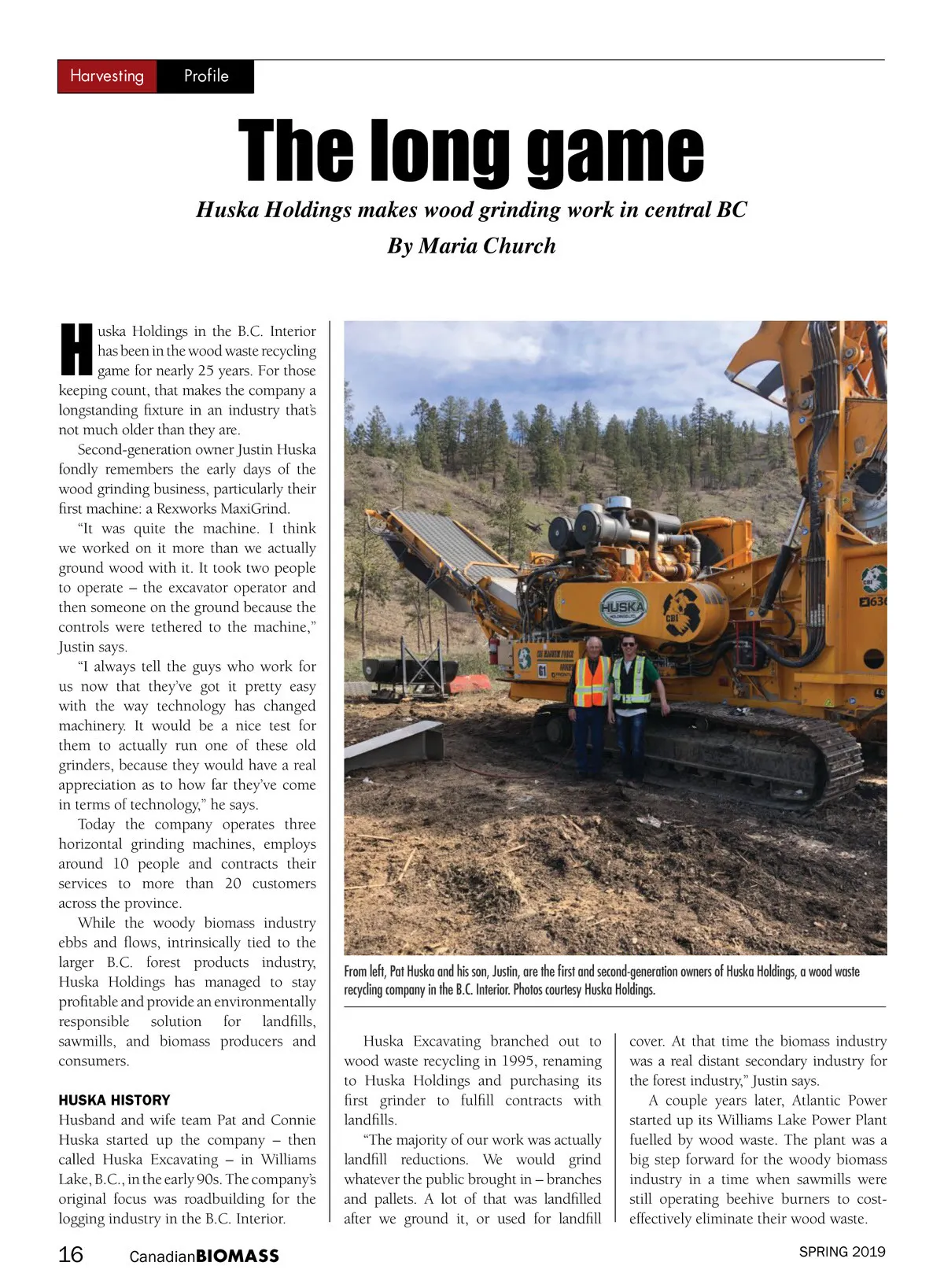
Harvesting Profile Huska Holdings makes wood grinding work in central BC By Maria Church The long game H uska Holdings in the B.C. Interior has been in the wood waste recycling game for nearly 25 years. For those keeping count, that makes the company a longstanding fixture in an industry that’s not much older than they are. Second-generation owner Justin Huska fondly remembers the early days of the wood grinding business, particularly their first machine: a Rexworks MaxiGrind. “It was quite the machine. I think we worked on it more than we actually ground wood with it. It took two people to operate – the excavator operator and then someone on the ground because the controls were tethered to the machine,” Justin says. “I always tell the guys who work for us now that they’ve got it pretty easy with the way technology has changed machinery. It would be a nice test for them to actually run one of these old grinders, because they would have a real appreciation as to how far they’ve come in terms of technology,” he says. Today the company operates three horizontal grinding machines, employs around 10 people and contracts their services to more than 20 customers across the province. While the woody biomass industry ebbs and flows, intrinsically tied to the larger B.C. forest products industry, Huska Holdings has managed to stay profitable and provide an environmentally responsible solution for landfills, sawmills, and biomass producers and consumers. From left, Pat Huska and his son, Justin, are the first and second-generation owners of Huska Holdings, a wood waste recycling company in the B.C. Interior. Photos courtesy Huska Holdings. HUSKA HISTORY Husband and wife team Pat and Connie Huska started up the company – then called Huska Excavating – in Williams Lake, B.C., in the early 90s. The company’s original focus was roadbuilding for the logging industry in the B.C. Interior. Huska Excavating branched out to wood waste recycling in 1995, renaming to Huska Holdings and purchasing its first grinder to fulfill contracts with landfills. “The majority of our work was actually landfill reductions. We would grind whatever the public brought in – branches and pallets. A lot of that was landfilled after we ground it, or used for landfill cover. At that time the biomass industry was a real distant secondary industry for the forest industry,” Justin says. A couple years later, Atlantic Power started up its Williams Lake Power Plant fuelled by wood waste. The plant was a big step forward for the woody biomass industry in a time when sawmills were still operating beehive burners to cost-effectively eliminate their wood waste. SPRING 2019 16 Canadian BIOMASS
Canadian Biomass Spring 2019: Page 16