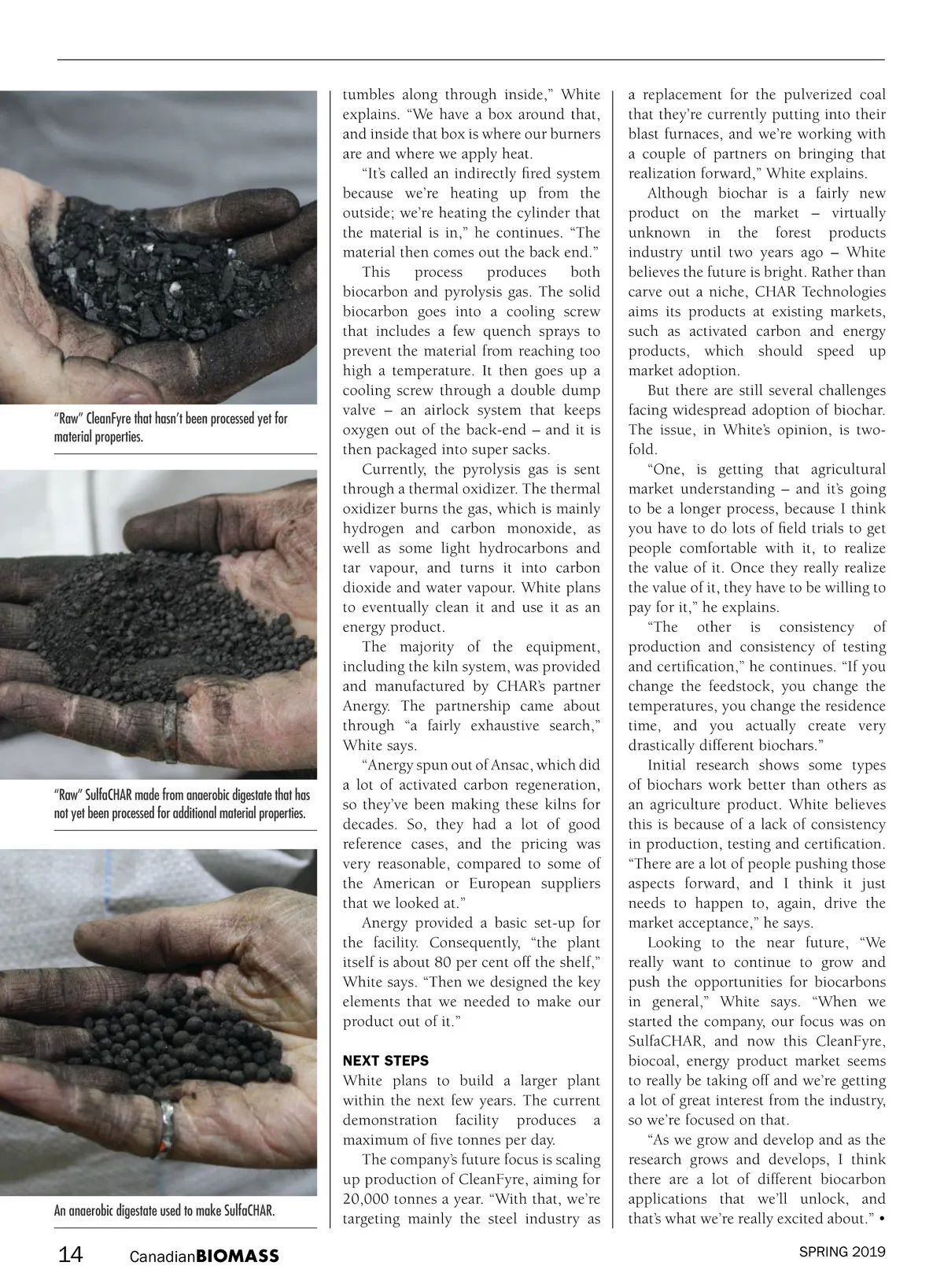
“Raw” CleanFyre that hasn’t been processed yet for material properties. “Raw” SulfaCHAR made from anaerobic digestate that has not yet been processed for additional material properties. tumbles along through inside,” White explains. “We have a box around that, and inside that box is where our burners are and where we apply heat. “It’s called an indirectly fired system because we’re heating up from the outside; we’re heating the cylinder that the material is in,” he continues. “The material then comes out the back end.” This process produces both biocarbon and pyrolysis gas. The solid biocarbon goes into a cooling screw that includes a few quench sprays to prevent the material from reaching too high a temperature. It then goes up a cooling screw through a double dump valve – an airlock system that keeps oxygen out of the back-end – and it is then packaged into super sacks. Currently, the pyrolysis gas is sent through a thermal oxidizer. The thermal oxidizer burns the gas, which is mainly hydrogen and carbon monoxide, as well as some light hydrocarbons and tar vapour, and turns it into carbon dioxide and water vapour. White plans to eventually clean it and use it as an energy product. The majority of the equipment, including the kiln system, was provided and manufactured by CHAR’s partner Anergy. The partnership came about through “a fairly exhaustive search,” White says. “Anergy spun out of Ansac, which did a lot of activated carbon regeneration, so they’ve been making these kilns for decades. So, they had a lot of good reference cases, and the pricing was very reasonable, compared to some of the American or European suppliers that we looked at.” Anergy provided a basic set-up for the facility. Consequently, “the plant itself is about 80 per cent off the shelf,” White says. “Then we designed the key elements that we needed to make our product out of it.” NEXT STEPS An anaerobic digestate used to make SulfaCHAR. White plans to build a larger plant within the next few years. The current demonstration facility produces a maximum of five tonnes per day. The company’s future focus is scaling up production of CleanFyre, aiming for 20,000 tonnes a year. “With that, we’re targeting mainly the steel industry as a replacement for the pulverized coal that they’re currently putting into their blast furnaces, and we’re working with a couple of partners on bringing that realization forward,” White explains. Although biochar is a fairly new product on the market – virtually unknown in the forest products industry until two years ago – White believes the future is bright. Rather than carve out a niche, CHAR Technologies aims its products at existing markets, such as activated carbon and energy products, which should speed up market adoption. But there are still several challenges facing widespread adoption of biochar. The issue, in White’s opinion, is two-fold. “One, is getting that agricultural market understanding – and it’s going to be a longer process, because I think you have to do lots of field trials to get people comfortable with it, to realize the value of it. Once they really realize the value of it, they have to be willing to pay for it,” he explains. “The other is consistency of production and consistency of testing and certification,” he continues. “If you change the feedstock, you change the temperatures, you change the residence time, and you actually create very drastically different biochars.” Initial research shows some types of biochars work better than others as an agriculture product. White believes this is because of a lack of consistency in production, testing and certification. “There are a lot of people pushing those aspects forward, and I think it just needs to happen to, again, drive the market acceptance,” he says. Looking to the near future, “We really want to continue to grow and push the opportunities for biocarbons in general,” White says. “When we started the company, our focus was on SulfaCHAR, and now this CleanFyre, biocoal, energy product market seems to really be taking off and we’re getting a lot of great interest from the industry, so we’re focused on that. “As we grow and develop and as the research grows and develops, I think there are a lot of different biocarbon applications that we’ll unlock, and that’s what we’re really excited about.” • SPRING 2019 14 Canadian BIOMASS
Canadian Biomass Spring 2019: Page 14