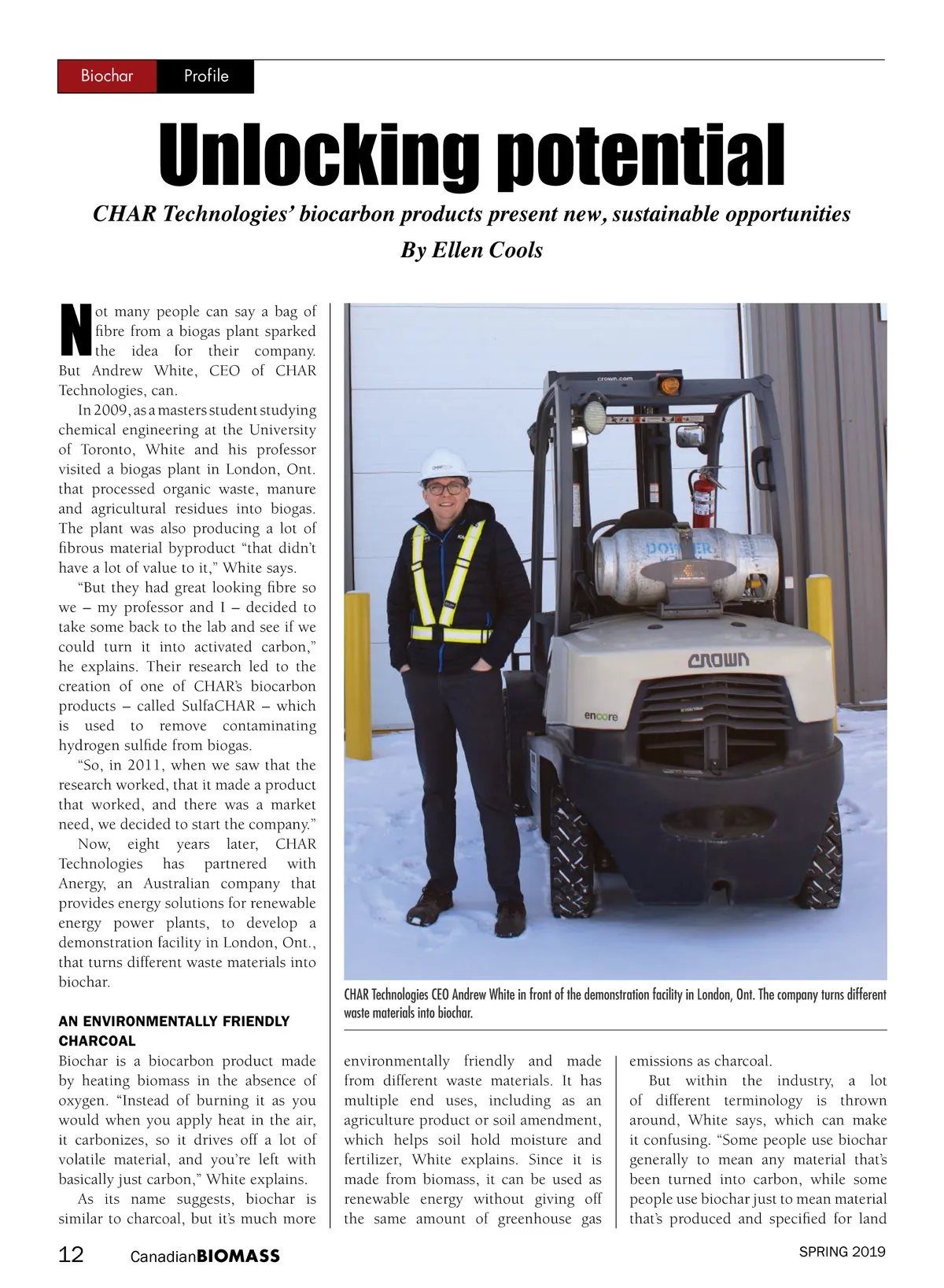
Biochar Profile CHAR Technologies’ biocarbon products present new, sustainable opportunities By Ellen Cools Unlocking potential ot many people can say a bag of fibre from a biogas plant sparked the idea for their company. But Andrew White, CEO of CHAR Technologies, can. In 2009, as a masters student studying chemical engineering at the University of Toronto, White and his professor visited a biogas plant in London, Ont. that processed organic waste, manure and agricultural residues into biogas. The plant was also producing a lot of fibrous material byproduct “that didn’t have a lot of value to it,” White says. “But they had great looking fibre so we – my professor and I – decided to take some back to the lab and see if we could turn it into activated carbon,” he explains. Their research led to the creation of one of CHAR’s biocarbon products – called SulfaCHAR – which is used to remove contaminating hydrogen sulfide from biogas. “So, in 2011, when we saw that the research worked, that it made a product that worked, and there was a market need, we decided to start the company.” Now, eight years later, CHAR Technologies has partnered with Anergy, an Australian company that provides energy solutions for renewable energy power plants, to develop a demonstration facility in London, Ont., that turns different waste materials into biochar. AN ENVIRONMENTALLY FRIENDLY CHARCOAL N CHAR Technologies CEO Andrew White in front of the demonstration facility in London, Ont. The company turns different waste materials into biochar. Biochar is a biocarbon product made by heating biomass in the absence of oxygen. “Instead of burning it as you would when you apply heat in the air, it carbonizes, so it drives off a lot of volatile material, and you’re left with basically just carbon,” White explains. As its name suggests, biochar is similar to charcoal, but it’s much more environmentally friendly and made from different waste materials. It has multiple end uses, including as an agriculture product or soil amendment, which helps soil hold moisture and fertilizer, White explains. Since it is made from biomass, it can be used as renewable energy without giving off the same amount of greenhouse gas emissions as charcoal. But within the industry, a lot of different terminology is thrown around, White says, which can make it confusing. “Some people use biochar generally to mean any material that’s been turned into carbon, while some people use biochar just to mean material that’s produced and specified for land SPRING 2019 12 Canadian BIOMASS
Canadian Biomass Spring 2019: Page 12