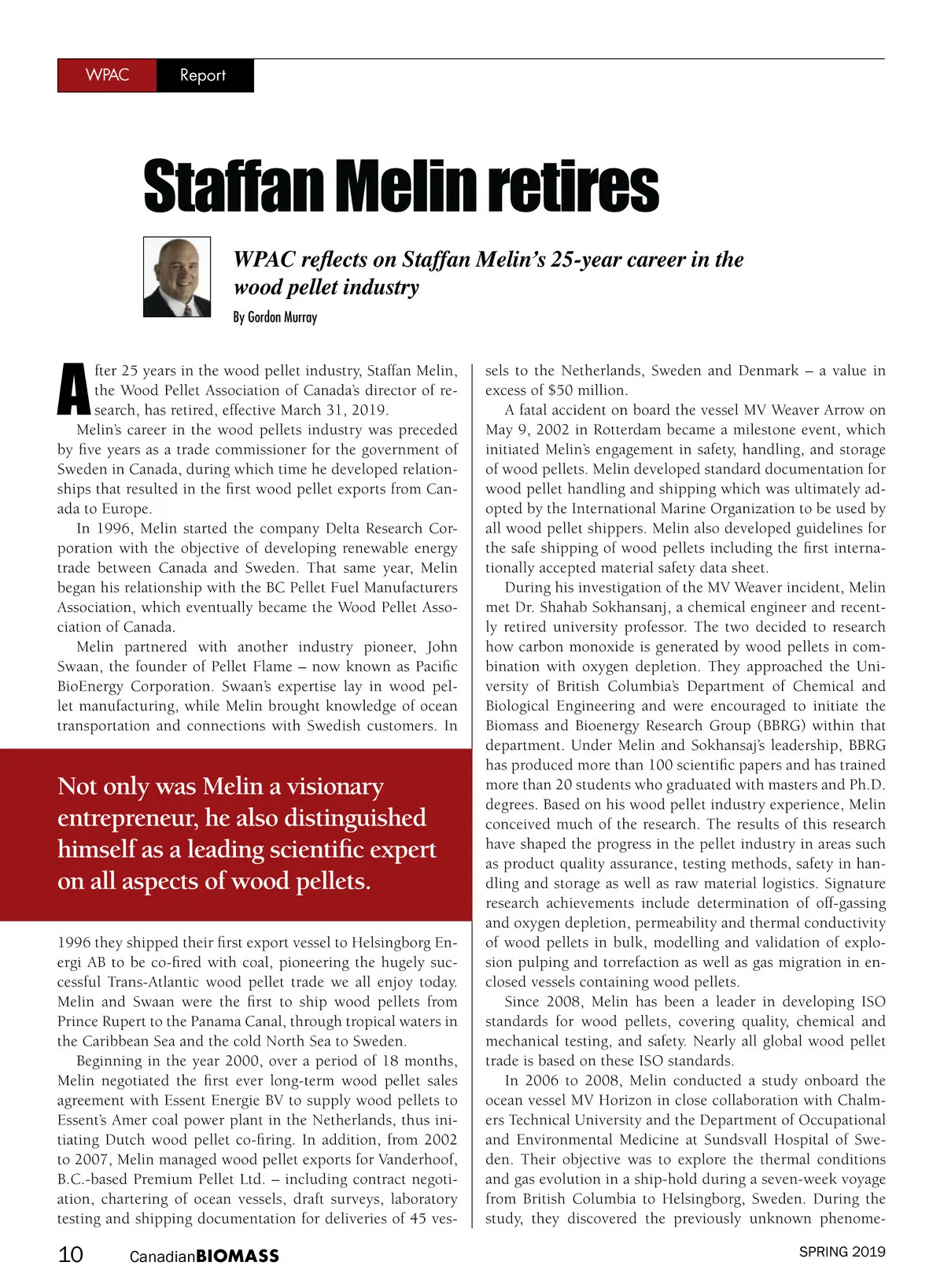
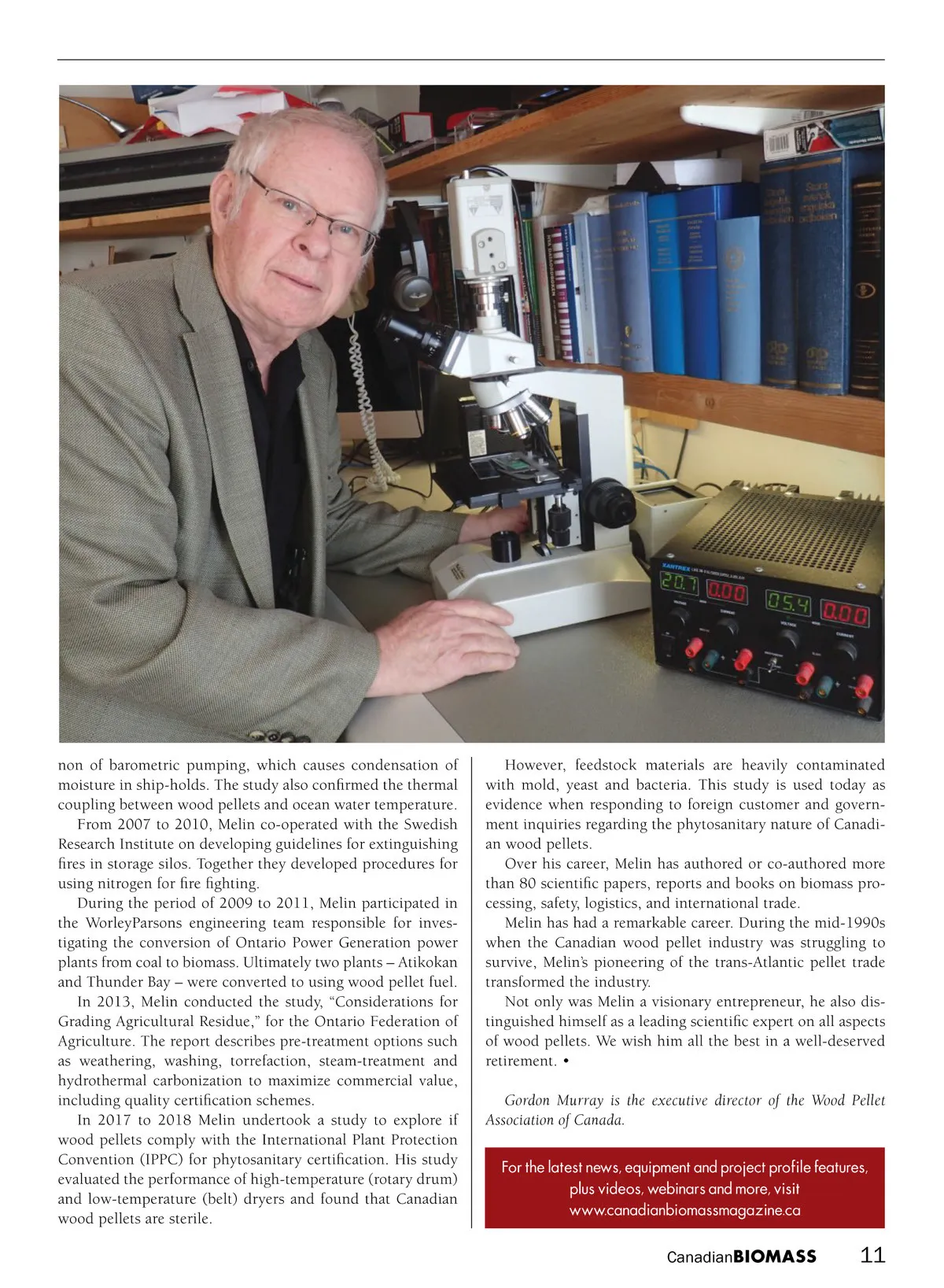
WPAC Report Staffan Melin retires WPAC reflects on Staffan Melin’s 25-year career in the wood pellet industry By Gordon Murray fter 25 years in the wood pellet industry, Staffan Melin, the Wood Pellet Association of Canada’s director of re-search, has retired, effective March 31, 2019. Melin’s career in the wood pellets industry was preceded by five years as a trade commissioner for the government of Sweden in Canada, during which time he developed relation-ships that resulted in the first wood pellet exports from Can-ada to Europe. In 1996, Melin started the company Delta Research Cor-poration with the objective of developing renewable energy trade between Canada and Sweden. That same year, Melin began his relationship with the BC Pellet Fuel Manufacturers Association, which eventually became the Wood Pellet Asso-ciation of Canada. Melin partnered with another industry pioneer, John Swaan, the founder of Pellet Flame – now known as Pacific BioEnergy Corporation. Swaan’s expertise lay in wood pel-let manufacturing, while Melin brought knowledge of ocean transportation and connections with Swedish customers. In A Not only was Melin a visionary entrepreneur, he also distinguished himself as a leading scientific expert on all aspects of wood pellets. 1996 they shipped their first export vessel to Helsingborg En-ergi AB to be co-fired with coal, pioneering the hugely suc-cessful Trans-Atlantic wood pellet trade we all enjoy today. Melin and Swaan were the first to ship wood pellets from Prince Rupert to the Panama Canal, through tropical waters in the Caribbean Sea and the cold North Sea to Sweden. Beginning in the year 2000, over a period of 18 months, Melin negotiated the first ever long-term wood pellet sales agreement with Essent Energie BV to supply wood pellets to Essent’s Amer coal power plant in the Netherlands, thus ini-tiating Dutch wood pellet co-firing. In addition, from 2002 to 2007, Melin managed wood pellet exports for Vanderhoof, B.C.-based Premium Pellet Ltd. – including contract negoti-ation, chartering of ocean vessels, draft surveys, laboratory testing and shipping documentation for deliveries of 45 ves-sels to the Netherlands, Sweden and Denmark – a value in excess of $50 million. A fatal accident on board the vessel MV Weaver Arrow on May 9, 2002 in Rotterdam became a milestone event, which initiated Melin’s engagement in safety, handling, and storage of wood pellets. Melin developed standard documentation for wood pellet handling and shipping which was ultimately ad-opted by the International Marine Organization to be used by all wood pellet shippers. Melin also developed guidelines for the safe shipping of wood pellets including the first interna-tionally accepted material safety data sheet. During his investigation of the MV Weaver incident, Melin met Dr. Shahab Sokhansanj, a chemical engineer and recent-ly retired university professor. The two decided to research how carbon monoxide is generated by wood pellets in com-bination with oxygen depletion. They approached the Uni-versity of British Columbia’s Department of Chemical and Biological Engineering and were encouraged to initiate the Biomass and Bioenergy Research Group (BBRG) within that department. Under Melin and Sokhansaj’s leadership, BBRG has produced more than 100 scientific papers and has trained more than 20 students who graduated with masters and Ph.D. degrees. Based on his wood pellet industry experience, Melin conceived much of the research. The results of this research have shaped the progress in the pellet industry in areas such as product quality assurance, testing methods, safety in han-dling and storage as well as raw material logistics. Signature research achievements include determination of off-gassing and oxygen depletion, permeability and thermal conductivity of wood pellets in bulk, modelling and validation of explo-sion pulping and torrefaction as well as gas migration in en-closed vessels containing wood pellets. Since 2008, Melin has been a leader in developing ISO standards for wood pellets, covering quality, chemical and mechanical testing, and safety. Nearly all global wood pellet trade is based on these ISO standards. In 2006 to 2008, Melin conducted a study onboard the ocean vessel MV Horizon in close collaboration with Chalm-ers Technical University and the Department of Occupational and Environmental Medicine at Sundsvall Hospital of Swe-den. Their objective was to explore the thermal conditions and gas evolution in a ship-hold during a seven-week voyage from British Columbia to Helsingborg, Sweden. During the study, they discovered the previously unknown phenome-SPRING 2019 10 Canadian BIOMASS
Canadian Biomass Spring 2019: Page 10