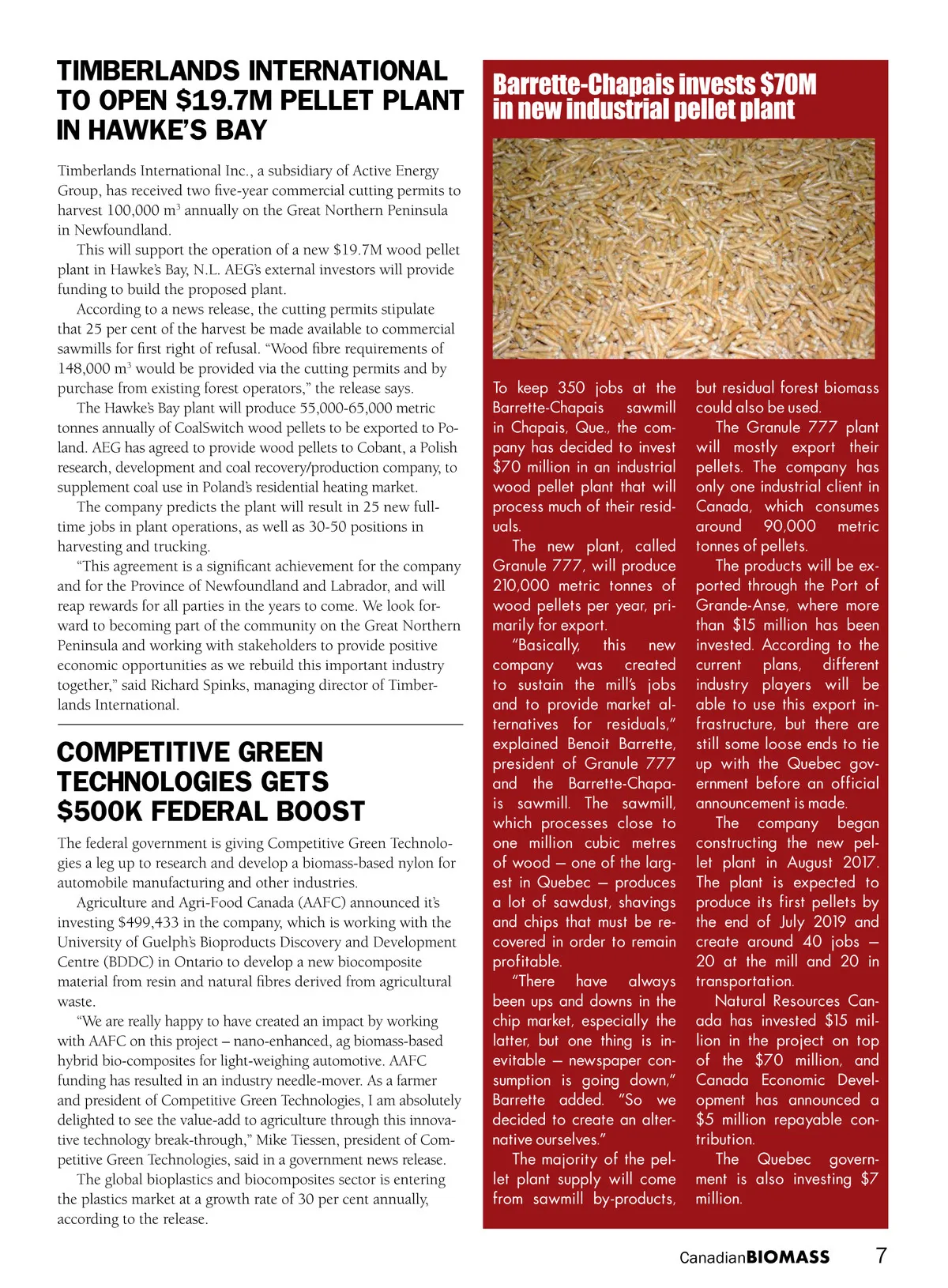
TIMBERLANDS INTERNATIONAL TO OPEN $19.7M PELLET PLANT IN HAWKE’S BAY Timberlands International Inc., a subsidiary of Active Energy Group, has received two five-year commercial cutting permits to harvest 100,000 m 3 annually on the Great Northern Peninsula in Newfoundland. This will support the operation of a new $19.7M wood pellet plant in Hawke’s Bay, N.L. AEG’s external investors will provide funding to build the proposed plant. According to a news release, the cutting permits stipulate that 25 per cent of the harvest be made available to commercial sawmills for first right of refusal. “Wood fibre requirements of 148,000 m 3 would be provided via the cutting permits and by purchase from existing forest operators,” the release says. The Hawke’s Bay plant will produce 55,000-65,000 metric tonnes annually of CoalSwitch wood pellets to be exported to Po-land. AEG has agreed to provide wood pellets to Cobant, a Polish research, development and coal recovery/production company, to supplement coal use in Poland’s residential heating market. The company predicts the plant will result in 25 new full-time jobs in plant operations, as well as 30-50 positions in harvesting and trucking. “This agreement is a significant achievement for the company and for the Province of Newfoundland and Labrador, and will reap rewards for all parties in the years to come. We look for-ward to becoming part of the community on the Great Northern Peninsula and working with stakeholders to provide positive economic opportunities as we rebuild this important industry together,” said Richard Spinks, managing director of Timber-lands International. Barrette-Chapais invests $70M in new industrial pellet plant COMPETITIVE GREEN TECHNOLOGIES GETS $500K FEDERAL BOOST The federal government is giving Competitive Green Technolo-gies a leg up to research and develop a biomass-based nylon for automobile manufacturing and other industries. Agriculture and Agri-Food Canada (AAFC) announced it’s investing $499,433 in the company, which is working with the University of Guelph’s Bioproducts Discovery and Development Centre (BDDC) in Ontario to develop a new biocomposite material from resin and natural fibres derived from agricultural waste. “We are really happy to have created an impact by working with AAFC on this project – nano-enhanced, ag biomass-based hybrid bio-composites for light-weighing automotive. AAFC funding has resulted in an industry needle-mover. As a farmer and president of Competitive Green Technologies, I am absolutely delighted to see the value-add to agriculture through this innova-tive technology break-through,” Mike Tiessen, president of Com-petitive Green Technologies, said in a government news release. The global bioplastics and biocomposites sector is entering the plastics market at a growth rate of 30 per cent annually, according to the release. To keep 350 jobs at the Barrette-Chapais sawmill in Chapais, Que., the com-pany has decided to invest $70 million in an industrial wood pellet plant that will process much of their resid-uals. The new plant, called Granule 777, will produce 210,000 metric tonnes of wood pellets per year, pri-marily for export. “Basically, this new company was created to sustain the mill’s jobs and to provide market al-ternatives for residuals,” explained Benoit Barrette, president of Granule 777 and the Barrette-Chapa-is sawmill. The sawmill, which processes close to one million cubic metres of wood – one of the larg-est in Quebec – produces a lot of sawdust, shavings and chips that must be re-covered in order to remain profitable. “There have always been ups and downs in the chip market, especially the latter, but one thing is in-evitable – newspaper con-sumption is going down,” Barrette added. “So we decided to create an alter-native ourselves.” The majority of the pel-let plant supply will come from sawmill by-products, but residual forest biomass could also be used. The Granule 777 plant will mostly export their pellets. The company has only one industrial client in Canada, which consumes around 90,000 metric tonnes of pellets. The products will be ex-ported through the Port of Grande-Anse, where more than $15 million has been invested. According to the current plans, different industry players will be able to use this export in-frastructure, but there are still some loose ends to tie up with the Quebec gov-ernment before an official announcement is made. The company began constructing the new pel-let plant in August 2017. The plant is expected to produce its first pellets by the end of July 2019 and create around 40 jobs – 20 at the mill and 20 in transportation. Natural Resources Can-ada has invested $15 mil-lion in the project on top of the $70 million, and Canada Economic Devel-opment has announced a $5 million repayable con-tribution. The Quebec govern-ment is also investing $7 million. Canadian BIOMASS 7
Canadian Biomass Winter 2019: Page 7