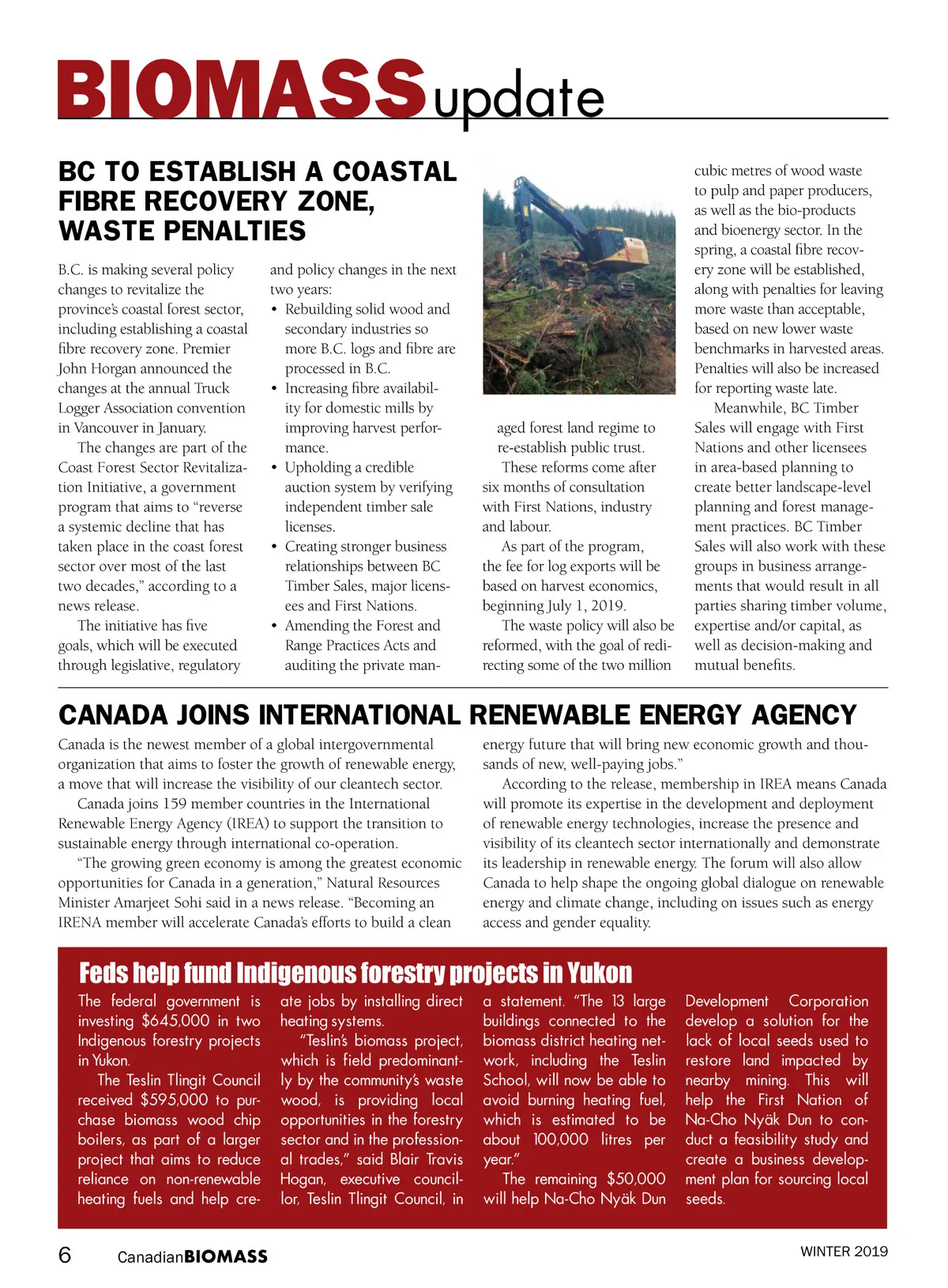
BIOMASS update BC TO ESTABLISH A COASTAL FIBRE RECOVERY ZONE, WASTE PENALTIES B.C. is making several policy changes to revitalize the province’s coastal forest sector, including establishing a coastal fibre recovery zone. Premier John Horgan announced the changes at the annual Truck Logger Association convention in Vancouver in January. The changes are part of the Coast Forest Sector Revitaliza-tion Initiative, a government program that aims to “reverse a systemic decline that has taken place in the coast forest sector over most of the last two decades,” according to a news release. The initiative has five goals, which will be executed through legislative, regulatory and policy changes in the next two years: • Rebuilding solid wood and secondary industries so more B.C. logs and fibre are processed in B.C. • Increasing fibre availabil-ity for domestic mills by improving harvest perfor-mance. • Upholding a credible auction system by verifying independent timber sale licenses. • Creating stronger business relationships between BC Timber Sales, major licens-ees and First Nations. • Amending the Forest and Range Practices Acts and auditing the private man-cubic metres of wood waste to pulp and paper producers, as well as the bio-products and bioenergy sector. In the spring, a coastal fibre recov-ery zone will be established, along with penalties for leaving more waste than acceptable, based on new lower waste benchmarks in harvested areas. Penalties will also be increased for reporting waste late. Meanwhile, BC Timber Sales will engage with First Nations and other licensees in area-based planning to create better landscape-level planning and forest manage-ment practices. BC Timber Sales will also work with these groups in business arrange-ments that would result in all parties sharing timber volume, expertise and/or capital, as well as decision-making and mutual benefits. aged forest land regime to re-establish public trust. These reforms come after six months of consultation with First Nations, industry and labour. As part of the program, the fee for log exports will be based on harvest economics, beginning July 1, 2019. The waste policy will also be reformed, with the goal of redi-recting some of the two million CANADA JOINS INTERNATIONAL RENEWABLE ENERGY AGENCY Canada is the newest member of a global intergovernmental organization that aims to foster the growth of renewable energy, a move that will increase the visibility of our cleantech sector. Canada joins 159 member countries in the International Renewable Energy Agency (IREA) to support the transition to sustainable energy through international co-operation. “The growing green economy is among the greatest economic opportunities for Canada in a generation,” Natural Resources Minister Amarjeet Sohi said in a news release. “Becoming an IRENA member will accelerate Canada’s efforts to build a clean energy future that will bring new economic growth and thou-sands of new, well-paying jobs.” According to the release, membership in IREA means Canada will promote its expertise in the development and deployment of renewable energy technologies, increase the presence and visibility of its cleantech sector internationally and demonstrate its leadership in renewable energy. The forum will also allow Canada to help shape the ongoing global dialogue on renewable energy and climate change, including on issues such as energy access and gender equality. The federal government is investing $645,000 in two Indigenous forestry projects in Yukon. The Teslin Tlingit Council received $595,000 to pur-chase biomass wood chip boilers, as part of a larger project that aims to reduce reliance on non-renewable heating fuels and help cre-Feds help fund Indigenous forestry projects in Yukon ate jobs by installing direct heating systems. “Teslin’ s biomass project, which is field predominant-ly by the community’ s waste wood, is providing local opportunities in the forestry sector and in the profession-al trades,” said Blair Travis Hogan, executive council-lor, Teslin Tlingit Council, in a statement. “The 13 large buildings connected to the biomass district heating net-work, including the Teslin School, will now be able to avoid burning heating fuel, which is estimated to be about 100,000 litres per year.” The remaining $50,000 will help Na-Cho Nyäk Dun Development Corporation develop a solution for the lack of local seeds used to restore land impacted by nearby mining. This will help the First Nation of Na-Cho Nyäk Dun to con-duct a feasibility study and create a business develop-ment plan for sourcing local seeds. WINTER 2019 6 Canadian BIOMASS
Canadian Biomass Winter 2019: Page 6