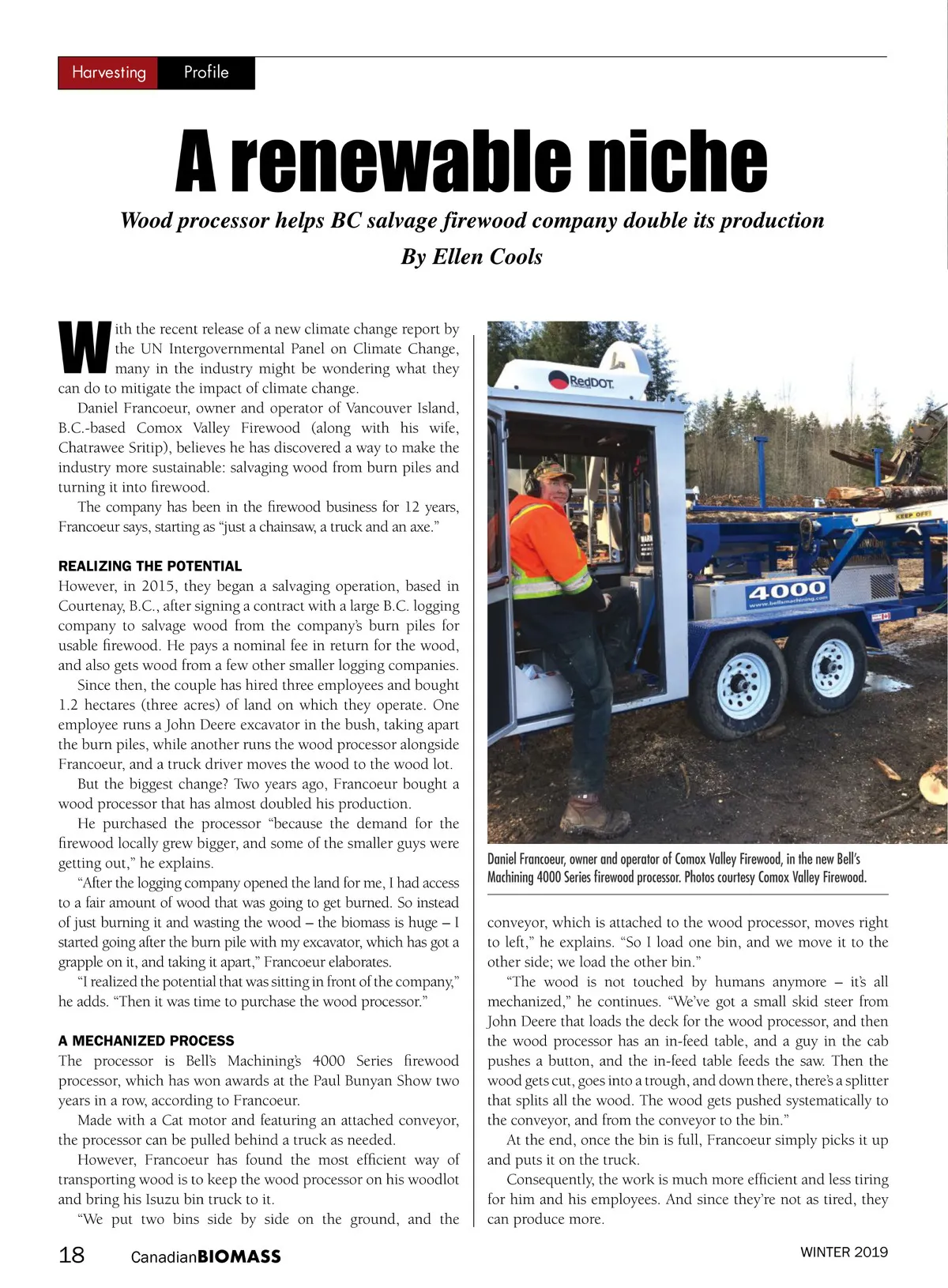
The Bell’s Machining 4000 Series processor has doubled Comox Valley Firewood’s production. The processor requires a lot of maintenance, he admits. “It’s wear and tear, right? The machine is working a lot of hours. It’s well-built, but it’s a different level of stress,” he elaborates. “Instead of stressing about tiring physically, you’ve got to be on top of it mechanically – change the oil and make sure everything’s safe.” However, it’s “nothing we couldn’t handle,” Francoeur says, and the positives far outweigh the negatives. QUALITY REIGNS SUPREME In fact, thanks to this increased efficiency, Comox Valley Firewood will be producing over 1,000 cord this year – maybe even 1,200 cord of firewood, says Francoeur. The cord is full cord – four foot by four foot by eight foot – as opposed to face cord, he adds. Before buying the processor, Comox Valley Firewood was producing 400 or 500 cord a year. “I believe we are one of the biggest producers right now in British Columbia,” Francoeur says. He expects to be able to pay for the excavator and processor within three to four years of operation, while also paying for his livelihood and his employees’ wages. But who is driving this demand? His customers are mainly local: local business people, homeowners and campgrounds (both provincial and private). Yet it’s the quality of wood produced by the processor that has really driven demand in recent years. “The product is the best, it’s all even, every piece that comes out of the wood processor is 15 inches or we do custom cuts. Every piece is the perfect length because of the way the machine is designed,” he explains. Eventually, “Word came out about town, and the logging company let me season the wood on the land for one year. So all the wood is already pre-dried or pre-seasoned wood.” “The wood is all even, so the people really like it, so we’ve gotten a lot more calls,” Francoeur continues. “I can barely handle my business right now. I’m getting 25 phone calls every day now for the last six weeks for firewood.” WHAT’S NEXT? “We’re just trying to find the right balance,” he says. “You go too big, you can lose everything.” For him, one of the biggest payoffs is how the processor has helped him grow a sustainable operation and become an example for renewable operations in forestry. “We’re really happy with preventing the waste of the wood, either rotting in the bush, or when we finish logging here, they put it in piles and burn it. So the biomass and the waste of our natural resources is minimized quite a bit now,” he says. “I think that could be done in other places in Canada, too, because we all use firewood.” “A lot of people want to say, ‘Oh, the industry shouldn’t be burning, they shouldn’t be wasting wood,’ but you’ve got to find a way to make money. We finally found a niche here, in a way, that’s going to save a lot of that biomass,” he continues. “Instead of burning all that debris at the end, we’re taking probably 50 per cent of it out of there, and salvaging it, cleaning wood and keeping people’s houses warm.” • To meet this demand, he will eventually hire more employees. Francoeur is also considering purchasing a logging truck, because he is now paying a logging truck three to five times per month to move wood from the mountain to the woodlot. The same B.C.-based logging company has also offered Francoeur land further north on the island to set up the same business. But he hasn’t made his move yet. Canadian BIOMASS Untitled-3 1 19 2019-02-12 9:43 AM
Canadian Biomass Winter 2019: Page 19