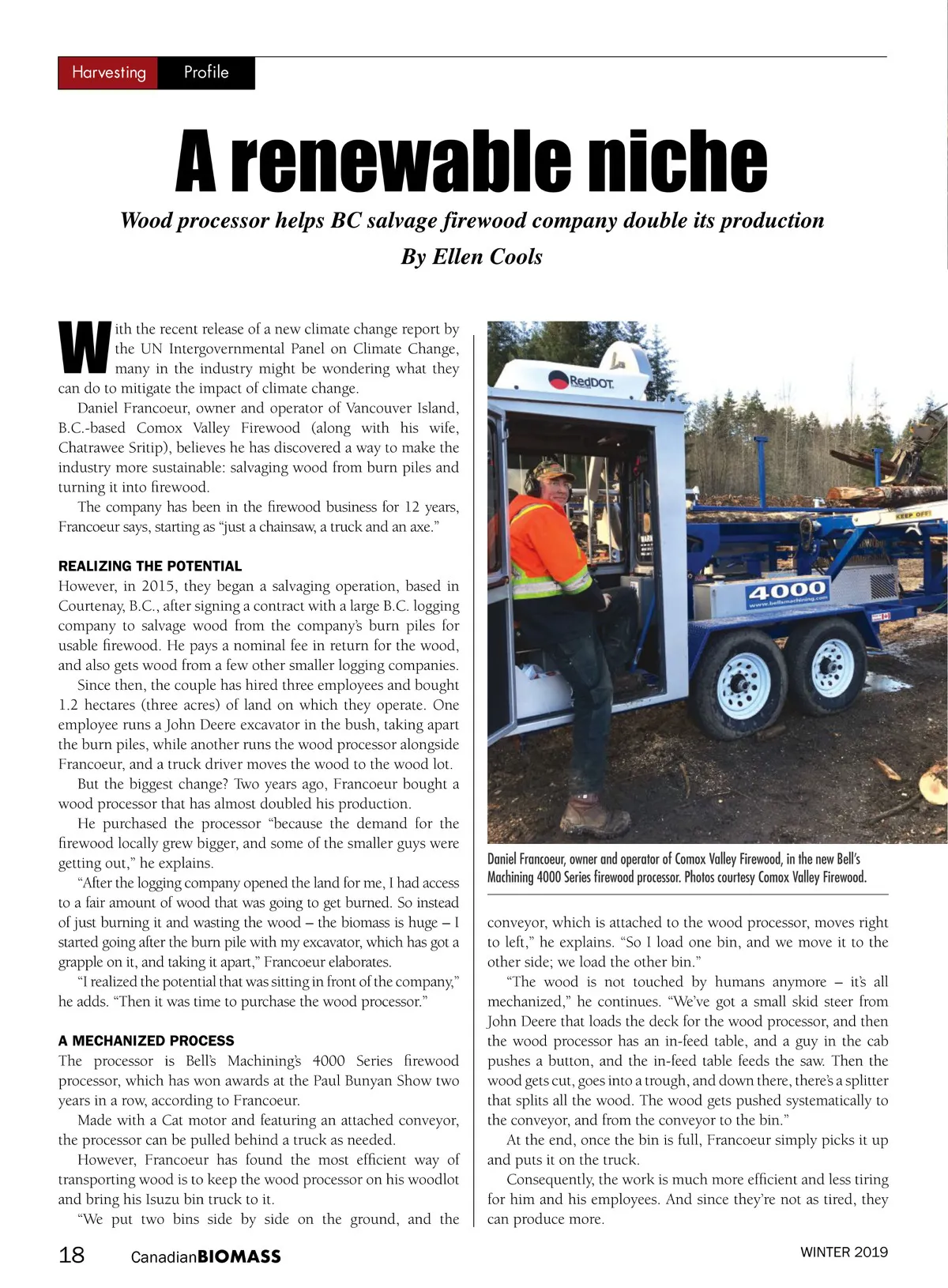
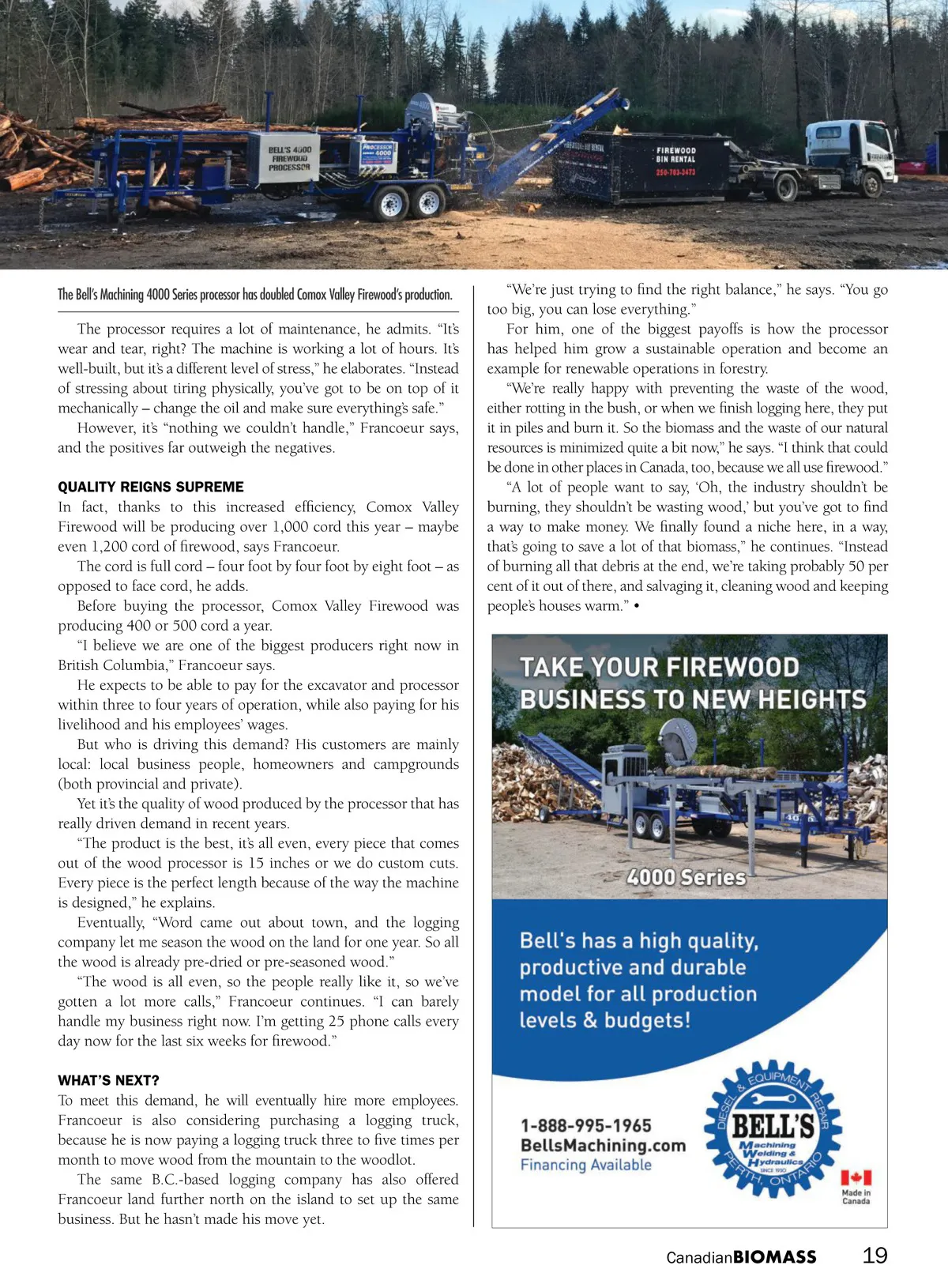
Harvesting Profile Wood processor helps BC salvage firewood company double its production By Ellen Cools A renewable niche W ith the recent release of a new climate change report by the UN Intergovernmental Panel on Climate Change, many in the industry might be wondering what they can do to mitigate the impact of climate change. Daniel Francoeur, owner and operator of Vancouver Island, B.C.-based Comox Valley Firewood (along with his wife, Chatrawee Sritip), believes he has discovered a way to make the industry more sustainable: salvaging wood from burn piles and turning it into firewood. The company has been in the firewood business for 12 years, Francoeur says, starting as “just a chainsaw, a truck and an axe.” REALIZING THE POTENTIAL However, in 2015, they began a salvaging operation, based in Courtenay, B.C., after signing a contract with a large B.C. logging company to salvage wood from the company’s burn piles for usable firewood. He pays a nominal fee in return for the wood, and also gets wood from a few other smaller logging companies. Since then, the couple has hired three employees and bought 1.2 hectares (three acres) of land on which they operate. One employee runs a John Deere excavator in the bush, taking apart the burn piles, while another runs the wood processor alongside Francoeur, and a truck driver moves the wood to the wood lot. But the biggest change? Two years ago, Francoeur bought a wood processor that has almost doubled his production. He purchased the processor “because the demand for the firewood locally grew bigger, and some of the smaller guys were getting out,” he explains. “After the logging company opened the land for me, I had access to a fair amount of wood that was going to get burned. So instead of just burning it and wasting the wood – the biomass is huge – I started going after the burn pile with my excavator, which has got a grapple on it, and taking it apart,” Francoeur elaborates. “I realized the potential that was sitting in front of the company,” he adds. “Then it was time to purchase the wood processor.” A MECHANIZED PROCESS Daniel Francoeur, owner and operator of Comox Valley Firewood, in the new Bell’s Machining 4000 Series firewood processor. Photos courtesy Comox Valley Firewood. The processor is Bell’s Machining’s 4000 Series firewood processor, which has won awards at the Paul Bunyan Show two years in a row, according to Francoeur. Made with a Cat motor and featuring an attached conveyor, the processor can be pulled behind a truck as needed. However, Francoeur has found the most efficient way of transporting wood is to keep the wood processor on his woodlot and bring his Isuzu bin truck to it. “We put two bins side by side on the ground, and the conveyor, which is attached to the wood processor, moves right to left,” he explains. “So I load one bin, and we move it to the other side; we load the other bin.” “The wood is not touched by humans anymore – it’s all mechanized,” he continues. “We’ve got a small skid steer from John Deere that loads the deck for the wood processor, and then the wood processor has an in-feed table, and a guy in the cab pushes a button, and the in-feed table feeds the saw. Then the wood gets cut, goes into a trough, and down there, there’s a splitter that splits all the wood. The wood gets pushed systematically to the conveyor, and from the conveyor to the bin.” At the end, once the bin is full, Francoeur simply picks it up and puts it on the truck. Consequently, the work is much more efficient and less tiring for him and his employees. And since they’re not as tired, they can produce more. WINTER 2019 18 Canadian BIOMASS
Canadian Biomass Winter 2019: Page 18