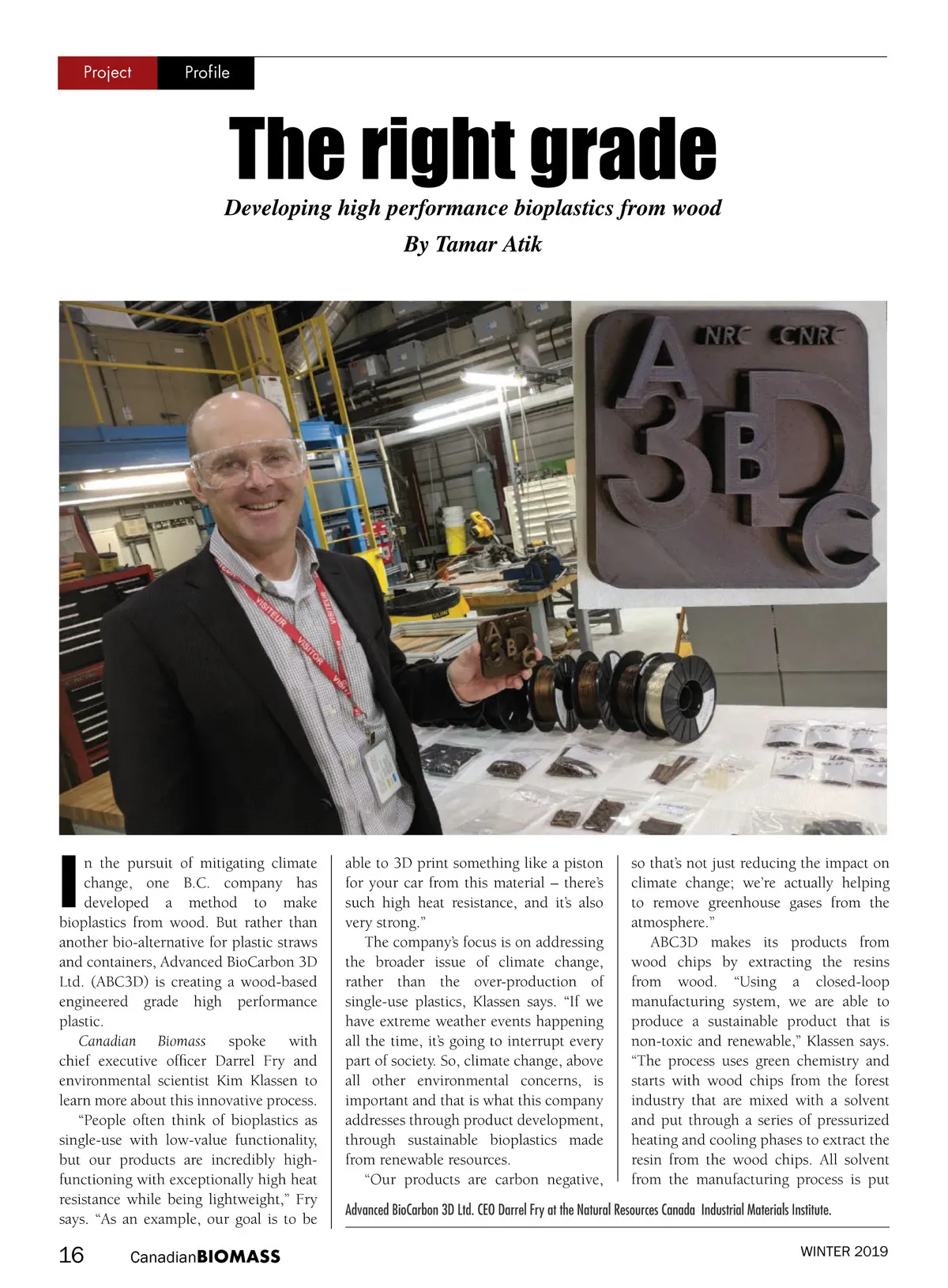
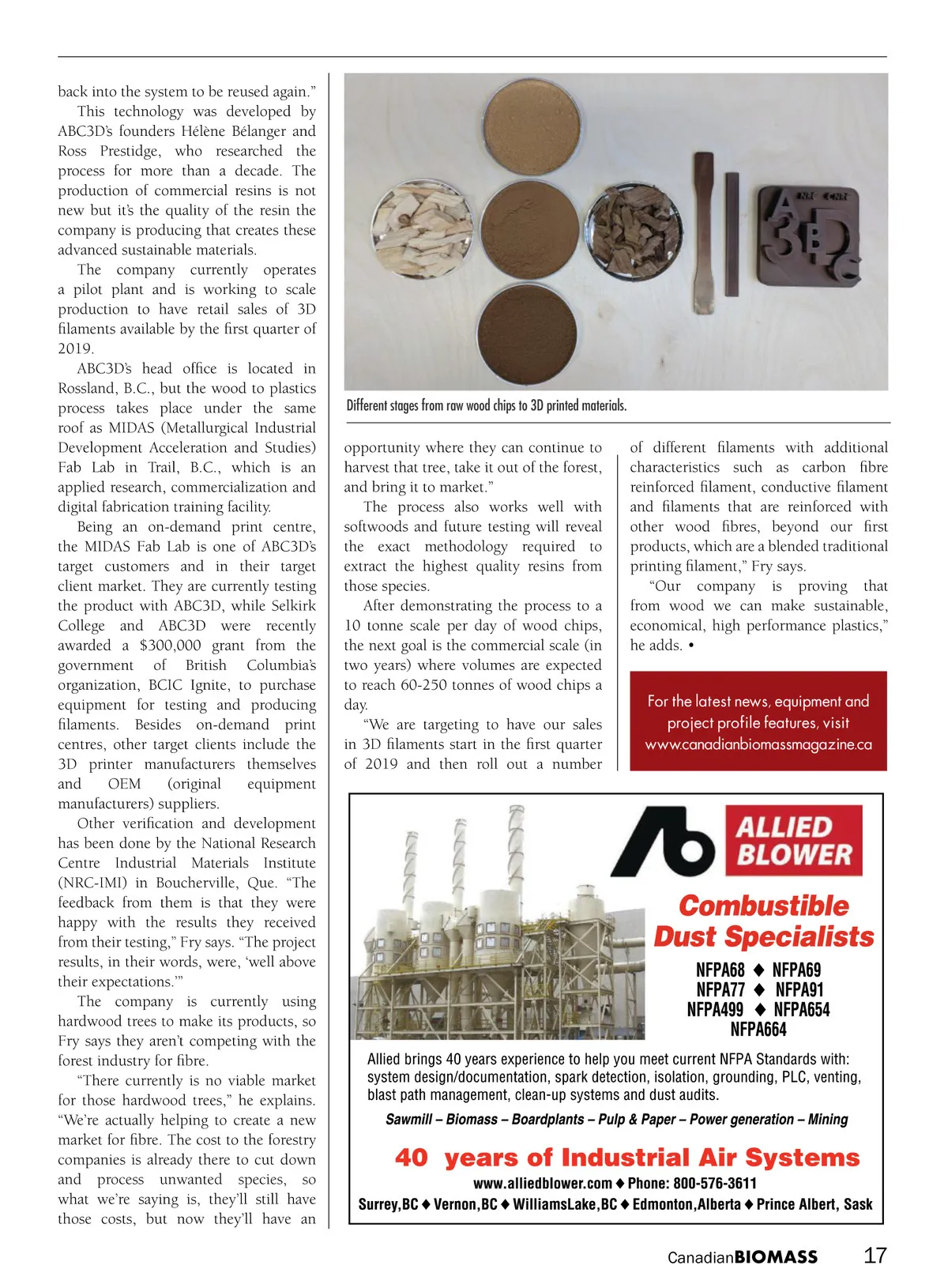
back into the system to be reused again.” This technology was developed by ABC3D’s founders Hélène Bélanger and Ross Prestidge, who researched the process for more than a decade. The production of commercial resins is not new but it’s the quality of the resin the company is producing that creates these advanced sustainable materials. The company currently operates a pilot plant and is working to scale production to have retail sales of 3D filaments available by the first quarter of 2019. ABC3D’s head office is located in Rossland, B.C., but the wood to plastics process takes place under the same roof as MIDAS (Metallurgical Industrial Development Acceleration and Studies) Fab Lab in Trail, B.C., which is an applied research, commercialization and digital fabrication training facility. Being an on-demand print centre, the MIDAS Fab Lab is one of ABC3D’s target customers and in their target client market. They are currently testing the product with ABC3D, while Selkirk College and ABC3D were recently awarded a $300,000 grant from the government of British Columbia’s organization, BCIC Ignite, to purchase equipment for testing and producing filaments. Besides on-demand print centres, other target clients include the 3D printer manufacturers themselves and OEM (original equipment manufacturers) suppliers. Other verification and development has been done by the National Research Centre Industrial Materials Institute (NRC-IMI) in Boucherville, Que. “The feedback from them is that they were happy with the results they received from their testing,” Fry says. “The project results, in their words, were, ‘well above their expectations.’” The company is currently using hardwood trees to make its products, so Fry says they aren’t competing with the forest industry for fibre. “There currently is no viable market for those hardwood trees,” he explains. “We’re actually helping to create a new market for fibre. The cost to the forestry companies is already there to cut down and process unwanted species, so what we’re saying is, they’ll still have those costs, but now they’ll have an Different stages from raw wood chips to 3D printed materials. opportunity where they can continue to harvest that tree, take it out of the forest, and bring it to market.” The process also works well with softwoods and future testing will reveal the exact methodology required to extract the highest quality resins from those species. After demonstrating the process to a 10 tonne scale per day of wood chips, the next goal is the commercial scale (in two years) where volumes are expected to reach 60-250 tonnes of wood chips a day. “We are targeting to have our sales in 3D filaments start in the first quarter of 2019 and then roll out a number of different filaments with additional characteristics such as carbon fibre reinforced filament, conductive filament and filaments that are reinforced with other wood fibres, beyond our first products, which are a blended traditional printing filament,” Fry says. “Our company is proving that from wood we can make sustainable, economical, high performance plastics,” he adds. • For the latest news, equipment and project profile features, visit www.canadianbiomassmagazine.ca Canadian BIOMASS allied blower biomass novdec14.indd 1 17 2014-11-18 2:22 PM
Canadian Biomass Winter 2019: Page 17