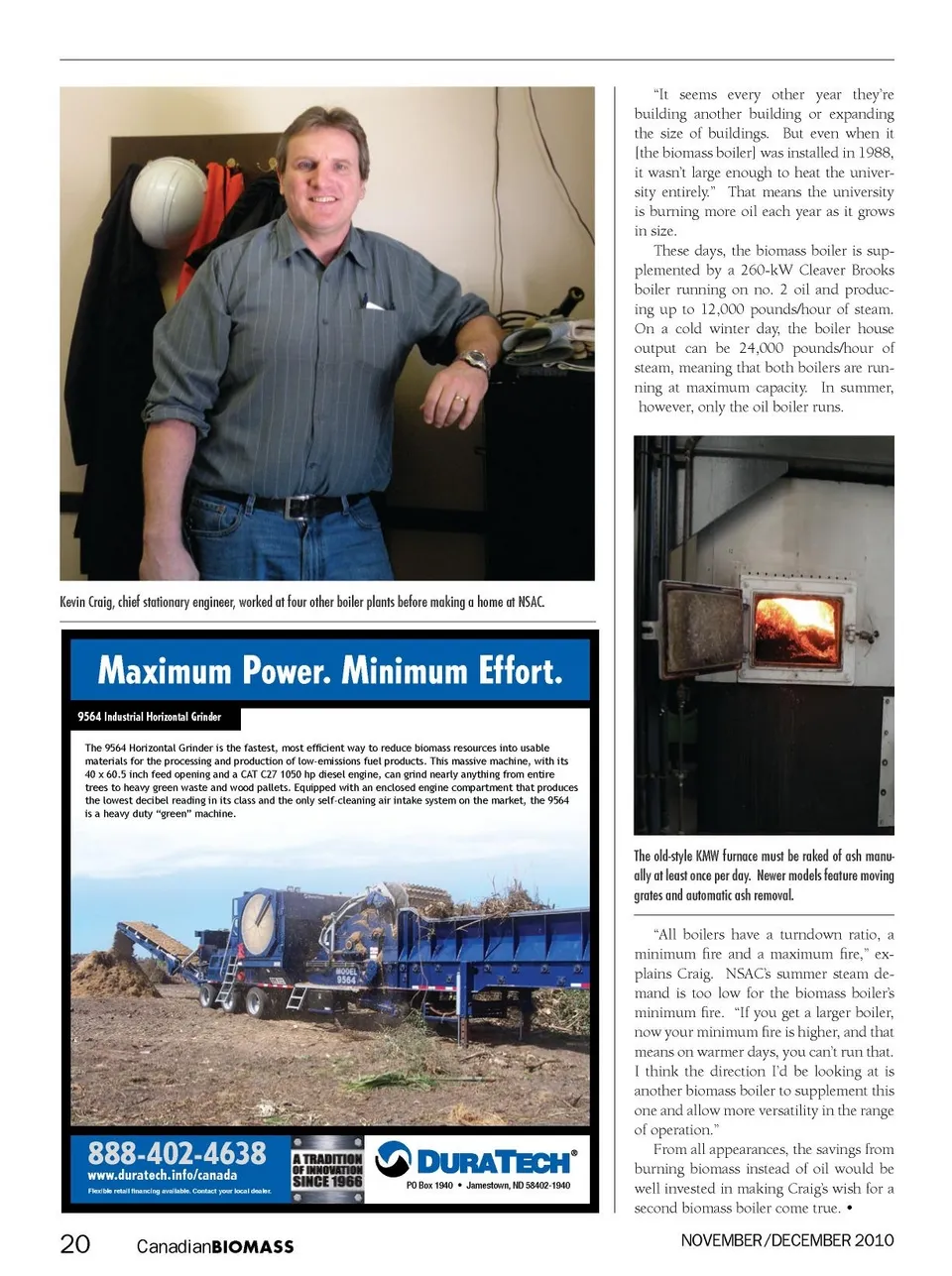
“It seems every other year they’re building another building or expanding the size of buildings. But even when it [the biomass boiler] was installed in 1988, it wasn’t large enough to heat the univer-sity entirely.” That means the university is burning more oil each year as it grows in size. These days, the biomass boiler is sup-plemented by a 260-kW Cleaver Brooks boiler running on no. 2 oil and produc-ing up to 12,000 pounds/hour of steam. On a cold winter day, the boiler house output can be 24,000 pounds/hour of steam, meaning that both boilers are run-ning at maximum capacity. In summer, however, only the oil boiler runs. Kevin Craig, chief stationary engineer, worked at four other boiler plants before making a home at NSAC. Maximum Power. Minimum Effort. 9564 Industrial Horizontal Grinder The 9564 Horizontal Grinder is the fastest, most efficient way to reduce biomass resources into usable materials for the processing and production of low-emissions fuel products. This massive machine, with its 40 x 60.5 inch feed opening and a CAT C27 1050 hp diesel engine, can grind nearly anything from entire trees to heavy green waste and wood pallets. Equipped with an enclosed engine compartment that produces the lowest decibel reading in its class and the only self-cleaning air intake system on the market, the 9564 is a heavy duty “green” machine. The old-style KMW furnace must be raked of ash manu-ally at least once per day. Newer models feature moving grates and automatic ash removal. 888-402-4638 w w w.duratech.info/canada Flexible retail financing available. Contact your local dealer. PO Box 1940 • Jamestown, ND 58402-1940 “All boilers have a turndown ratio, a minimum fire and a maximum fire,” ex-plains Craig. NSAC’s summer steam de-mand is too low for the biomass boiler’s minimum fire. “If you get a larger boiler, now your minimum fire is higher, and that means on warmer days, you can’t run that. I think the direction I’d be looking at is another biomass boiler to supplement this one and allow more versatility in the range of operation.” From all appearances, the savings from burning biomass instead of oil would be well invested in making Craig’s wish for a second biomass boiler come true. • NOVEMBER/DECEMBER 2010 20 Canadian BIOMASS
Canadian Biomass November/December 2010: Page 20