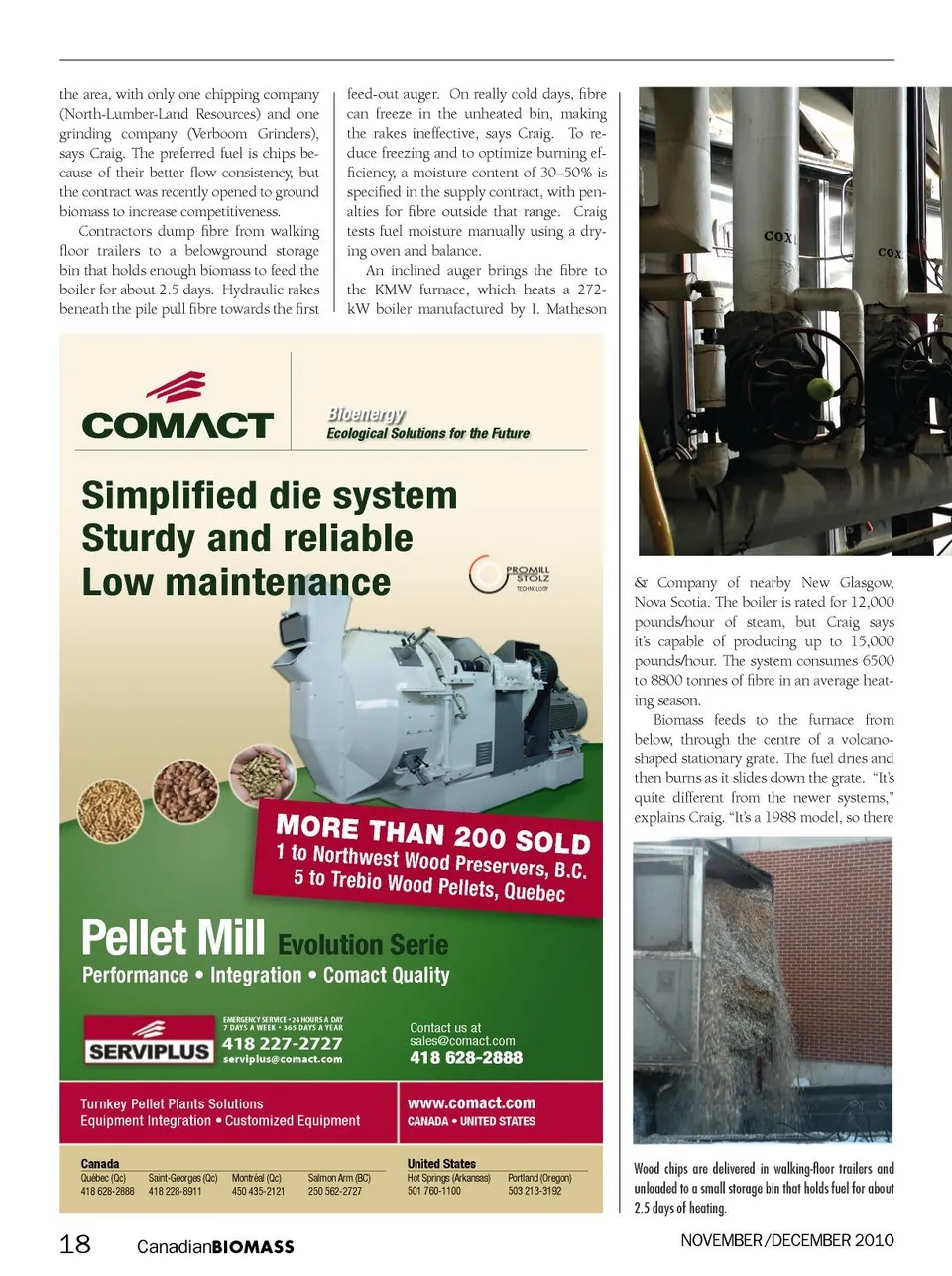
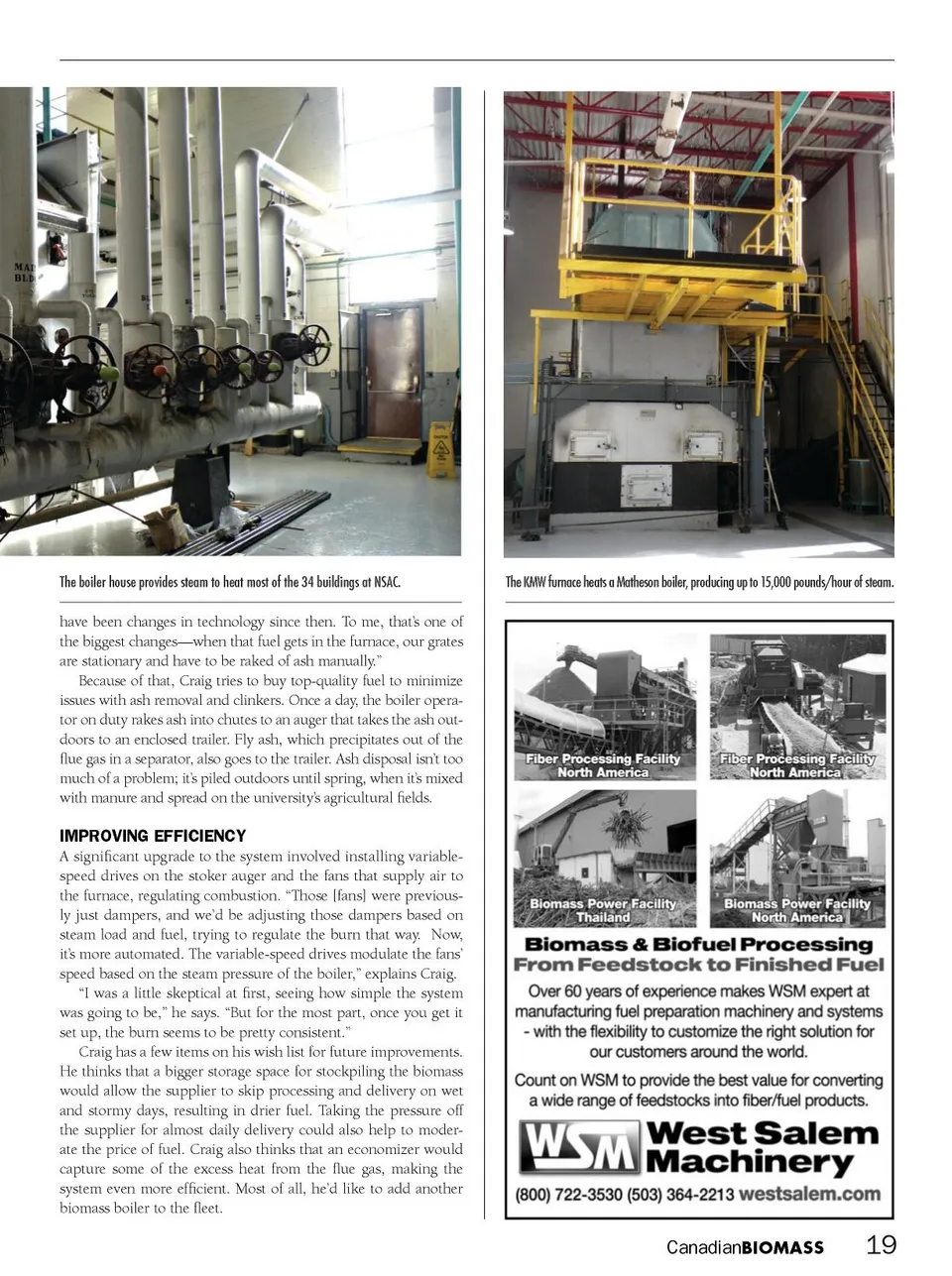
The boiler house provides steam to heat most of the 34 buildings at NSAC. The KMW furnace heats a Matheson boiler, producing up to 15,000 pounds/hour of steam. have been changes in technology since then. To me, that’s one of the biggest changes—when that fuel gets in the furnace, our grates are stationary and have to be raked of ash manually.” Because of that, Craig tries to buy top-quality fuel to minimize issues with ash removal and clinkers. Once a day, the boiler opera-tor on duty rakes ash into chutes to an auger that takes the ash out-doors to an enclosed trailer. Fly ash, which precipitates out of the flue gas in a separator, also goes to the trailer. Ash disposal isn’t too much of a problem; it’s piled outdoors until spring, when it’s mixed with manure and spread on the university’s agricultural fields. ImprovINg eFFICIeNCy A sig nificant upgrade to the system involved installing var iable-speed drives on the stoker auger and the fans that supply air to the furnace, regulating combustion. “Those [fans] were previous-ly just dampers, and we’d be adjusting those dampers based on steam load and fuel, trying to regulate the burn that way. Now, it’s more automated. The variable-speed drives modulate the fans’ speed based on the steam pressure of the boiler,” explains Craig. “I was a little skeptical at first, seeing how simple the system was going to be,” he says. “But for the most part, once you get it set up, the burn seems to be pretty consistent.” Craig has a few items on his wish list for future improvements. He thinks that a bigger storage space for stockpiling the biomass would allow the supplier to skip processing and delivery on wet and stormy days, resulting in drier fuel. Taking the pressure off the supplier for almost daily delivery could also help to moder-ate the price of fuel. Craig also thinks that an economizer would capture some of the excess heat from the flue gas, making the system even more efficient. Most of all, he’d like to add another biomass boiler to the fleet. Canadian BIOMASS 19
Canadian Biomass November/December 2010: Page 19