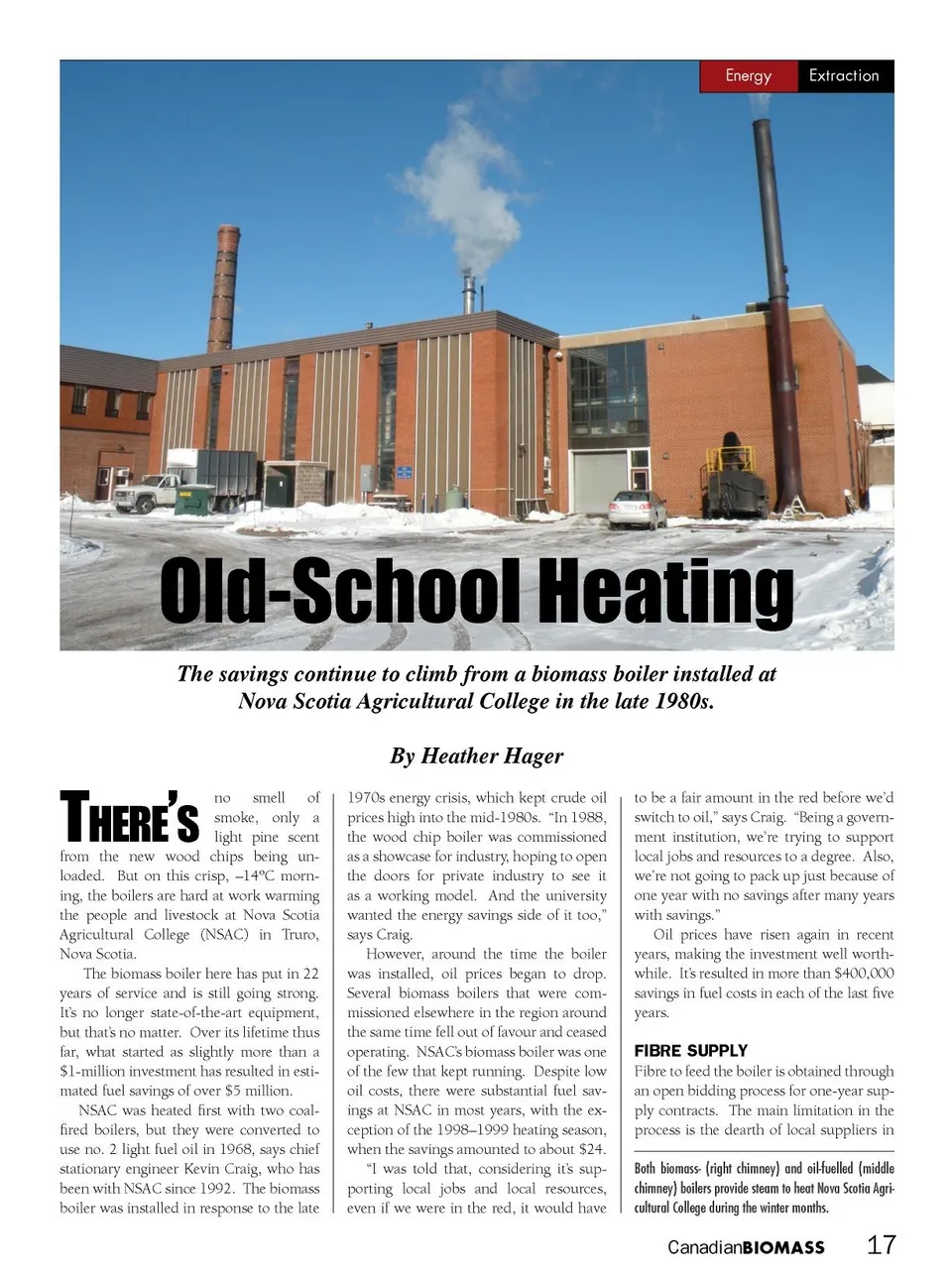
Energy Extraction Old-School Heating The savings continue to climb from a biomass boiler installed at Nova Scotia Agricultural College in the late 1980s. no smell of smoke, only a light pine scent from the new wood chips being un-loaded. But on this crisp, –14ºC morn-ing, the boilers are hard at work warming the people and livestock at Nova Scotia Agricultural College (NSAC) in Truro, Nova Scotia. The biomass boiler here has put in 22 years of service and is still going strong. It’s no longer state-of-the-art equipment, but that’s no matter. Over its lifetime thus far, what started as slightly more than a $1-million investment has resulted in esti-mated fuel savings of over $5 million. NSAC was heated first with two coal-fired boilers, but they were converted to use no. 2 light fuel oil in 1968, says chief stationary engineer Kevin Craig, who has been with NSAC since 1992. The biomass boiler was installed in response to the late T here ’ s By Heather Hager 1970s energy crisis, which kept crude oil prices high into the mid-1980s. “In 1988, the wood chip boiler was commissioned as a showcase for industry, hoping to open the doors for private industry to see it as a working model. And the university wanted the energy savings side of it too,” says Craig. However, around the time the boiler was installed, oil prices began to drop. Several biomass boilers that were com-missioned elsewhere in the region around the same time fell out of favour and ceased operating. NSAC’s biomass boiler was one of the few that kept running. Despite low oil costs, there were substantial fuel sav-ings at NSAC in most years, with the ex-ception of the 1998–1999 heating season, when the savings amounted to about $24. “I was told that, considering it’s sup-porting local jobs and local resources, even if we were in the red, it would have to be a fair amount in the red before we’d switch to oil,” says Craig. “Being a govern-ment institution, we’re trying to support local jobs and resources to a degree. Also, we’re not going to pack up just because of one year with no savings after many years with savings.” Oil prices have risen again in recent years, making the investment well worth-while. It’s resulted in more than $400,000 savings in fuel costs in each of the last five years. FIBre supply Fibre to feed the boiler is obtained through an open bidding process for one-year sup-ply contracts. The main limitation in the process is the dearth of local suppliers in Both biomass-(right chimney) and oil-fuelled (middle chimney) boilers provide steam to heat Nova Scotia Agri-cultural College during the winter months. Canadian BIOMASS 17
Canadian Biomass November/December 2010: Page 17