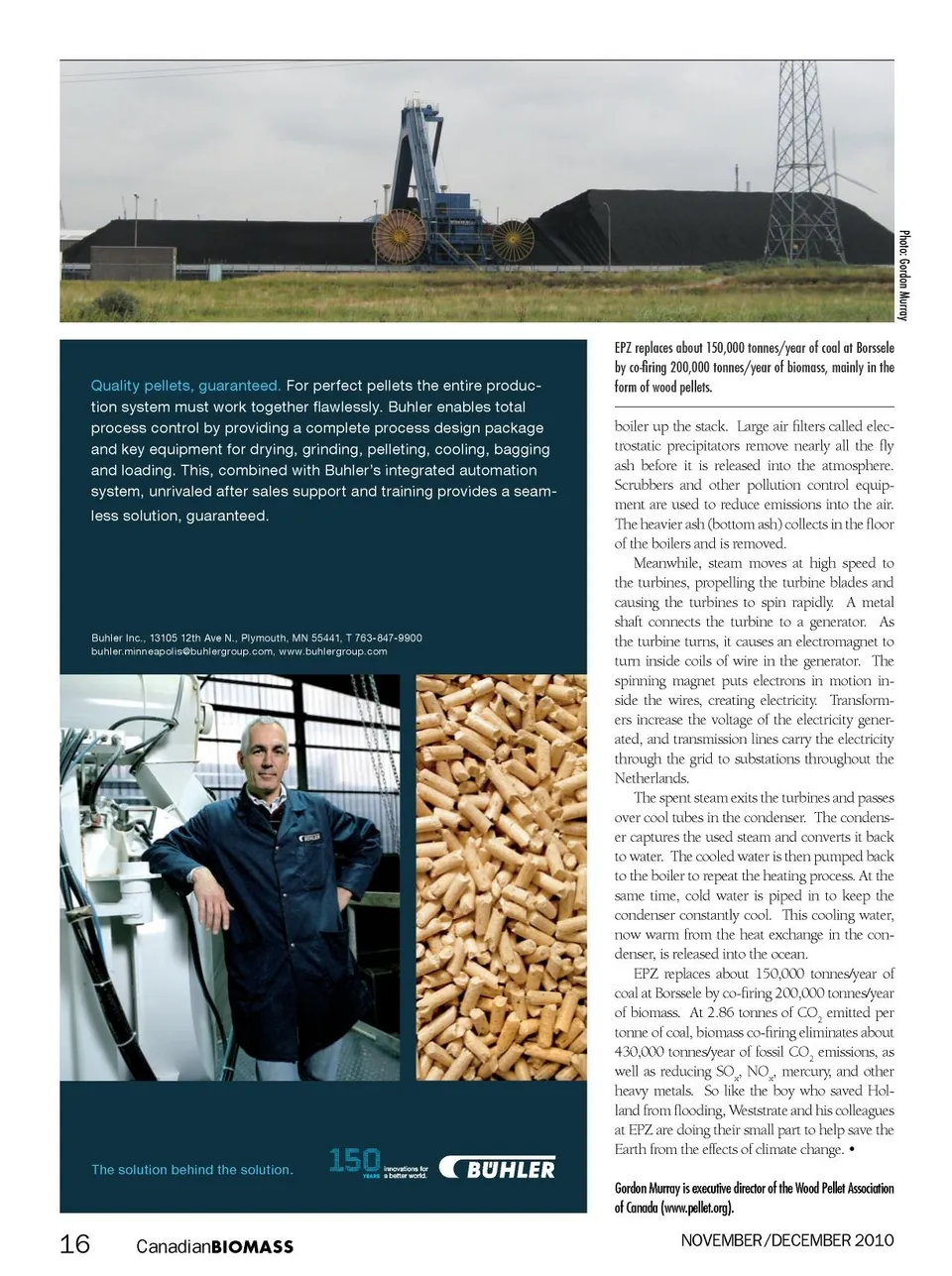
Photo: Gordon Murray Q u a l i t y p e l l e t s , g u a r a n te e d . Fo r p e r f e c t p e l l e t s t h e e n t i r e p r o d u c -tion sys te m mu s t wo r k to gethe r flawle s sly. Buhle r e na ble s tot a l p r o c e s s c o n t r o l by p r ov i d i n g a c o m p l e te p r o c e s s d e s i g n p a c k a g e a n d ke y e q u i p m e n t f o r d r y i n g , g r i n d i n g , p e l l e t i n g , c o o l i n g , b a g g i n g a nd loading. T his, c ombine d with Buhle r’s inte gr ate d au tomation s y s te m , u n r i va l e d a f te r s a l e s s u p p o r t a n d t r a i n i n g p r ov i d e s a s e a m -l e s s s o l u t i o n , g u a r a n te e d . EPZ replaces about 150,000 tonnes/year of coal at Borssele by co-firing 200,000 tonnes/year of biomass, mainly in the form of wood pellets. Buhler Inc., 13105 12th Ave N., Plymouth, MN 55441, T 763-847-9900 [email protected], www.buhlergroup.com boiler up the stack. Large air filters called elec-trostatic precipitators remove nearly all the fly ash before it is released into the atmosphere. Scrubbers and other pollution control equip-ment are used to reduce emissions into the air. The heavier ash (bottom ash) collects in the floor of the boilers and is removed. Meanwhile, steam moves at high speed to the turbines, propelling the turbine blades and causing the turbines to spin rapidly. A metal shaft connects the turbine to a generator. As the turbine turns, it causes an electromagnet to turn inside coils of wire in the generator. The spinning magnet puts electrons in motion in-side the wires, creating electricity. Transform-ers increase the voltage of the electricity gener-ated, and transmission lines carry the electricity through the grid to substations throughout the Netherlands. The spent steam exits the turbines and passes over cool tubes in the condenser. The condens-er captures the used steam and converts it back to water. The cooled water is then pumped back to the boiler to repeat the heating process. At the same time, cold water is piped in to keep the condenser constantly cool. This cooling water, now warm from the heat exchange in the con-denser, is released into the ocean. EPZ replaces about 150,000 tonnes/year of coal at Borssele by co-firing 200,000 tonnes/year of biomass. At 2.86 tonnes of CO 2 emitted per tonne of coal, biomass co-firing eliminates about 430,000 tonnes/year of fossil CO 2 emissions, as well as reducing SO x , NO x , mercury, and other heavy metals. So like the boy who saved Hol-land from flooding, Weststrate and his colleagues at EPZ are doing their small part to help save the Earth from the effects of climate change. • Gordon Murray is executive director of the Wood Pellet Association of Canada (www.pellet.org). The solution behind the solution. 16 Canadian BIOMASS 2/8/2010 12:14:28 PM NOVEMBER/DECEMBER 2010 Quality Pellets (Canadian Biomass) 150.indd 1
Canadian Biomass November/December 2010: Page 16