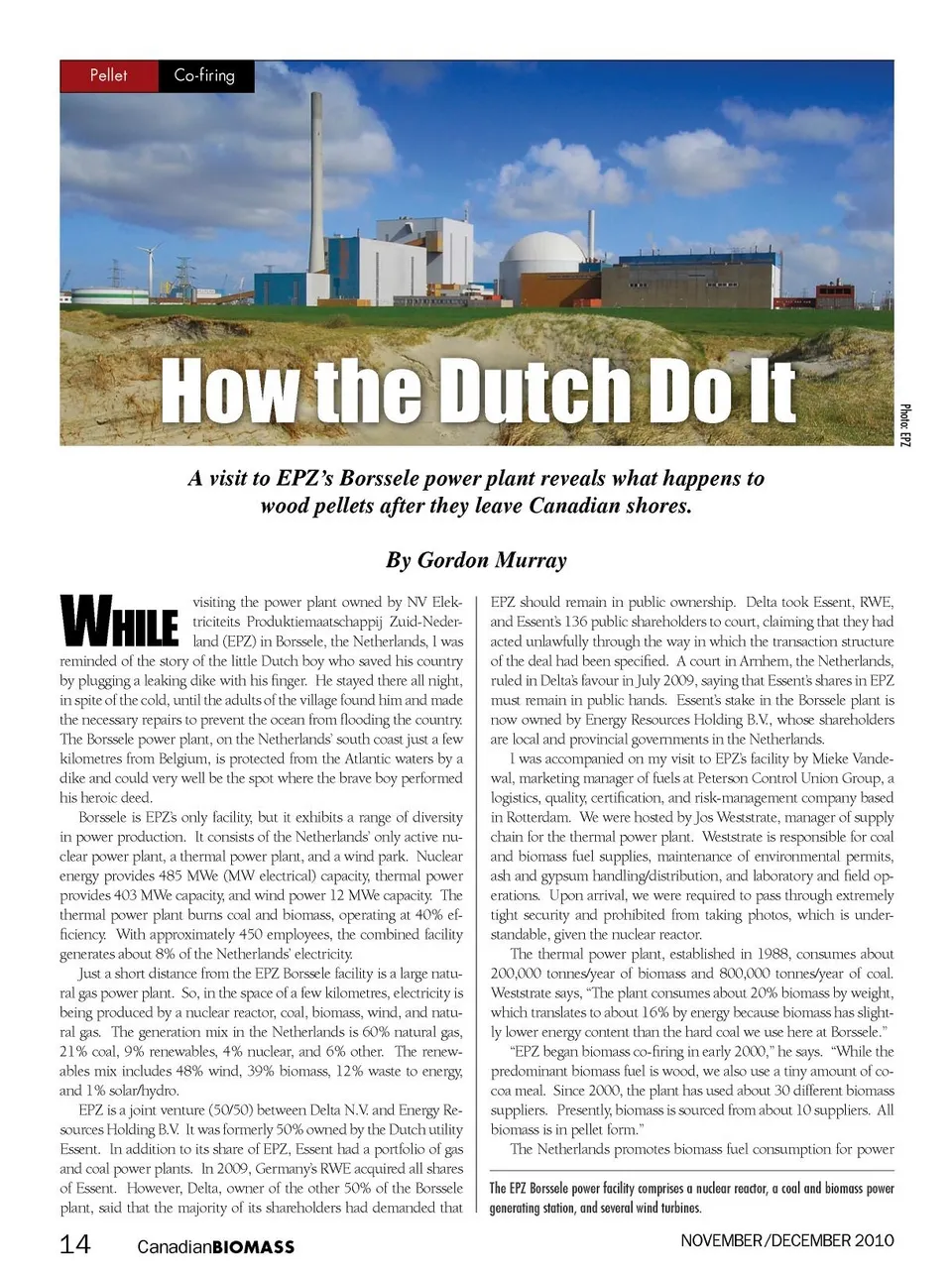
generation as a means of reducing CO 2 emissions. The Dutch govern-ment’s support mechanism for large-scale co-firing provides a feed-in tariff of about six to seven cents euro per kilowatt-hour. However, there is some uncertainty because the scheme will run out by 2012 and it is uncertain if it will be renewed or replaced. Coal and biomass for Borssele is sourced from many countries, in-cluding Canada. Typically, large Panamax and Capesize freighters will be unloaded in the deepwater Port of Rotterdam, stored temporarily, and then reloaded to Coaster-size vessels or barges and shipped to the Port of Vlissingen, which is too shallow to accommodate the large transoceanic freighters. After being unloaded, coal is stored outdoors, whereas pellets are stored under cover. After being gathered by re-claimers, coal is moved by conveyor to the power plant. Pellets, on the other hand, are loaded into trucks by front-end loaders and trans-ported to the power plant. EPZ uses a direct co-firing process to burn the pellets and coal. Once coal reaches the power plant, it is reduced to fine powder in coal pulverizers, which press the coal powder through sieves. Wood pellets are handled separately because wood powder tends to plug the sieves in the coal pulverizers. Instead, wood pellets are reduced to powder in hammermills. The coal powder and wood powder are each blown separately by hot air into a suspension-type boiler, where the powder instantly catches fire and burns with high intensity. The heat boils water, creating high-pressure steam to rotate turbines. As the coal and biomass burn, they produce ash and emissions such as carbon dioxide, sulphur oxides (SO x ), and nitrogen oxides (NO x ). The gases, together with the lighter ash (fly ash), are vented from the Supply Chain Supervisor Photo: Gordon Murray Mieke Vandewal is marketing manager of fuels at Peterson Control Union Group (PCU). PCU, headquartered in Rotterdam, the Netherlands, is a logistics, quality, certifi-cation, and risk-management company with 2000 employees in 50 countries. The com-At Peterson Control pany was established in 1920 as a privately Union Group, Mieke owned inspection company for grain, which Vandewal coordinates was traded and transported on the rivers and critical links in the canals of the Netherlands. Over the years, fuel supply chain. PCU has expanded into many industries, including agriculture and feed, biofuels and biomass, coal, minerals, food, forestry, oil and gas, and textiles. PCU plays an important role in the international wood pel-let industry. The company provides independent verification for buyers and sellers by providing ship hold and cargo inspections, draft surveys to establish cargo volumes, and laboratory testing of product samples for certification and to ensure contractual standards are met. It also provides many other essential services, including remote temperature monitoring of storage silos for fire and explosion prevention, coordination of transhipping from terminals to power plants, and supervision of cargo unloading. As marketing manager of fuels, Vandewal coordinates all ac-tivities from the time the ship is loaded in the exporting country through to unloading at the terminal, temporary storage, tran-shipping, and eventual consumption by the power plant. Canadian BIOMASS 15
Canadian Biomass November/December 2010: Page 15